



Lesson Planet
Search educational resources
  • Sign In Try It Free
  • AI Teacher Tools
    • Discover Resources Search reviewed educational resources by keyword, subject, grade, type, and more
    • Curriculum Manager (My Content) Manage saved and uploaded resources and folders To Access the Curriculum Manager Sign In or Join Now
    • Browse Resource Directory Browse educational resources by subject and topic
    • Curriculum Calendar Explore curriculum resources by date
    • Lesson Planning Articles Timely and inspiring teaching ideas that you can apply in your classroom
    • Our Story
    • Frequently Asked Questions
    • Testimonials
    • Contact Us
  • Pricing
  • School Access
    • Your school or district can sign up for Lesson Planet — with no cost to teachers
      Learn More
  • Sign In
  • Try It Free

Hi, what do you want to do?

Create a lesson plan
Generate resources with 80+ AI teacher tools
Search 200,000 instructional videos
Find a teaching resource
Teach Engineering: What Do Bread and Beer Have in Common? Lesson PlanTeach Engineering: What Do Bread and Beer Have in Common? Lesson Plan
Publisher
TeachEngineering
Resource Details
Curator Rating
Educator Rating
Not yet Rated
Grade
6th - 8th
Subjects
Science
2 more...
Resource Type
Lesson Plans
Audiences
For Administrator Use
1 more...
Lexile Measures
1220L
Lesson Plan

Teach Engineering: What Do Bread and Beer Have in Common?

Curated by ACT

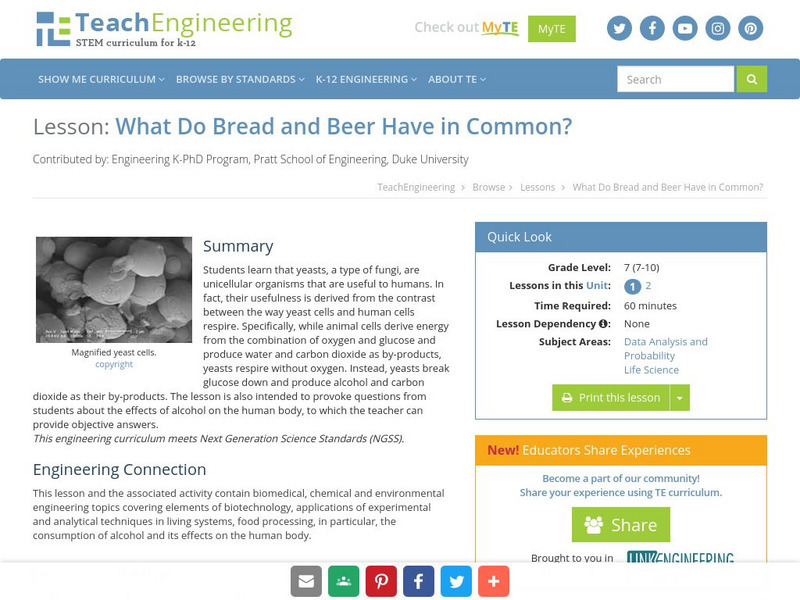
Middle schoolers are presented with information that will allow them to recognize that yeasts are unicellular organisms that are useful to humans. In fact, their usefulness is derived from the contrast between the way yeast cells and human cells respire. Specifically, while animal cells derive energy from the combination of oxygen and glucose and produce water and carbon dioxide as by-products, yeasts respire without oxygen. Instead, yeasts break glucose down and produce alcohol and carbon dioxide as their by-products. The lesson is also intended to provoke questions from students about the effects of alcohol on the human body, to which the teacher can provide objective answers.

3 Views 0 Downloads

Concepts

cellular respiration, engineering, fermentation, unicellular organisms, yeast, stem

Additional Tags

alcoholism, integrated teaching and learning program and laboratory, teachengineering, alcohol

Classroom Considerations

  • Knovation Readability Score: 5 (1 low difficulty, 5 high difficulty)

See similar resources:

Activity

Physics in Concert

IOP Institute of Physics
What do physicists and musicians have in common? A lot more than you might think. After first viewing a slide show presentation and completing a series of skills practice worksheets on the physics of light, sound, and...
6th - 12th Science
CCSS: Adaptable
Lesson Plan

Fibers, Dyes, and the Environment

Cornell University
Nanofibers can be made through electrospinning or force spinning in order to reduce the negative impact on the environment. Pupils study the role of fibers and dye on the environment through a series of five hands-on activities. Then,...
6th - 12th Science
CCSS: Adaptable
Instructional Video

Big Changes in the Big Forest

Crash Course Kids
What do animals and humans have in common? We both build homes that are suitable for our means of living, of course! This is the focus of a video that compares how humans and animals change the environment around them.
5 mins 3rd - 8th Science
Lesson Plan

What Do Bread and Beer Have in Common?

Curated OER
Young scholars listen to an explanation of yeast cells and how they effect bread and beer. They discuss the ways alcohol affects the human body and participate in an indirect observation about cell respiration in yeast-molasses cultures.
7th - 10th Science
Instructional Video

LS1C - Organization for Matter and Energy Flow in Organisms

Bozeman Science
How do you plan to approach standard LS1C, Organization for Matter and Energy Flow in Organisms? Avoid information overload with helpful advice in a short video. Topics include energy sources, relationships between organisms, and...
6 mins K - 12th Science
Instructional Video

LS2B - Cycles of Matter and Energy Transfer in Ecosystems

Bozeman Science
Produce, consume, decompose...repeat! Examine how matter and energy cycles in ecosystems by watching a video discussing NGSS standard LS2B. The narrator explains the requirements of the standard at each grade level, plus gives tips to...
8 mins 3rd - 12th Science
Instructional Video

Jellyfish Predate Dinosaurs. How Have They Survived So Long?

TED-Ed
Jellyfish range in size, species, hunting habits, and venom secretions. But one thing most all jellyfish have in common is their ability to survive and flourish in our oceans since before dinosaurs. Watch the video and find out...
5 mins 6th - 12th Science
Lesson Plan

Buoyancy: Integrating Science and Literature

Curated OER
Integrate science and literature by using the scientific method to test the veracity of the floating peach described in Roald Dahl's James and the Giant Peach. Clips from a Bill Nye: The Science Guy episode about buoyancy frontload...
4th - 6th Science
Instructional Video

How Do Crystals Work?

TED-Ed
What do amazonite, heliotrope, carnelian, and diamonds have in common? There are all crystals and members of one of the six crystal families. Viewers of a fascinating short video learn about the molecular structure of crystals that cause...
5 mins 6th - 12th Science
CCSS: Adaptable
Instructional Video

How Do Schools of Fish Swim in Harmony?

TED-Ed
How does the way our brains work relate to the way fish swim in harmony? An engaging video explains how emergence is the answer to both.
6 mins 7th - 12th Science
CCSS: Adaptable
Try It Free
© 1999-2026 Learning Explorer, Inc.
Teacher Lesson Plans, Worksheets and Resources

Sign up for the Lesson Planet Monthly Newsletter

Open Educational Resources (OER)

  • Health
  • Language Arts
  • Languages
  • Math
  • Physical Education
  • Science
  • Social Studies
  • Special Education
  • Visual and Performing Arts
View All Lesson Plans

Discover Resources

  • Our Review Process
  • How it Works
  • How to Search
  • Create a Collection

Manage Curriculum

  • Edit a Collection
  • Assign to Students
  • Manage My Content
Contact Us Site Map Privacy Policy Terms of Use