Hi, what do you want to do?






Illustrative Mathematics
Stained Glass
A complex question looking for the total cost of a stained glass window by calculating area and circumference of a circle. With detailed components, this activity will challenge your designers to figure out if they have enough money to...

Illustrative Mathematics
How Thick Is a Soda Can I?
The humble soda can gets the geometric treatment in an activity that links math and science calculations. After a few basic assumptions are made and discussed, surface area calculations combine with density information to develop an...

Noyce Foundation
Poly-Gone
Investigate polygons from rectangles to triangles to octagons. Each level of the five-problem series targets a different grade level. Beginning with the level A problem, learners examine the relationship between area and perimeter by...

Noyce Foundation
Cubism
If cubism were a religion, would you follow it? Lower-level tasks focus primarily on counting the number cubes in a structure and relating the number to surface area. As learners progress to higher-level tasks, isometric drawings and...

Illustrative Mathematics
Ice Cream Cone
Every pupil with a sweet tooth will be clamoring for this lab and analysis, particularly when they're allowed to eat the results! Volume and surface area formulas for cones are developed from models, and then extended to the printing of...

Noyce Foundation
Lyle's Triangles
Try five problems on triangles. Levels A and B focus on shapes that can be created from right triangles. Level C touches upon the relationship between the area of a six-pointed star and the area of each triangle of which it is composed....

101 Questions
Apple Mothership
Explore Apple's spaceship office building. Built in the shape of a circle, the office building offers a unique floor plan challenge. Young scholars use the dimensions of the building to estimate the square footage for each employee.

Illustrative Mathematics
How Many Leaves on a Tree? (Version 2)
A second attack at figuring out the number of leaves on a tree, this activity makes both an excellent follow-up to version 1 and a stand-alone activity. Learners practice setting parameters and deciding acceptable estimate precision, and...

Noyce Foundation
Piece it Together
Score some problems all related to soccer balls. The first few problems focus on pattern blocks to see relationships between figures. More advanced problems focus on actual soccer balls, the patterns on the balls, and their volumes and...

Curated OER
Glasses
Provide your class some practice with the dimensions of geometric figures. Here you have a set of three different-shaped, stemmed drinking glasses with diameters and heights provided. Math-minded individuals calculate the volume of each....

Curated OER
Math: The Cathedral Project
Second graders take a field trip to a nearby church or other historical building and examine it from a mathematical perspective. In groups, they calculate the seating capacity, describe the window patterns, differentiate types of...

Illustrative Mathematics
Why Randomize?
Your statisticians draw several samplings from the same data set, some randomized and some not, and consider the distribution of the sample means of the two different types of samplings. The exercise demonstrates that non-random samples...

University of Georgia
University of Georgia: Texas Area Estimate
Drawings and discussion of several methods to estimate the area of an irregular shape, like the state of Texas.
Shodor Education Foundation
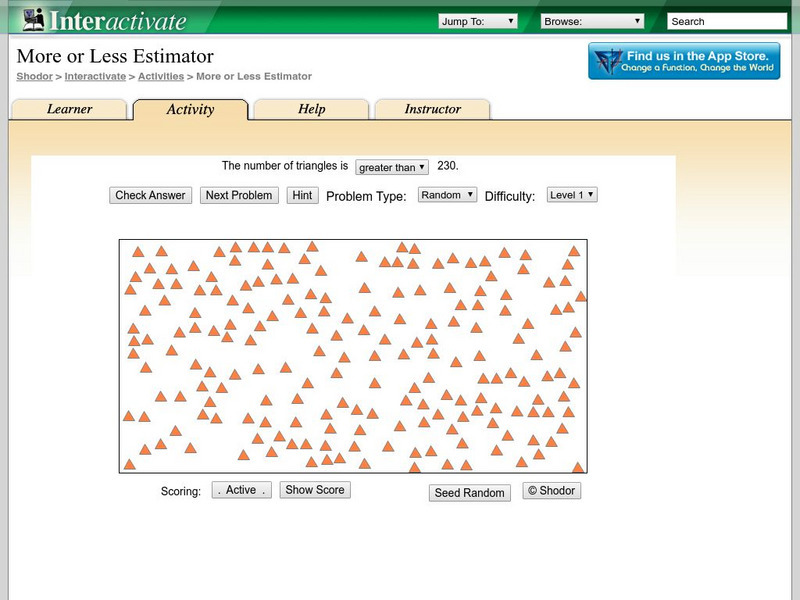
Shodor Interactivate: More or Less Estimator
Practice your estimation skills by comparing the number of objects shown, the length of a curve or the area of a shape to a given number. Your choices are "greater than" or "less than".
Washington State University
Washington State University: Estimate the Area Under a Curve
You can have a good time with this java applet that lets you place adjustable shapes under a curve and then sums the areas to approximate the area of the curve.
TeachEngineering
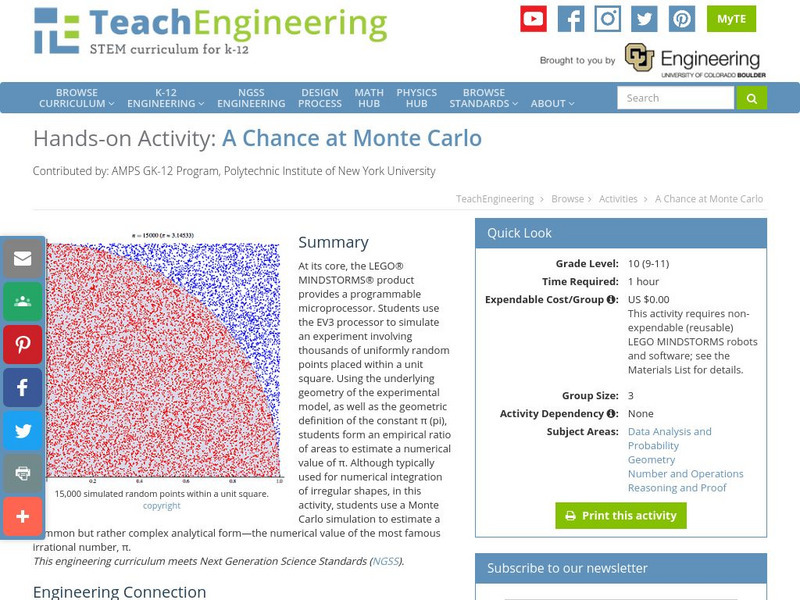
Teach Engineering: A Chance at Monte Carlo
At its core, the LEGO MINDSTORMS product provides a programmable microprocessor. Students use the EV3 processor to simulate an experiment involving thousands of uniformly random points placed within a unit square. Using the underlying...