Hi, what do you want to do?






Virtual Salt
Virtual Salt: Evaluating Internet Research Resources
This site by Virtual Salt offers a great deal of information on evaluating internet sources. Gives tips on what to look for when screening information for usefulness and reliability.
Other
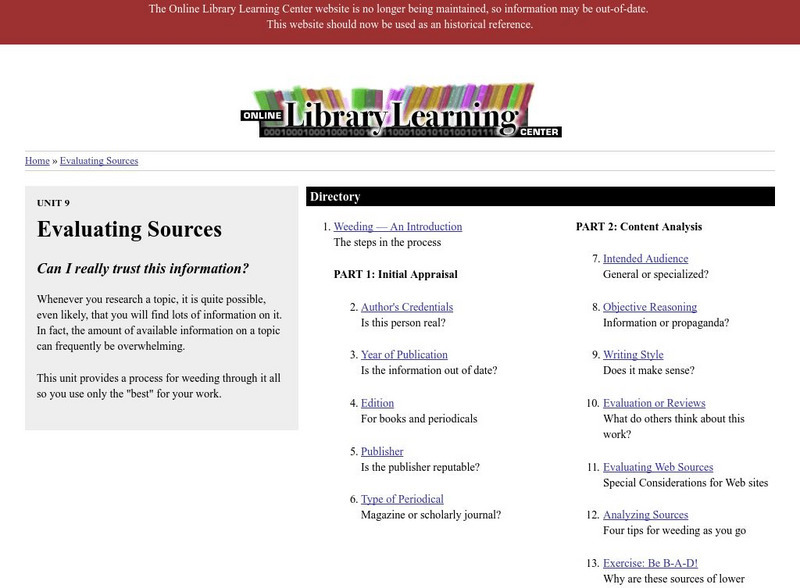
Online Library Learning Center: Evaluating Sources
Use this "Weed and feed," approach to get only the best resources for your research project.
TES Global
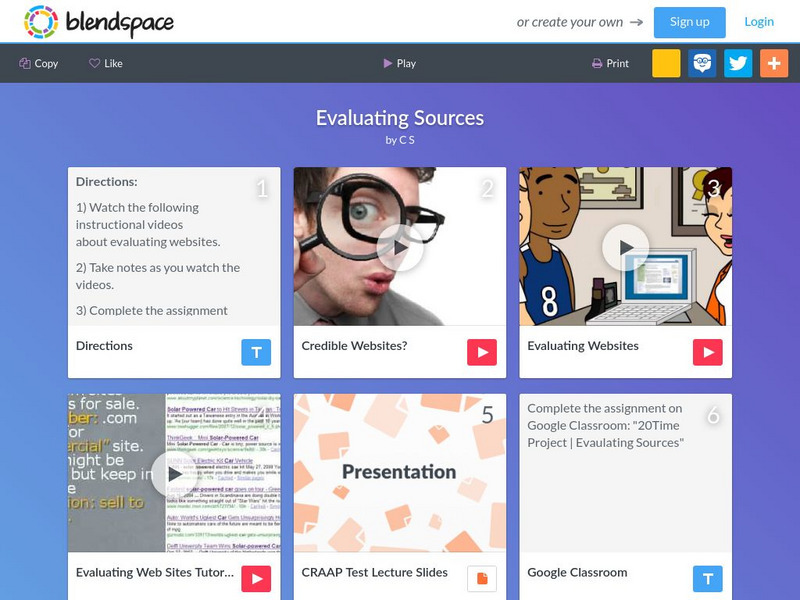
Blendspace: Evaluating Sources
A seven-part learning module with links to texts, videos, slides, and a quiz to use while learning how to evaluate research sources.
Texas Education Agency
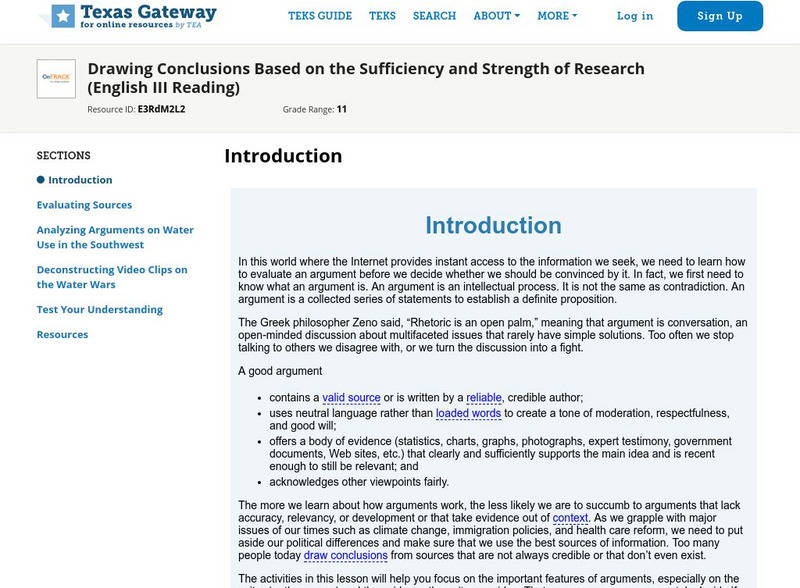
Texas Gateway: Drawing Conclusions on the Sufficiency and Strength of Research
The activities in this lesson will help you focus on the important features of arguments, especially on the writer (or the source) and the evidence the writer provides. That way, you can more accurately decide if an argument is valid and...
Louisiana Department of Education
Louisiana Doe: Curriculum Hub: Ela Guidebooks: Application Student Selected Task: Evaluate Resources
We will evaluate the usefulness of sources, select sources for our research, and record bibliographic information for the sources we select. This will help us prepare our research.
Sophia Learning
Sophia: Research Sources: Websites
This slideshow lesson focuses on the use of websites for research sources. It gives the pros and cons to using websites as sources and discusses the need to evaluate websites and what to look for.
Annenberg Foundation
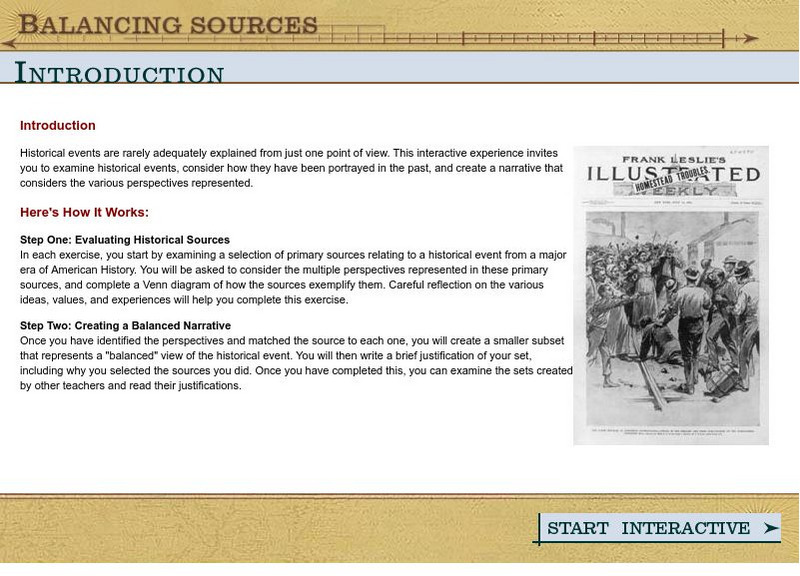
Annenberg Learner: Balancing Sources
This is from an American history course designed for teachers to enrich their knowledge and their teaching practice. This interactive is a set of nine exercises where teachers evaluate primary resources related to a specific event in...
Other
Monash University Library: Evaluating What You Find
This site explains how to evaluate the information you find in your research and provides practice exercises. It includes three sections: Evaluating the reliability of sources, Academic research on the internet, and Evaluating academic...
Grammarly
Grammarly Handbook: Evaluating Resources
This page explains the need for evaluating resources and offers links to rules for evaluating primary, secondary, or tertiary resources and determining if resources are good or bad.
Louisiana Department of Education
Louisiana Doe: Curriculum Hub: Ela Guidebooks: Teenage Brain: Summarizing Research Sources
We will summarize the sources used in our research to establish our initial understanding.
TES Global
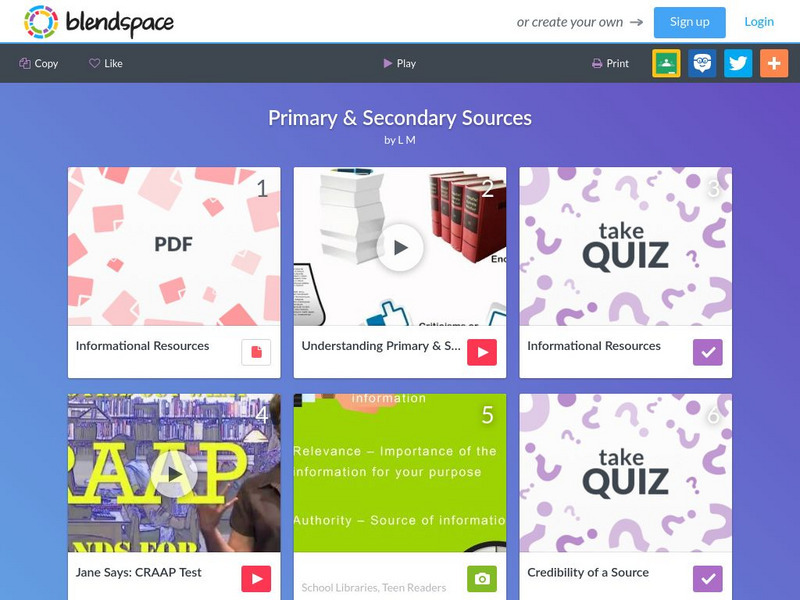
Blendspace: Primary & Secondary Sources
A twelve-part learning module with links to texts, videos, quizzes, images, and websites to use while learning about primary and secondary research sources.
Grammarly
Grammarly Handbook: Good or Bad Resource?
This page focuses on how to evaluate resources; it establishes criteria for determining good and bad resources. Primary resources are always good, but secondary and tertiary ones need to be evaluated more closely.
Other
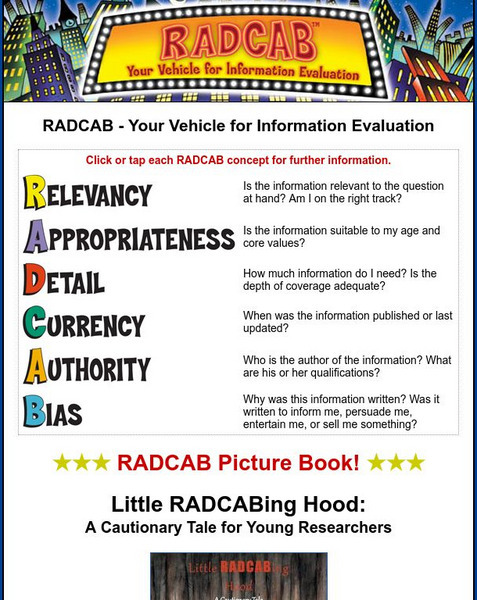
Radcab: Your Vehicle for Information Evaluation
How do you know you are using a trustworthy source when writing a research paper? Use this acronym for easy questions to ask yourself to make sure you have a reliable source. Click on each one for further details.
Sophia Learning
Sophia: Research Sources: Online Research Databases
This lesson discusses using research databases to conduct research.
Texas Education Agency
Texas Gateway: Gathering Appropriate Information (English Iii Writing)
[Accessible by TX Educators. Free Registration/Login Required] This lesson focuses on finding and evaluating relevant sources for a research project. It includes primary and secondary sources and print and internet sources. W.11-12.2...
PBS
Pbs Learning Media: News and Media Literacy
This collection, which includes videos, blog articles, student handouts, lesson plans, and tip sheets for families, helps students identify, analyze, and investigate the news and information they get from online sources. Media literacy...

ClassFlow
Class Flow: Evaluate Site
[Free Registration/Login Required] This flipchart provides students with strategies for researching on the internet and how to tell if a resource is reputable. CCSS.ELA-Literacy.CCRA.R.7
Other
Pro Quest Guided Research Worksheet: How to Identify Fake News in 10 Steps [Pdf]
A checklist to use for assessing whether a resource is fake news or not. Students select "Yes" or "No" to various questions. The more thumbs-down icons, the more likely the news article is fake.
Other
Power Up What Works: Conducting Research
This resource describes the first phase of a Grade 6 teacher's lesson where students develop a plan for working on a research project and then collect information. Each student has chosen a topic relating to how the economic systems of...

Other
Oregon School Library Information System
An excellent site that supports school libraries which includes tools for both elementary and secondary students. Choose the appropriate level to find resources on citing sources, research process, choosing research resources, finding...
ReadWriteThink
Read Write Think: Hoax/no Hoax? Online Comprehension and Evaluation Strategies
Learners use research-based comprehension strategies to read and evaluate websites, and practice analysis by comparing hoax and real websites and by identifying false or misleading information. SL.11-12.2 Eval&Integrate sources
Cornell University
Cornell University: Evaluating Web Sites: Criteria and Tools
Examining context as well as other factors is important for research success. Learn what questions to ask and what factors to look for in the evaluation process.
Other
The Virtual Chase: Evaluating Information on the Web
This resource teaches researchers how to evaluate information that they find on the Internet for accuracy, authority, timeliness, and objectivity. Features include a checklist for evaluating websites, information on common...

Alabama Learning Exchange
Alex: Searching for and Citing Digital Sources
Students will locate, retrieve, store, and correctly cite digital information for research projects.