Hi, what do you want to do?






ShortCutsTv
Experimental Design
This short film uses a real world example (the relationship between learning and time of day) to explore 3 different types of experimental design: Repeated Measures; Independent Measures; Matched Pairs.
Science360
Engineering a more efficient way to diagnose prostate cancer - Science Nation
To diagnose prostate cancer, urologists, such as John Wei, and pathologists, such as Scott Tomlins, at the University of Michigan Health System, use biomarkers, which are biochemical signatures in blood, urine and tissue...
IDG TECHtalk
How to tweak Windows logs to better investigate attacks
Default Windows event log settings won’t give you all the information you need to investigate security incidents. Here’s how to get the info you need.
Curated Video
I WONDER - What Is Passover?
This video is answering the question of what is Passover.
NASA
Landsat Helps Warn of Algae in Lakes, Rivers
From space, satellites such as the NASA and USGS Landsat 8 can help scientists identify where an algal bloom has formed in lakes or rivers. It’s a complicated data analysis process, but one that researchers are...

Northeast Arkansas Education Cooperative
Sampling Methods and Preventing Bias
Experimental design can be both incredibly intuitive and very high-concept when first introduced to learners. This video does a great job of discussing sampling methods and bias simply, without over-reducing...

Fuse School
Reliability, Accuracy and Precision
Scientific results should be reliable, accurate, and precise, but what is the difference between the three? The first video in a series of 29 uses the metaphor of dart throwing to explain these three key terms in scientific experimental...

Crash Course
The Replication Crisis: Crash Course Statistics #31
There is growing evidence that suggests the results of many studies are not reproducible. The 31st lesson of the Crash Course Statistics playlist discusses possible causes of the problem and identifies solutions since producibility is...

Crash Course
Intro to History of Science: Crash Course History of Science #1
How, and where, did the scientific process as we know it begin? Journey back through time with the introductory video from Crash Course's History of Science series. The resource highlights what people do and don't know about the world,...

Mathematics Assessment Project
Modeling Motion: Rolling Cups
Connect the size of a rolling cup to the size of circle it makes. Pupils view videos of cups of different sizes rolling in a circle. Using the videos and additional data, they attempt to determine a relationship between cup...
Massachusetts Institute of Technology
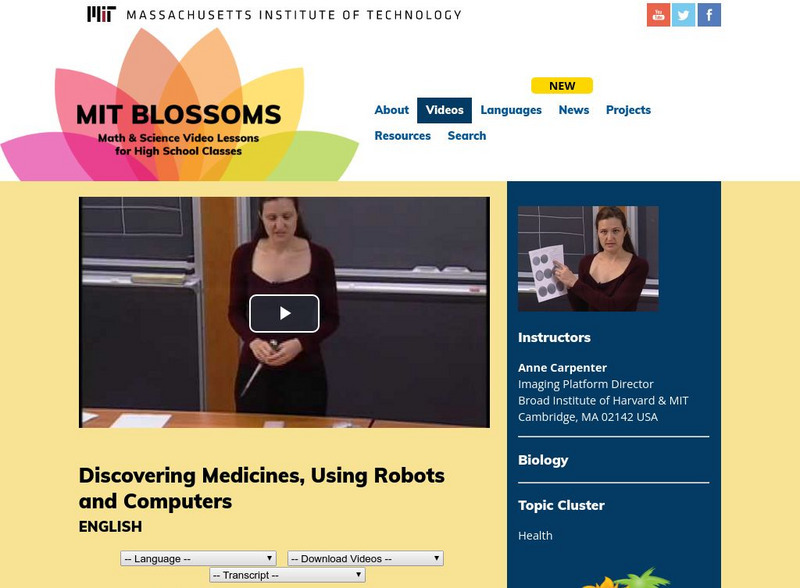
Mit: Blossoms: Discovering Medicines, Using Robots and Computers
Students meet a scientist who created software that looks at images of cells and determines which images show cells that have responded to potential medicines. Students will learn about how this technology is currently enabling research...

Eduardo Teixeira
Inquiry Based Learning
Explains what inquiry-based learning is, how it begins with a question, develops into a hypothesis, then an experimental design which explores the question. Students collect and record data, which they critically analyze, and draw a...