Hi, what do you want to do?






National Geographic
National Geographic: Engineering Solutions to Freshwater Problems
Explore how water-based problems in freshwater outlets can be resolved or slowed down with engineering solutions.
TeachEngineering
Teach Engineering: Battling for Oxygen
Using gumdrops and toothpicks, students conduct a large-group, interactive ozone depletion model. Students explore the dynamic and competing upper atmospheric roles of the protective ozone layer, the sun's UV radiation and harmful...
Science Buddies
Science Buddies: Science Careers: Materials Scientist and Engineer
An interest in chemistry and physics is what you need to explore the career of materials scientist or engineer. In this career you manipulate atoms to change the structure of materials to make new products. This Science Buddies site lays...

TryEngineering
Try Engineering: Engineering Air Traffic
Young scholars work in teams to explore how radar and computer technology is used to provide the necessary data to air traffic controllers. Students become "engineers" as they work to find ways to enhance the current air traffic control...
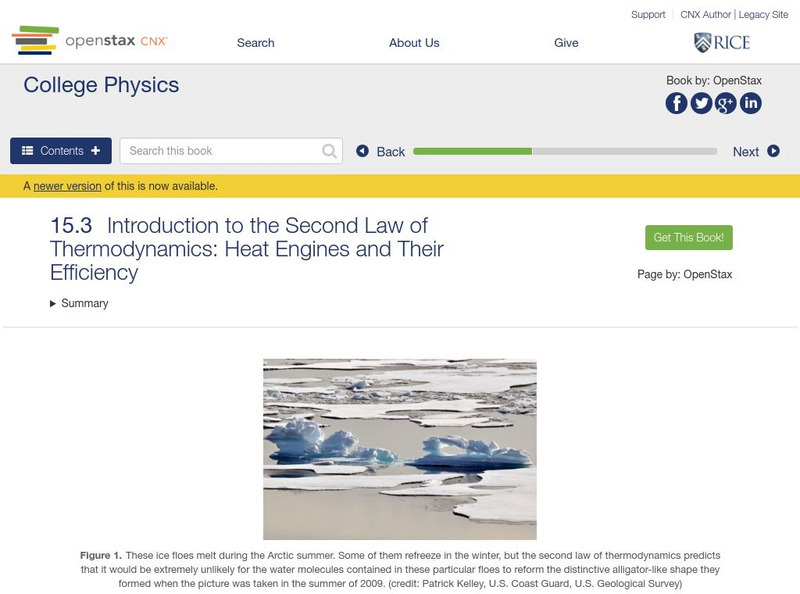
OpenStax
Open Stax: Second Law of Thermodynamics: Heat Engines and Their Efficiency
In this section of the textbook, learn about the second law of thermodynamics and how it relates to the function of heat engine. Section will also explain how to calculate net work and efficiency of cyclical processes such as a heat...
TryEngineering
Try Engineering: Engineering Ups and Downs
Engineering design lesson examines the principles behind working elevators. Teams of students explore how elevators work, then design, build, and evaluate their own elevator to service a toy car garage.
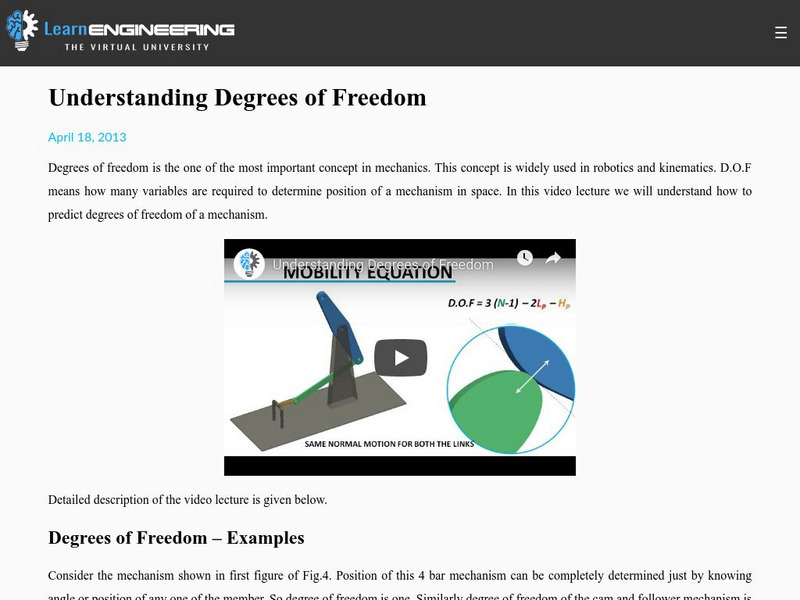
Learn Engineering
Learn Engineering: Understanding Degrees of Freedom
Explores how to predict degrees of freedom of a mechanism. Understand that in mechanics degrees of freedom is one of the most important concepts. Video length: 4 min. 41 sec.
TeachEngineering
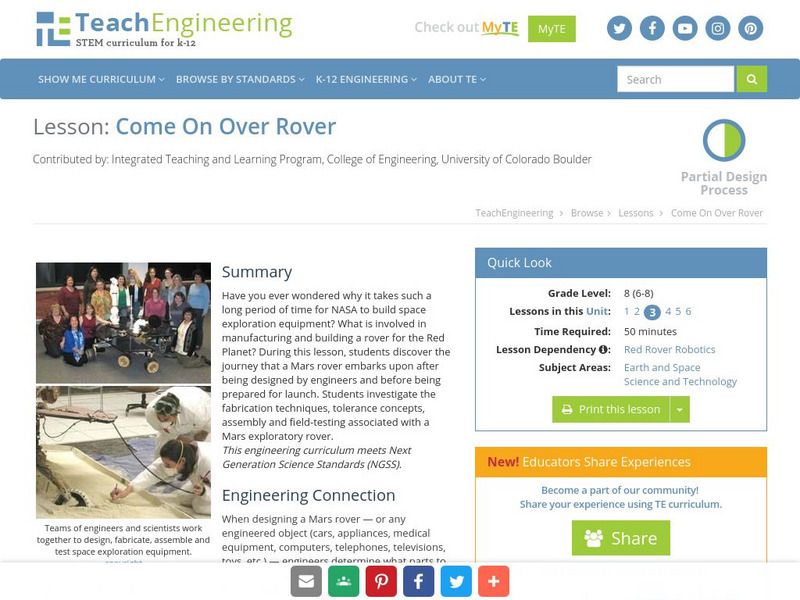
Teach Engineering: Come on Over Rover
Have you ever wondered why it takes such a long period of time for NASA to build space exploration equipment? What is involved in manufacturing and building a rover for the Red Planet? During this lesson, students will discover the...
CK-12 Foundation
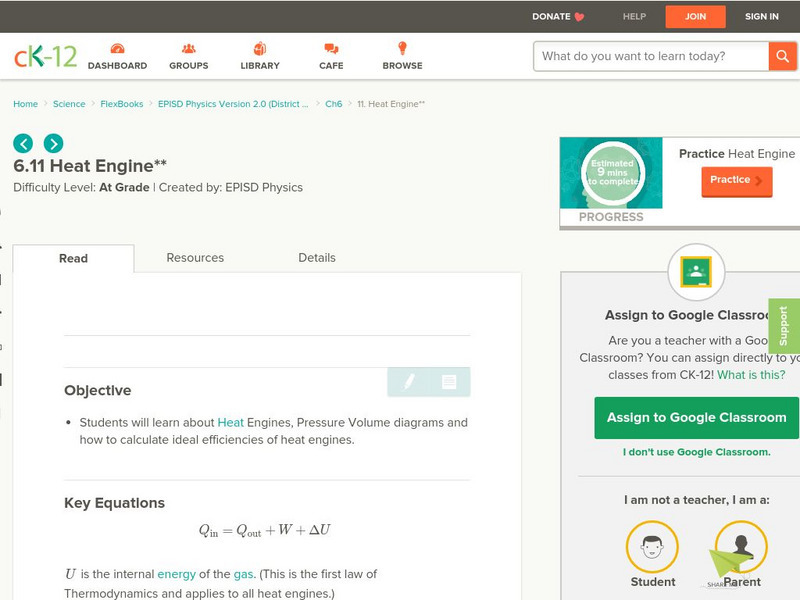
Ck 12: Heat Engine
[Free Registration/Login may be required to access all resource tools.] Students will learn about heat engines, explore pressure volume diagrams, and figure how to calculate ideal efficiencies of heat engines.
TryEngineering
Try Engineering: Find It With Gps!
Using a GPS handheld device and online resources, learners work in teams to explore the technology behind GPS, current GPS applications, and brainstorm new applications for future global use to solve society's issues.
University of Richmond
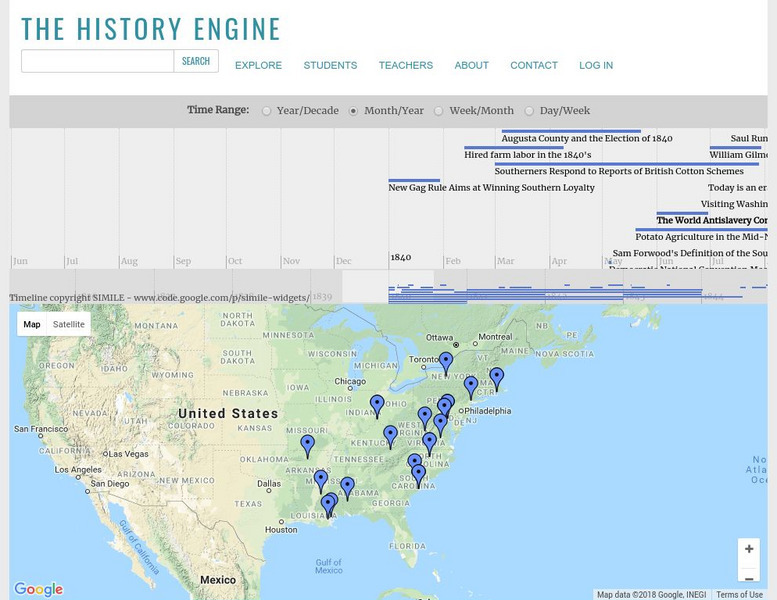
University of Richmond: The History Engine
Explore this in-depth history of the United States beginning in 1840 by clicking on a date or location on this interactive map, or by manipulating the timeline above. Each event is accompanied by a description and details, with links to...
TeachEngineering
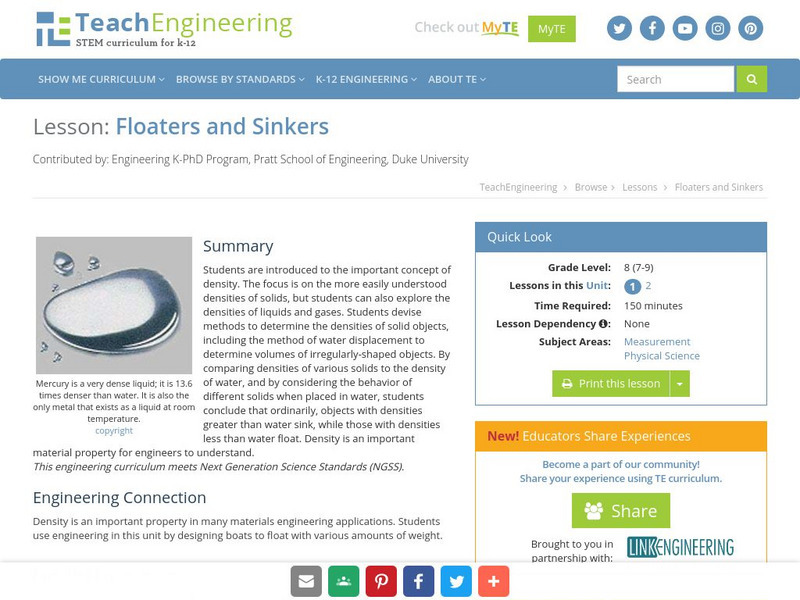
Teach Engineering: Floaters and Sinkers
This activity introduces students to the important concept of density. The focus is on the more easily understood densities of solids, but students can also explore the densities of liquids and gases. Students devise methods to determine...
TeachEngineering
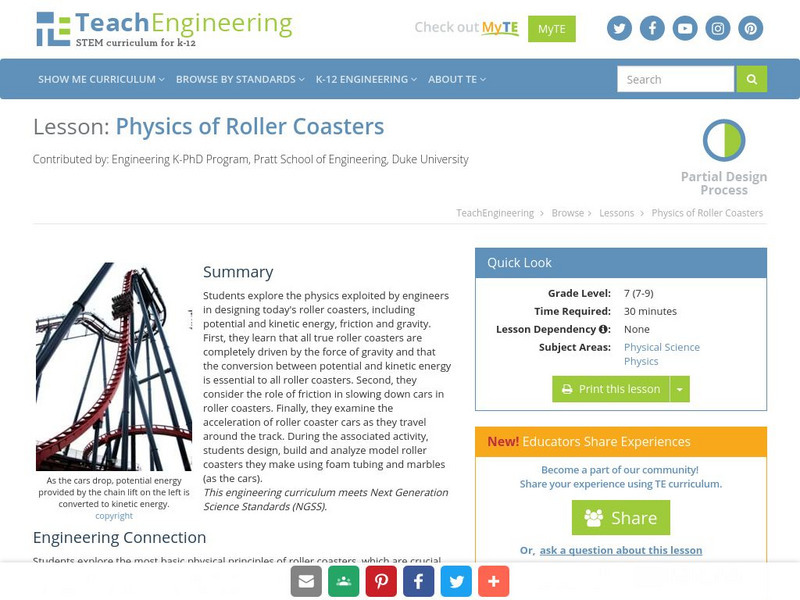
Teach Engineering: Physics of Roller Coasters
Young scholars explore the physics utilized by engineers in designing today's roller coasters, including potential and kinetic energy, friction, and gravity. First, students learn that all true roller coasters are completely driven by...
TeachEngineering
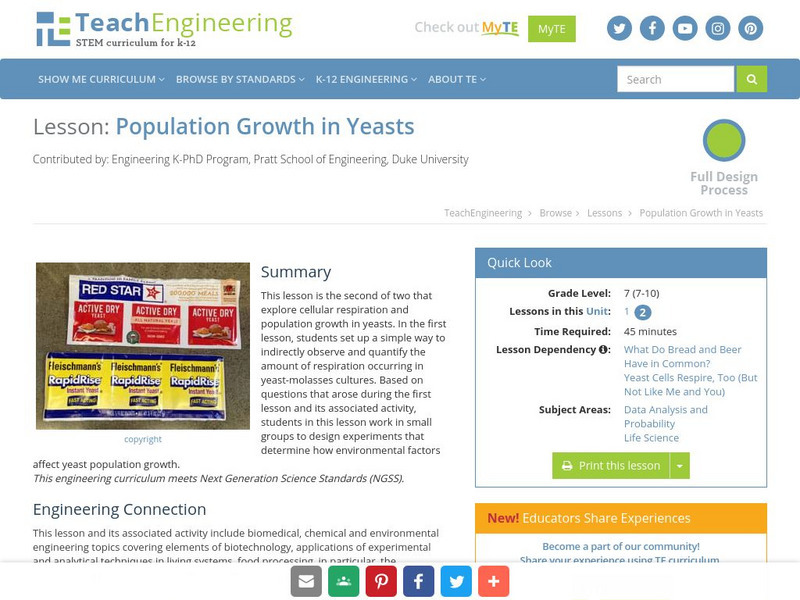
Teach Engineering: Population Growth in Yeasts
This lesson is the second of two that explore cellular respiration and population growth in yeasts. In the first lesson, young scholars set up a simple way to indirectly observe and quantify the amount of respiration occurring in...
Other
American Society for Engineering Education: E Gfi: Activity: Keep a Cube
In this activity, student teams in grades K-6 explore the design process by engineering a way to keep an ice cube from melting for 30 minutes. [6:00]
TryEngineering
Try Engineering: Build a Big Wheel
Learners learn about the engineering design process as they design, build, test, and evaluate a big wheel or Ferris wheel made with pasta, glue, and teabags. The objective of the lesson is to explore how big wheels have been designed...
TryEngineering
Try Engineering: Telescoping Periscope
Working in teams of "engineers", students explore how a periscope works and is used. They design, build, and test a working periscope made from everyday materials that has adjustable mirrors and be able to telescope as well.

Learn Engineering
Learn Engineering: Theory of Vibration
Did you know that some bridges have failed due to the effect of vibration? This article and video explore vibration and its importance in the design of civil structures and mechanical equipment. The article discusses all concepts covered...

TeachEngineering
Teach Engineering: Hands on Activity: Designing a Thermostat
By building a basic thermostat, students will explore basic circuitry and electricity. The thermostat built out of a breadboard, temperature sensor chip, amplifier, and battery creates a linear relationship between temperature of the...
TryEngineering
Try Engineering: Hand Biometrics Technology
Lesson probes how biometrics technologies have been used worldwide to address security and identification systems. After exploring different biometric techniques, learners work in teams to find their own hand geometry biometrics, then...
TryEngineering
Try Engineering: Tinkering With Tops
Lesson explores the history, design, and motion of spinning tops. Student teams design and build their own tops that can spin for at least 10 seconds within a circle 30 centimeters in diameter.
NC State University
The Engineering Place: Volcanoes: Viscosity Demonstration
For this lesson plan, learners explore how the viscosity of lava affects the intensity of a volcanic eruption, and the resultant landforms that are created.
TeachEngineering
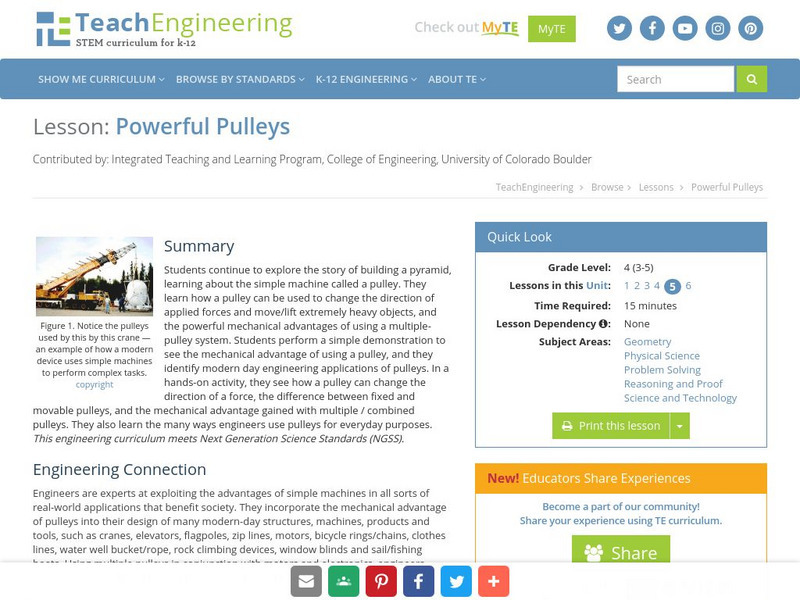
Teach Engineering: Powerful Pulleys
Students continue to explore the story of building a pyramid, learning about the simple machine called a pulley. They learn how a pulley can be used to change the direction of applied forces and move/lift extremely heavy objects, and the...
TeachEngineering
Teach Engineering: Harvesting Oil From the Earth
In this lesson, students investigate sources of fossil fuels, particularly oil. Students will learn how engineers and scientists look for oil by taking core samples from a model of the Earth. Also, students will explore and analyze oil...