Hi, what do you want to do?






CK-12 Foundation
Exponential Decay: Cool Sunglasses
Who wouldn't want to wear four pairs of sunglasses? Each pair of sunglasses reduces the percent of incoming light by one-half. An interactive tutorial helps young mathematicians build a graph that models this scenario. They...

CK-12 Foundation
Linear, Exponential, and Quadratic Models: Bernoulli Effect
How can an object as heavy as an airplane fly? Turns out the answer is quadratic! Your classes explore the Bernoulli Effect through an interactive graph representation. As a plane increases in speed, the lift force also increases. Young...

CK-12 Foundation
Geometric Sequences and Exponential Functions: Bouncing Ball
Explore a geometric sequence model through a simulation. Learners change the starting drop height of a ball and watch how the heights of following bounces change. They consider the ratio of the consecutive bounces as they analyze...

Learning Games Lab
Logarithm Calculator
Support your young scientists' knowledge of logarithms with a quick video lesson. The instruction first presents the relationship between a base-10 logarithm and an exponential equation. It then demonstrates how to use a calculator to...

CK-12 Foundation
Logarithms: Logarithm Triangle
Study logarithmic properties using a triangle. A clever manipulative shows how a triangle can represent the three parts of a logarithmic or exponential equation. Pupils review the concept and then answer guiding questions to further...
Ministry of Education and Universities of the Region of Murcia (Spain)
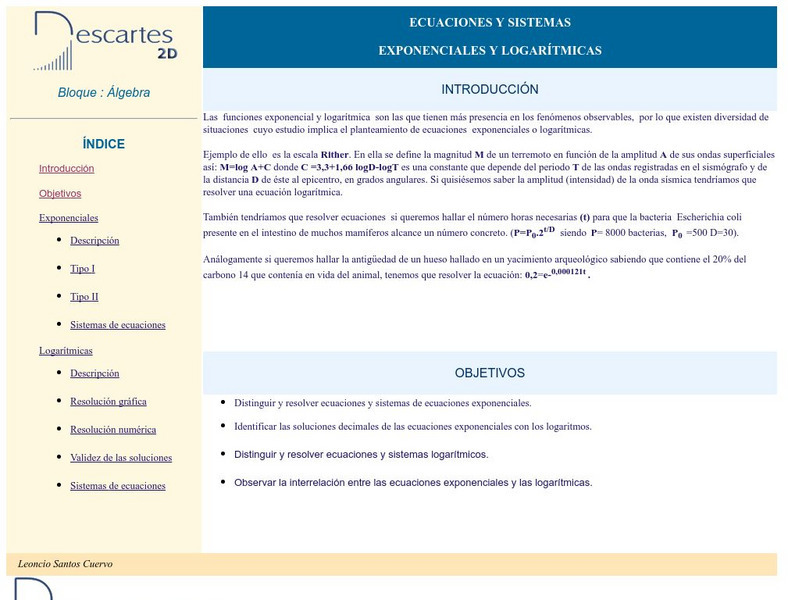
Ministerio De Educacion Y Ciencia: Exponenciales Y Logaritmicas
In this activity you will learn how to differentiate and solve logarithmic equations and observe the relationship between logarithmic and exponential equations.

Physics Aviary
Physics Aviary: Quick Graph 3.0
This program was designed as a quick graphing program that students could use on a computer, tablet or smart phone when a more complex graphing program is not available. This program will let students plot up to 10 data points and then...