Hi, what do you want to do?






Broward County Public Schools
Force and Motion
Get the ball rolling with this upper-elementary science unit on forces and motion. Offering over three weeks of physical science lessons, this resource is a great way to engage the class in learning about simple machines, friction,...

Chicago Children's Museum
Simple Machines: Force and Motion
Get things moving with this elementary science unit on simple machines. Through a series of nine lessons including teacher demonstrations, hands-on activities, and science experiments, young scientists learn about forces, motion,...

Columbus City Schools
May the Force Be with You
You won't have to force your classes to complete these engaging activities! Through exploration, young scientists learn that force has both magnitude and direction. They draw force diagrams, investigate force models, and complete a...

Columbus City Schools
Force Field Physics
Attracted class members to an activity-packed journey through the science behind the invisible forces at work all around us. From jump rope generators to junkyard wars, there's never a dull moment when eighth grade physics scholars...

Henry Ford Museum
Physics, Technology and Engineering in Automobile Racing
Start your engines! This five-lesson unit introduces physics and Newton's laws through automobile racing. Each lesson includes background information, a student worksheet, and an answer key. There are also culminating...

Curated OER
Earthquakes: Third Grade Lesson Plans and Activities
Introduce third graders to energy waves with a hands-on geology activity, in which they answer questions and compare seismograms in the San Francisco Bay area. After a demonstration that shows how bigger waves indicate a...

Columbus City Schools
It’s All Relative
Are the people on the other side of the world standing upside down? Pupils discuss the relationship between movement and position words. The unit explores the concept of reference points through animation, modeling, photography, and...

Columbus City Schools
Totally Tides
Surf's up, big kahunas! How do surfers know when the big waves will appear? They use science! Over the course of five days, dive in to the inner workings of tidal waves and learn to predict sea levels with the moon as your guide.

Roald Dahl
Roald Dahl Matilda Lesson Plans
Fifty eye-catching pages contain six lessons about Roald Dahl's novel, Matilda. Each lesson has a theme and covers a different subject—literacy, social-emotional learning, science, and geography. Scholars analyze characters, examine...

Curated OER
The Motions of the Oceans
Students examine the topics of ocean waves, currents, and tides. They locate and label ocean currents on a world map, conduct experiments, analyze key vocabulary, view demonstrations and record the data, and complete handouts.

Columbus City Schools
It’s Electric!
Shocking! Who knew so many great ideas existed for teaching middle schoolers about electricity? Find them all within this energetic framework. You'll light up at the variety of printable and web-based resources within! After building...

University of Florida
Understanding Car Crashes: It's Basic Physics!
Make an impact on young physicists with this fun collection of resources. After first watching a video and taking notes on the physics of car crashes, students go on to complete a series of activities that explore the...

Curated OER
Astronomy
Students complete a unit of lessons on our solar system, its stars, and astronomers. They record information in a space journal, design constellations, define key vocabulary, observe the phases of the moon, and create a group planet...

Curated OER
Our Universe: Always Moving, Always Changing
Students explore the main concepts of astronomy through the eleven lessons of this unit. The past, present, and future methods of studying the science are examined in this unit.
Utah State Office of Education
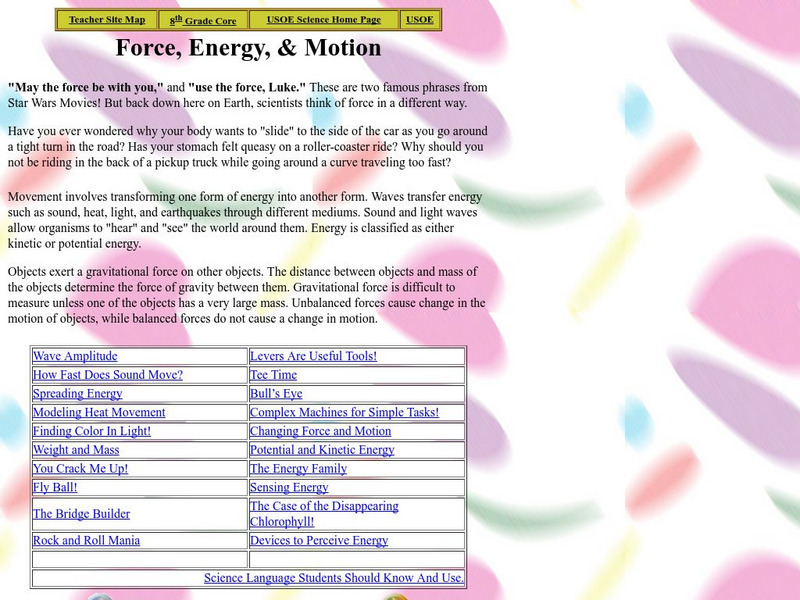
Utah State Office of Education: Force, Energy, & Motion
A unit on energy, force, and motion presented with interactive and classroom activities. Students gain an understanding of weight, mass, potential and kinetic energy, sound, and heat with this engaging resource.

TeachEngineering
Teach Engineering: Energy of Motion
By taking a look at the energy of motion all around us, students learn about the types of energy and their characteristics. They first learn about the two simplest forms of mechanical energy: kinetic and potential energy, as illustrated...
Georgia Department of Education
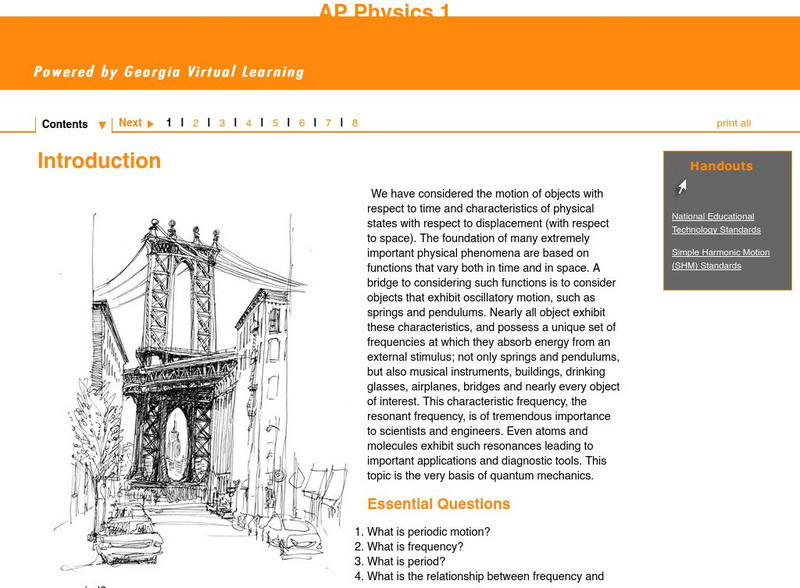
Ga Virtual Learning: Ap Physics 1: Simple Harmonic Motion
In this unit, students will discover the period of time of one oscillation, the frequency of oscillation, the object displacement, its velocity, and its acceleration. They will also discover how to apply the principles of conservation of...
TeachEngineering
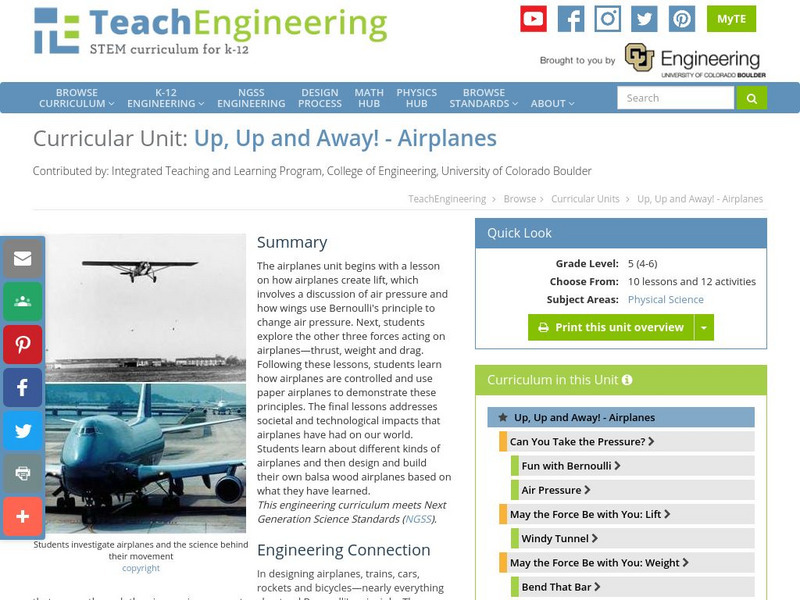
Teach Engineering: Up, Up and Away! Airplanes
The airplanes unit begins with a lesson on how airplanes create lift, which involves a discussion of air pressure and how wings use Bernoulli's Principle to change air pressure. Following the lessons on lift, students explore the other...
City College of New York
City Technology: Fantastic Elastic
Explore engineering technology with this unit. Students will study how to design and execute two types of homemade vehicles using elastic.
TeachEngineering
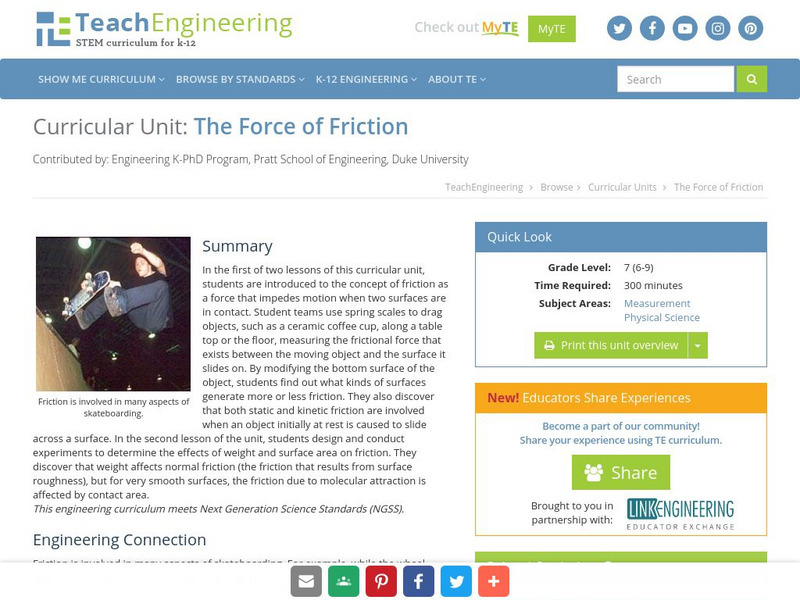
Teach Engineering: The Force of Friction
In the first of two lessons of this curricular unit, students are introduced to the concept of friction as a force that impedes motion when two surfaces are in contact. Student teams use spring scales to drag objects, such as a ceramic...
TeachEngineering
Teach Engineering: Mechanics Mania
Through ten lessons and numerous activities, students explore the natural universal rules engineers and physicists use to understand how things move and stay still. Together, these rules are called "mechanics." The study of mechanics is...
TeachEngineering
Teach Engineering: Surface Tension
Surface tension accounts for many of the interesting properties we associate with water. By learning about surface tension and adhesive forces, students learn why liquid jets of water break into droplets rather than staying in a...