Hi, what do you want to do?






Curated OER
Engineering Pop-Ups
Students explore the art of paper engineering and pop-up-books. They listen to a teacher-led lecture on pop-up books, discuss the process of paper engineering, and plan, design and construct an original pop-up book.

Curated OER
Paper Suspension Bridges: You Want Me To Go Up There?
A few class periods will be required to complete this physics investigation with your high schoolers. There is an unavailable video written into the lesson plan, but there is plenty of material here to bridge the gap. Two terrific...

Curated OER
Surface Friction and Wear Characteristics of Common Materials
Students identify the factors affecting friction. For this physics lesson, students construct their own rocket car and race them. They graph the average speeds and discuss how lubricants affect friction between rubbing surfaces.

Curated OER
Newton's Laws
Students identify Sir Isaac Newton and his contribution to physics. They write Newton's three Laws of classical mechanics. and apply Newton's Laws to the world around them. They isolate a situation and apply Newton's Laws.

Curated OER
Sciences Working Together
Students research articles about science technology and society. For this science and technology lesson, students answer questions about an article they chose. They share what they learned with their peers.

Curated OER
A Focus on Mechanical Friction
Students explore mechanical friction. They perform experiments to observe the direction of mechanical motion and the difference between rolling and sliding friction. Data results on the experiments are recorded and students answer...

Curated OER
RESISTANCE IS FUTILE
Young scholars explore friction and use objects such as coins and marbles to study the concept.

Curated OER
Vectors
Students differentiate distance and displacement. For this physics lesson, students use formulas to calculate for displacement. They draw vectors using the grid.

Curated OER
Impulse and Momentum
Young scholars are introduced to the concepts of impulse and momentum and problem solving strategies for these types of problems. In groups, they discover the law of conservation of momentum and share their answers with the class.

Science Struck
Science Struck: Guide to Free Body Diagrams in Physics
A detailed explanation of the different types of forces that can be applied to an object and how to represent them in a free body diagram. Includes examples and some practice problems to try, with solutions provided.
CK-12 Foundation
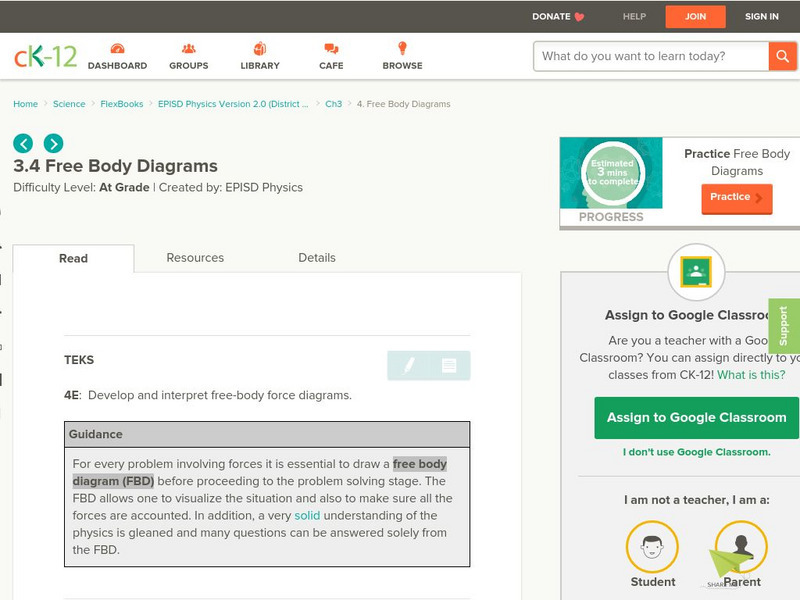
Ck 12: Episd: Free Body Diagrams
[Free Registration/Login may be required to access all resource tools.] Students will understand how to read and create free body diagrams.

Khan Academy
Khan Academy: Introduction to Forces and Free Body Diagrams Review
Review the key concepts and skills for forces, including how to draw free body diagrams.
Physics Classroom
The Physics Classroom: Newtons Laws: Free Body Diagram Interactive
A skill-building tool that presents students with twelve situations for which they must construct free-body diagrams. Force arrows allow user to toggle the magnitude of the force. Feedback is immediate; opportunities to correct answers...
Sophia Learning
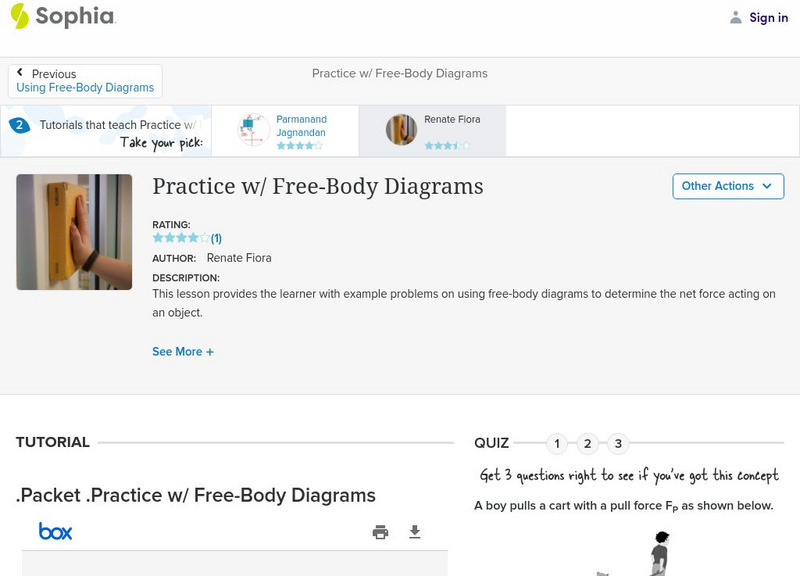
Sophia: Practice With Free Body Diagrams
Need some practice drawing free-body diagrams? This slideshow lesson gives several examples of different situations and the forces that need to be shown in the free-body diagram.
Physics Classroom
The Physics Classroom: Newton's Laws: Drawing Free Body Diagrams
Students practice reading situations where forces are acting upon objects in all directions and magnitudes, and then draw free-body diagrams to represent the forces. Each problem has a self-checking key linked right on the page.
Sophia Learning
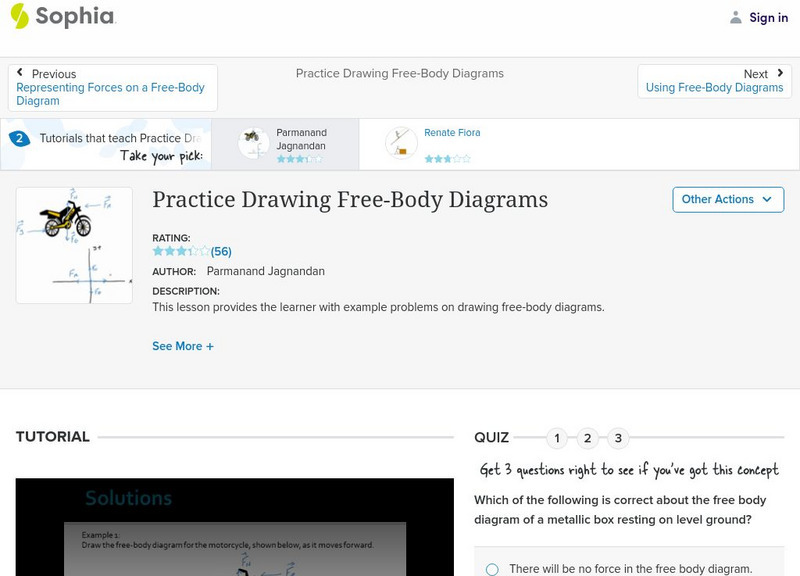
Sophia: Practice Drawing Free Body Diagrams: Lesson 1
This lesson provides the learner with example problems on drawing free-body diagrams. It is 1 of 2 in the series titled "Practice Drawing Free-Body Diagrams."
Sophia Learning
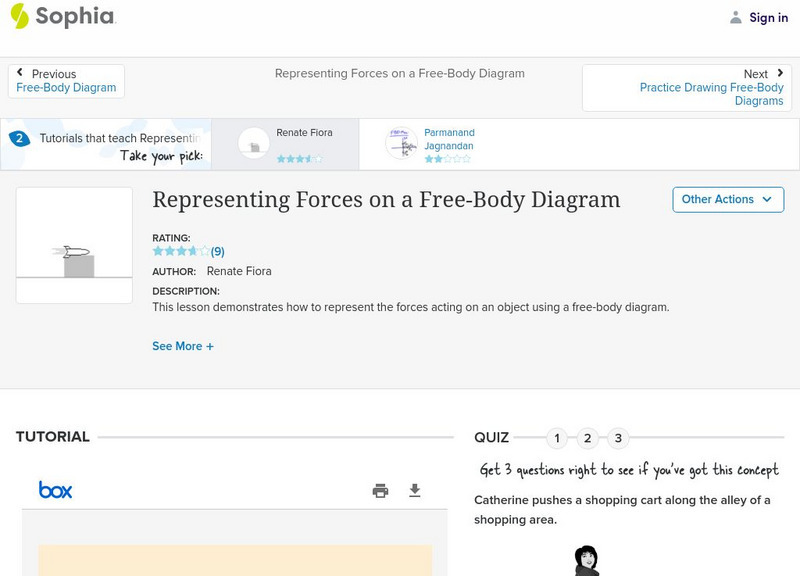
Sophia: Representing Forces on a Free Body Diagram: Lesson 2
This lesson demonstrates how to represent the forces acting on an object using a free-body diagram. It is 2 of 2 in the series titled "Representing Forces on a Free-Body Diagram."
Sophia Learning
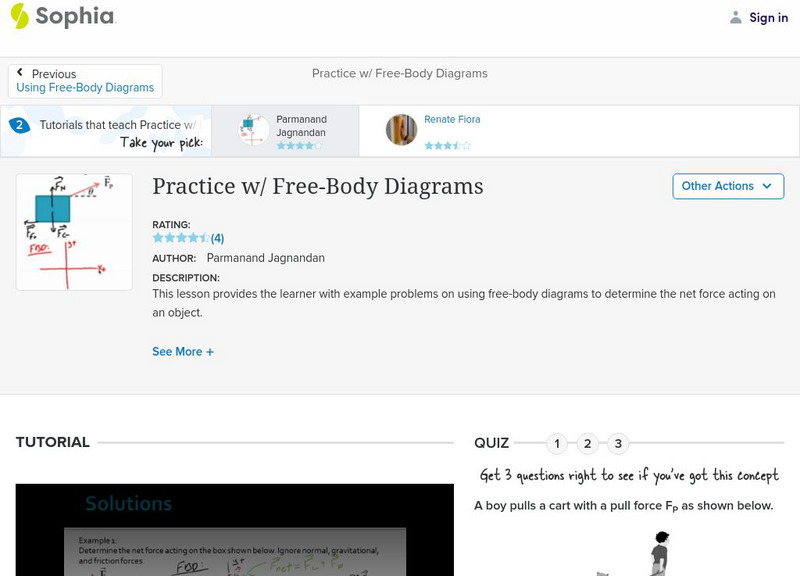
Sophia: Practice W/ Free Body Diagrams: Lesson 1
This lesson provides the learner with example problems on using free-body diagrams to determine the net force acting on an object. It is 1 of 2 in the series titled "Practice w/ Free-Body Diagrams."
Sophia Learning
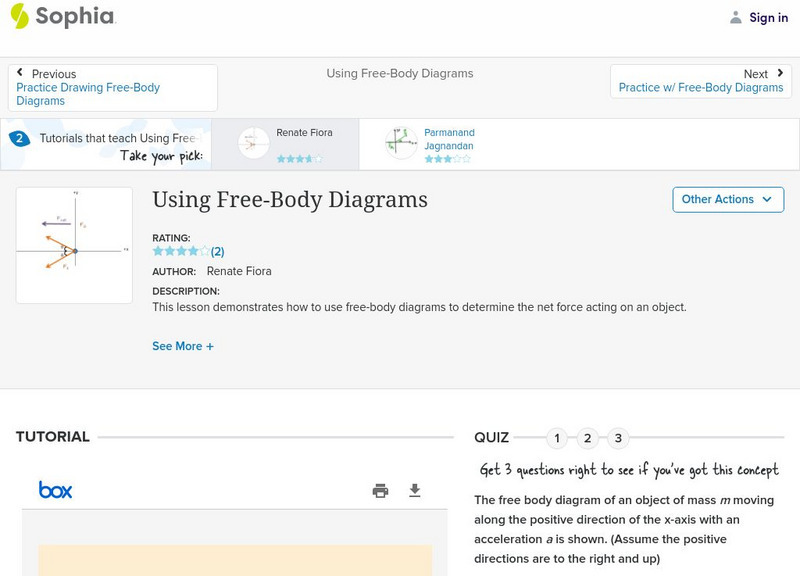
Sophia: Using Free Body Diagrams: Lesson 2
This lesson demonstrates how to use free-body diagrams to determine the net force acting on an object.

Sophia Learning
Sophia: Practice Drawing Free Body Diagrams: Lesson 2
This lesson provides the learner with example problems on drawing free-body diagrams. It is 2 of 2 in the series titled "Practice Drawing Free-Body Diagrams."
CK-12 Foundation
Ck 12: Physics Simulation: Free Body Simulation
Learn to draw free-body diagrams in this simulation where you place arrows to indicate the directions that forces are acting on an object.
Sophia Learning
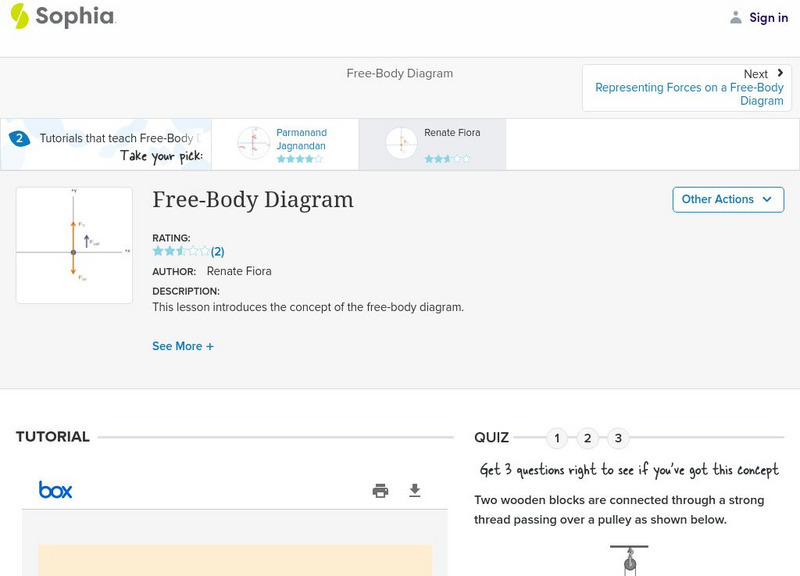
Sophia: Free Body Diagram: Lesson 2
This lesson introduces the concept of the free-body diagram. It is 2 of 2 in the series titled "Free-Body Diagram."
University of Colorado
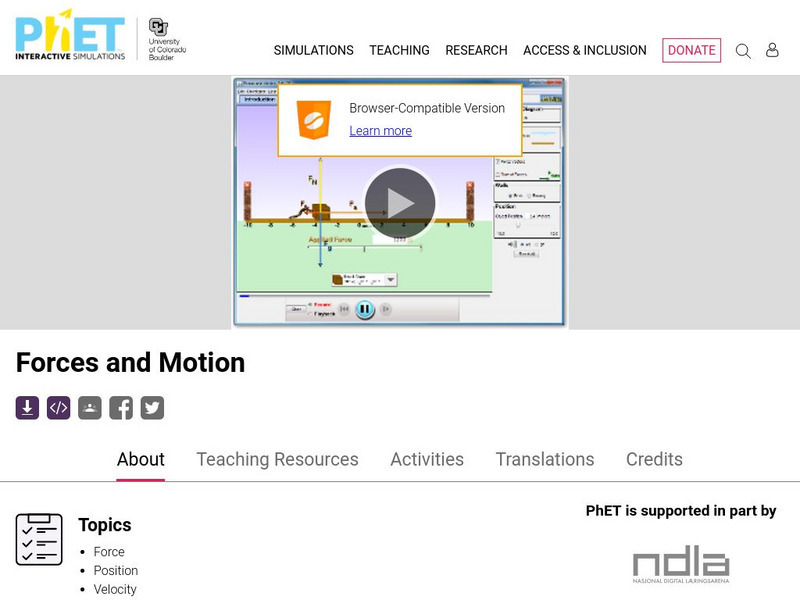
University of Colorado: Ph Et Interactive Simulations: Forces and Motion
Explore the forces at work when you try to push a filing cabinet. Create an applied force and see the resulting friction force and total force acting on the cabinet. Charts show the forces, position, velocity, and acceleration vs. time.
Physics Classroom
The Physics Classroom: Newton's Laws: Balanced and Unbalanced Forces
Students study several free-body diagrams to better understand balanced and unbalanced forces.