Hi, what do you want to do?






Curated OER
Butterfly Metamorphosis Booklet
Students study the four different stages of butterfly metamorphosis, In this butterfly life cycle lesson, students construct a metamorphosis booklet by recording and illustrating the butterfly life cycles in the booklet. Vocabulary and...

Curated OER
Peanut Butter Broccoli
Fifth graders explore food production by viewing DNA presentations. In this genetic engineering lesson, 5th graders discuss the foods they typically eat at home and how many common foods are engineered in a way that can produce a bigger...

Curated OER
Rock, Paper, Scissors
Fifth graders explore genetic traits. In this genetic traits lesson, 5th graders investigate dominant and recessive traits. Students identify similar traits between a parent organism and its offspring.

Curated OER
Language Arts: Then and Now
First graders hear Great Grandma and I. They locate objects representing then (seed) and now (tomato). They make then and now charts for members of their families.

Curated OER
The Animal Kingdom
In this animal kingdom learning exercise, students read for information and determine comprehension. In this matching and fill in the blanks learning exercise, students answer twelve questions.

Curated OER
Sunken Millions Animals
This PowerPoint includes a game with ocean graphics in which two teams answer increasingly difficult questions about animals. Topics covered include plant and animal cells, animal adaptation, and similarities and differences between...

Curated OER
Animal Parenting
Students analyze parenting instincts. In this parenting instincts lesson plan, students view a drawing of animal they studies and describe what they learned about the animal. Students teach the class about their animal and the class...

Curated OER
Growing Eyeballs
Students investigate vision and the anatomy of the human eye. They complete a Webquest, watch a video about the structure of the eye, take an online quiz, answer discussion questions, and read newspaper articles about activities that...
Other
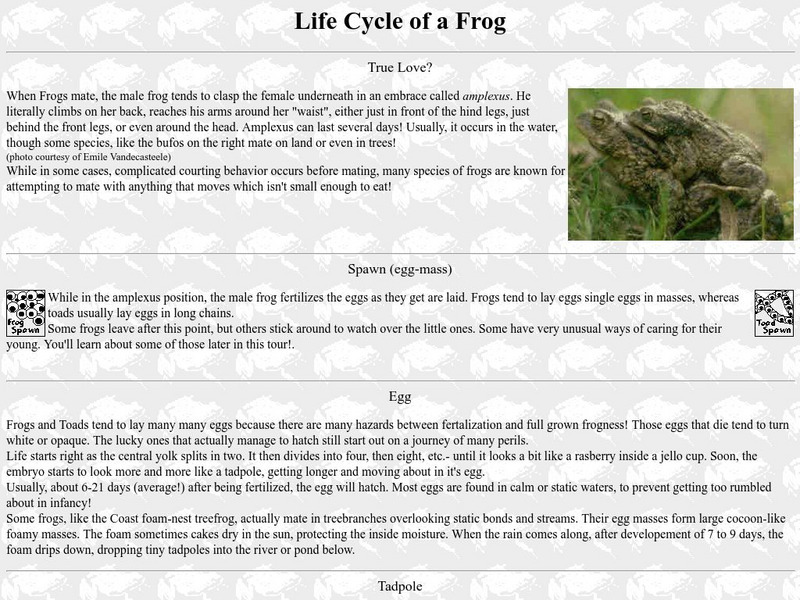
All About Frogs: Life Cycle of a Frog
Understand the reproduction and life cycle of a frog from mating through spawn, eggs, tadpoles, and growing legs to the final frog. Nice details.
PBS
Pbs Nature: Frogs and Toads
Do you know how to tell the difference between a frog and a toad? This site provides interesting facts and information about this type of amphibian from where they live to what they eat and more.

Curated OER
Science Kids: Science Images: Frog Metamorphosis
This drawing shows the metamorphosis of a frog. The five different images each show a stage in the development from tadpole to fully grown frog.
Natural History Museum
Natural History Museum: Reptiles, Amphibians and Fishes
This online exhibit from the Natural History Museum branches out in many fields to cover the broad topics of reptiles, amphibians and fishes. Thirteen subtopics are provided including several videos and informative articles.
Curated OER
[Frog Spawn]
Understand the reproduction and life cycle of a frog from mating through spawn, eggs, tadpoles, and growing legs to the final frog. Nice details.
Curated OER
[Toads Mating]
Understand the reproduction and life cycle of a frog from mating through spawn, eggs, tadpoles, and growing legs to the final frog. Nice details.
Curated OER
[Toad Spawn]
Understand the reproduction and life cycle of a frog from mating through spawn, eggs, tadpoles, and growing legs to the final frog. Nice details.
Curated OER
[Froglet]
Understand the reproduction and life cycle of a frog from mating through spawn, eggs, tadpoles, and growing legs to the final frog. Nice details.