Hi, what do you want to do?






Curated OER
Newton's Laws
Learners give examples of each of Newton's three laws as they occur in everyday experiences. They visually represent and differentiate the difference between a direct proportion and an inverse proportion. Students explain how the...

Colorado State University
Why Do Raindrops Sometimes Land Gently and Sometimes with a Splat?
A mouse can fall from large heights without injury! Air resistance is a large influence on small falling objects. In an exploratory lesson, young scholars build a raindrop bottle to compare the falling rate of different-sized objects.

It's About Time
Run and Jump
Has your class wondered how fast a human could run or how high they are capable of jumping? Help them understand these concepts as they explore acceleration and use an accelerometer to make semiquantitative measurements of acceleration...

Curated OER
Motion Through the Ages
Eighth graders conduct internet research to produce a timeline of man's growth in understanding of concepts of motion and planetary motion through history.

Curated OER
WHAT HOLDS US TO EARTH?
Students they imagine they are Galileo and try to duplicate Galileo's experiments and results.

Curated OER
The Scientific Revolution
Scientists participate in studying how new scientific advances have changed the world. They explain how astronomers have changed the way people view the universe, summarize the advances that were made in chemistry and medicine, and...

Curated OER
Albert Einstein Challenge
In this famous person instructional activity, students answer 10 multiple choice questions about the life and times of Albert Einstein. They answer questions about his childhood, first jobs and scientific theories.

Mr. E. Science
Forces
May the mass times acceleration be with you. The presentation covers forces, Newton's three Laws of Motion, momentum, and vectors.

Curated OER
Lesson 4 Activity 1: Mapping the Third Dimension
Students work in pairs to construct a simple stereoscope.

Curated OER
Albert Einstein Crossword Puzzle
In this Albert Einstein crossword activity, students read 10 clues that pertain to the famous scientist. Students fit their answers from the word bank into a crossword puzzle.

Curated OER
Projectile Motion Demonstration
Students dicusss Newton's First Law of Motion. They calculate a projectile moving horizontally and vertically at different intervals. They particpate in an experiment in which the projectile is at an angle. They record and discuss the...

Curated OER
Paper Helicopters
In this paper helicopter worksheet, students design and experiment making a paper helicopter to explore how some things fall and how varying the size of the rotor blades affect the way a helicopter spins.

Curated OER
Hot Wheels
Students observe the action produced by toy cars. In this geometry lesson, students discuss motion and distance as they relate to the movement of a spherical object.They collect data and make conjectures based on their data.

Curated OER
Force & Motion
Third graders are introduced to the concepts of force and motion. In groups, they travel between stations to analyze the effect of force and motion on various objects. They research how various careers use these concepts as well.

Curated OER
Aristotelian and Newtonian Motion
Students use a quotation from Einstein as a reference to categorize their descriptions as either Newtonian or Aristotelian. They discuss the idealized nature of the Newtonian approach. Students describe the events they observe when an...

Curated OER
Astronomy
In this astronomy activity, students read a detailed text about our solar system. Students then answer 15 questions about the information presented.

PBS
Pbs Learning Media: Galileo: His Experiments
This interactive activity from the NOVA Web site samples Galileo's experiments with falling objects, projectiles, inclined planes, and pendulums.
Vision Learning
Visionlearning: Mechanics: Gravity: Newtonian Relationships
Explanation of how astronomers and scientist developed the current theories of gravity.
NASA
Nasa Space Science Data Archive: Galileo Project Information
This is the homepage of all of the archived information about and from the Galileo Mission. Included is data from the flybys of Venus, Earth, Moon, and Asteroids Gaspra and Ida, as well as the current data from Jupiter and its moons. See...
Concord Consortium
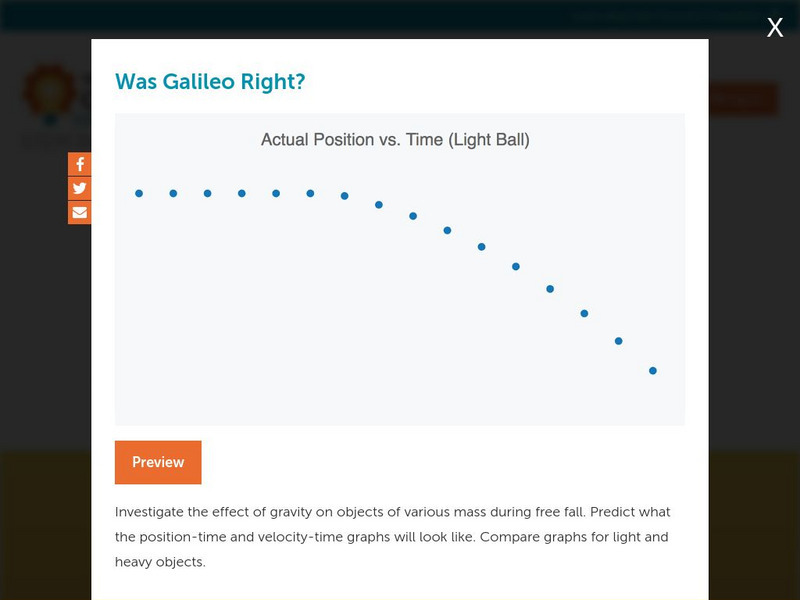
Concord Consortium: Was Galileo Right?
Investigate the effect of gravity on objects of various mass during free fall. Predict what the position-time and velocity-time graphs will look like. Compare graphs for light and heavy objects.

Discovery Education
Discovery Education: Physical Science: Gravity Gets You Down
In this instructional activity, young scholars make predictions about falling objects of different sizes and masses to learn about gravity and air resistance. Includes audio vocabulary list and extension activities.
PBS
Pbs Learning Media: More on Galileo's Big Mistake
Even great scientists make mistakes! This illustrated essay from the NOVA Web site looks at Galileo's theory of the tides, which, while well thought out, was wrong.
Science Buddies
Science Buddies: What Goes Up, Must Come Down
Standing on a balcony near the top of the 179-foot tall Tower of Pisa, a young scientist dropped two iron balls into the crowd below. The scientist, young Galileo, was not trying to knock his fellow professors on the head, but was trying...
Utah Education Network
Uen: Trb 3:4 Investigation 1 I'm Falling for You!
Third graders will experience gravity just like Galileo did during his experiments.