Hi, what do you want to do?






Texas State Energy Conservation Office
Investigation: Gas Laws in Action - Propane
Using helium as an example of propane, physical science middle schoolers experiment with and graph the relationship between temperature and volume in gases. In a whole-class demonstration, they show how molecules behave under different...

Colorado State University
What Makes a Gas, a Greenhouse Gas?—The Carbon Dioxide Dance
Investigate a heated topic in environmental science. Scholars team up to play the parts of gas molecules in the atmosphere. As the teacher moves about, acting as the electromagnetic wave, learners react as their molecules would to the...

US Department of Energy
Dissolved Gases in Water
Using different types of water, earth science explorers set out to prove the ocean's ability to absorb greenhouse gases. They heat, shake, and freeze the water samples to examine the gas content. This lesson is useful in a unit on...

Colorado State University
What Causes Pressure?
Are you feeling the pressure? Let loose a little with a kinesthetic activity that models molecular motion in a closed space! The activity varies conditions such as volume and temperature and examines the effects on molecules.

Exploratorium
Indicating Electrolysis
Sure, your learners know water is made up of two molecules, but watching them separate helps the class see the construction like never before. This resource provides directions on how to build a simple electrolysis device using a...

US Department of Energy
Hydrogen and Electrolysis
Electrify your science class with this simple electrolysis experiment. After first reading about hydrogen and its potential as an alternative energy source, a demonstration is performed showing young scientists how water molecules can be...

Colorado State University
How Do Long and Short EM Waves Interact with the Earth's Atmosphere?
Things are about to heat up in your classroom! A kinesthetic lesson asks learners to play the part of the gases in the earth's atmosphere and interact with the sun's radiation. The focus is to learn the impact of the increasing...

Forest Foundation
Forests, Carbon & Our Climate
To conclude their examination of forest ecosystems, class members consider the role forests play in the carbon cycle and how forests can offset climate change.

Colorado State University
Why Can Warm Air "Hold" More Moisture than Cold Air?—Vapor Pressure Exercise
Does it feel a little humid in here? Learners assume the role of water vapor in the atmosphere as they explore the differences between warm and cold air. They roll dice to determine their level of energy, which determines if they...

American Chemical Society
The Energy of Evaporation
Do all liquids evaporate at the same rate? Young scientists observe the evaporation rate of three different liquids. They measure the time, the temperature, and the change in energy. After comparing the chemical formulas, scholars...

Exploratorium
Hand-Held Heat Engine
See the direct relationship between pressure and temperature using these classic science toys. As individuals hold the glass bulb, the liquid inside reaches it's boiling temperature, which is just a bit above room temperature. As the...

NorthEast Ohio Geoscience Education Outreach
Introduction to Density
Seventh grade scientists weigh in on the concept of density. In a nutshell, they participate in the following activities:
Measurement of the mass and volume of fruit in order to compare densities
Measurement of the mass of oil and water...

Museum of Science
The Atom's Family: Mighty Molecules
In this activity, students construct models of molecules using marshmallows and gum drops.
Other
The Science House: Floating Candles
In this experiment students observe a combustion reaction and deduce the components necessary for the reaction to occur. They also see the relationship between pressure, volume, and number of molecules for gases.
Concord Consortium
Concord Consortium: Molecular Workbench Showcase: Chemistry, States of Matter
See how gas, liquid, and solid molecules react to external pressure in this simulation. Also see a model of intermolecular motion through elliptical particles.
Exploratorium
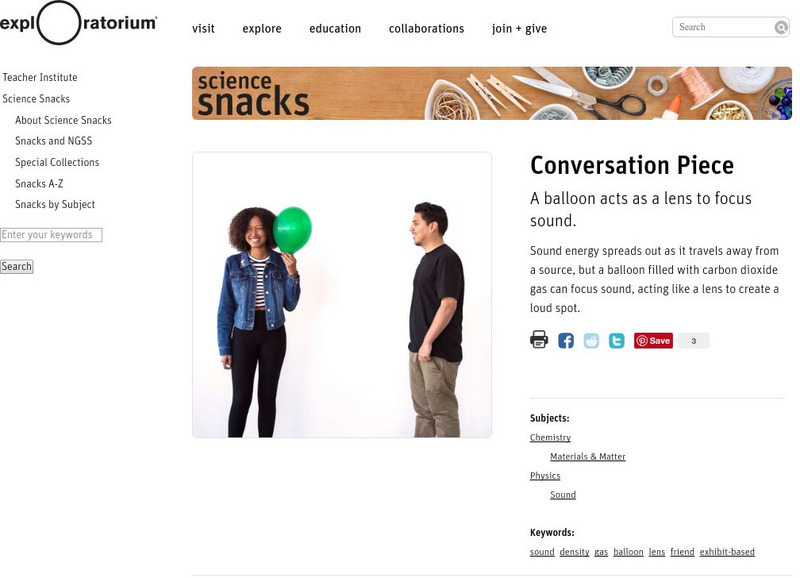
Exploratorium: Science Snacks: Conversation Piece
Did you know a balloon filled with carbon dioxide can act as an amplifier? In this activity test how sound travels through carbon dioxide molecules.
American Geosciences Institute
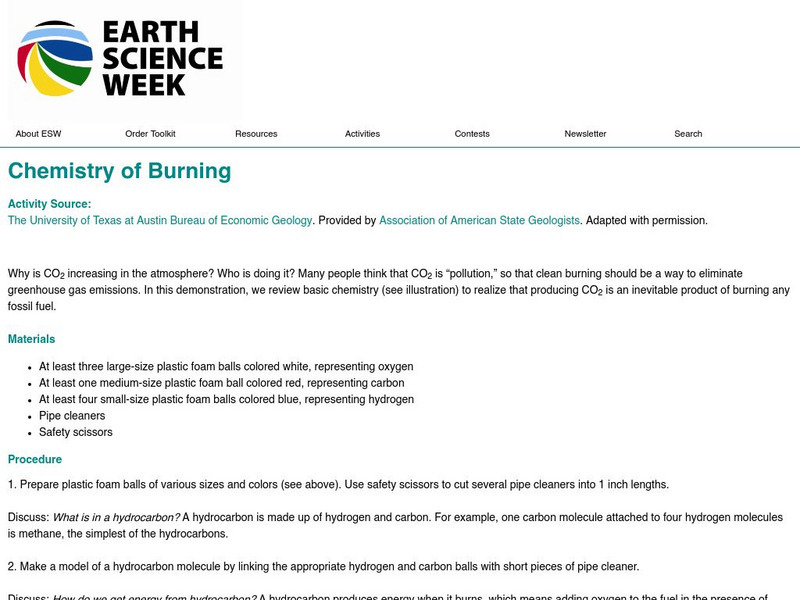
American Geosciences Institute: Earth Science Week: Chemistry of Burning
In this activity, students use pipe cleaners and foam balls to build a model of a hydrocarbon molecule. They then modify it to demonstrate the chemical reaction that happens when the hydrocarbon is burned.
Bill Nye
Bill Nye: Sock It to Me
This tutorial by Bill Nye explains how evaporating water (or sweat!) can cool you down.
Museum of Science
The Atom's Family: Phases of Matter
Help the Phantom choose a material and observe the changes at different temperatures in the molecule chamber. What happens to the elements or molecules as the temperature changes?

PBS
Pbs Teachers: Bottle Fountain Experiment
Demonstrate how heating expands air molecules by constructing a bottle fountain powered by air pressure.

PBS
Pbs Teachers: Hot Air Balloon Experiment
Explore how heat affects the density of air by building and flying a hot air balloon using large plastic bags and the hot air from an electric hairdryer.