Hi, what do you want to do?






Chicago Botanic Garden
Calculating Your Ecological Footprint
You can lower your ecological footprint by recycling! Lesson four in this series of five has individuals, through the use of a computer, calculate their ecological footprints. Through discussions and analysis they determine how many...

Chicago Botanic Garden
Calculating Your Carbon Footprint
Unplugging from technology for one day per week will decrease your carbon footprint—are you up to the challenge? Part two in a series of three allows individuals to explore their personal carbon footprints. By first taking a quiz at home...

Curated OER
I Feel Renewed!
Learners participate in a simulation of the equal and unequal distribution of the earth's renewable resources. They discuss renewable resources and how food resources can increase and decrease, participate in the simulation, and analyze...

Curated OER
How To Make Yeast Cells Thrive
Students set up and run the experiments they designed in the lesson, 'Population Growth in Yeasts,' using simple yeast-molasses cultures in test tubes. They demonstrate understanding that several environmental factors can contribute to...

Curated OER
Punnett Square Popcorn
In this genetics worksheet, students use the Punnett Square to learn about dominance and codominance in inherited traits. This worksheet has 1 short answer question and 6 problems to solve.
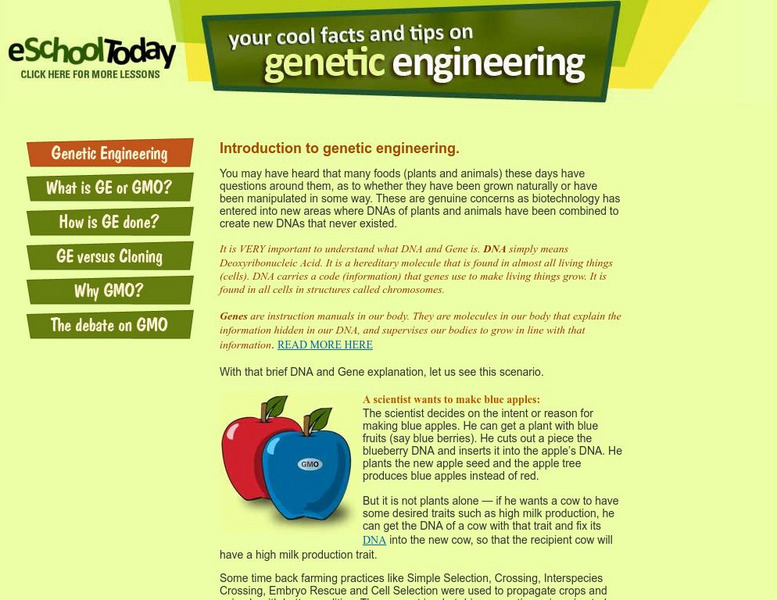
eSchool Today
E School Today: Your Cool Facts and Tips on Genetic Engineering
Explains a basic concept in genetic engineering, i.e., the genetic modification of living things. Describes how it is done, how it differs from cloning, the benefits it offers, and the concerns people have about this practice.

Popular Science
Popular Science: Something Funny Down on the Pharm
This article investigates the growing industry of pharming, or genetically engineering and growing crops in order to produce pharmaceutical drugs. While there is huge potential for this industry, the article concentrates on the...

CK-12 Foundation
Ck 12: Life Science: Biotechnology in Agriculture
[Free Registration/Login may be required to access all resource tools.] The majority of the corn in the United States is genetically engineered. Corn syrup is used to sweeten many things, like Coke. Corn is also fed to the cows. Learn...
PBS
Pbs Learning Media: Engineer a Crop: Transgenic Manipulation
You're the geneticist now. In this interactive feature developed for the companion Web site for NOVA/FRONTLINE: "Harvest of Fear," use the latest in genetic technology to engineer your own "supercrop" of tomatoes.
PBS
Frontline and Nova: Harvest of Fear
Review the risks, benefits, hopes, and fears associated with biotechnology and bioengineered food crops. Find in-depth interviews with genetic scientists, food industry representatives, farmers, and critics of biotechnology. Accompanying...
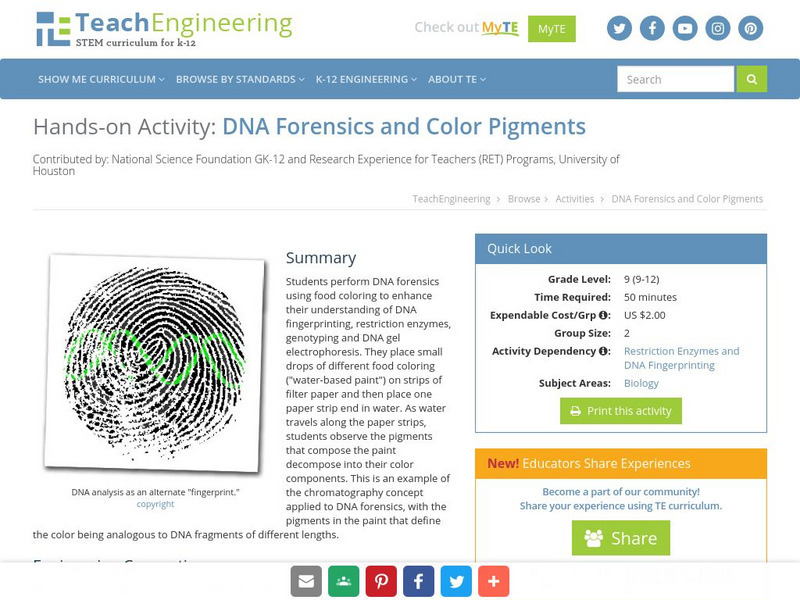
TeachEngineering
Teach Engineering: Dna Forensics and Color Pigments
Students perform DNA forensics using food coloring to enhance their understanding of DNA fingerprinting, restriction enzymes, genotyping and DNA gel electrophoresis. They place small drops of different food coloring ("water-based paint")...
PBS
Pbs Teachers: Scientific American: Dragon Science: Food for Thought
Investigate how geneticists use selective breeding to capitalize on hybrid vigor by using colored chips to represent traits in succeeding generations. Use Explain why farmers must buy new hybrid seed each year.
University of Arizona
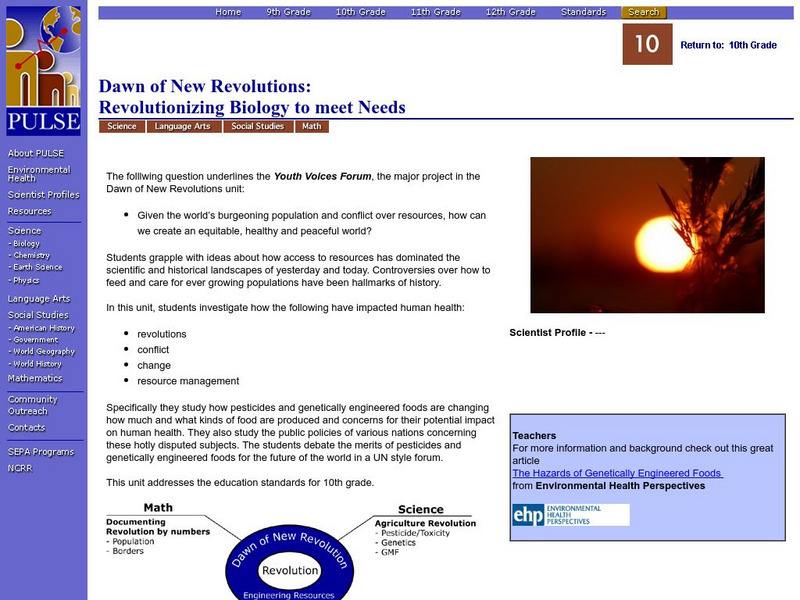
Pulse: Dawn of New Revolutions
A cross curricular unit focusing on how much and what kinds of foods are produced because of pesticides and genetically engineered foods. Students will investigate the impact on humans due to the new technology in food production. Topics...
PBS
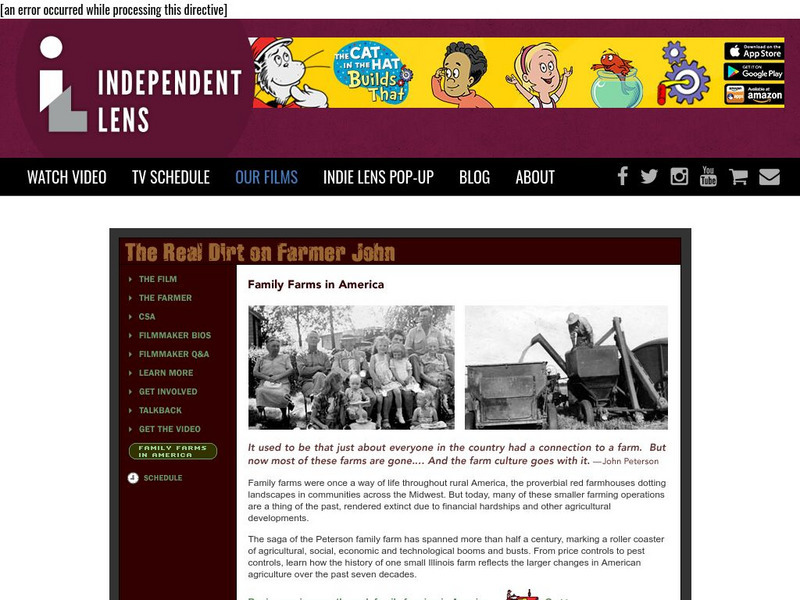
Pbs Teachers: The Real Dirt on Farmer John: Family Farms in America
Trace the evolution in American agriculture with this interactive timeline. Learn how the history of one small Illinois farm reflects the larger changes, decade by decade.

Other
Dna for Dinner?
This WebQuest is designed to help students answer the question, "Should genetically modified food crops be specifically labeled for consumers and why? In answering this questions students will also draft a law and explain their...

PBS
Pbs Teachers: Technology and Ethics
Investigate the meaning of ethics and morality as applied to technology and scientific advances. Research various issues related to scientific, technological and medical advances in the past decade and take a stand on each.
CK-12 Foundation
Ck 12: Life Science: 3.21 Agriculture
Learn how biotechnology can alter crops to change many different phenotypes of plants.