Hi, what do you want to do?






Curated OER
Fractals
Students explore the concept of fractals. In this fractal lesson, students use applets to explore Koch's Snowflake, Sierpinski's Triangle, and other fractals. Students develop these concepts through exploration and teacher guided...

Odell Education
Translation and Reflection
Bring about the change you want to see in the world or at least in your lesson plans. Young mathematicians learn about translation and reflections by applying them to polygons on the coordinate plane. Results provide data to develop...

Curated OER
Angles, Parallel Lines, and Polygons
Students examine how to investigate polygons using an instrument of their own construction. They should be able to prove the general formula for the number of degrees in any polygon (including a triangle). Finally they investigate an...

Curated OER
Wind Tunnel Aerodynamics Problem Set
High schoolers, after reading an explanation from a NASA Web-based textbook, demonstrate an understanding of the text by applying it to the calculation of area, velocity, and pressure in a wind tunnel.

Curated OER
Writing Directions for Mathematical Activities
Fifth graders reorganize comic strips to have them make sense, complete outline and organize their thoughts into outline form to explain directions,
and use that outline to complete their own directions for geometry activities.

Curated OER
Drag Equation - Level 1
Pupils, after reading the Drag Equation page from the NASA Web site, demonstrate an understanding of this equation and how drag is dependent on the variables included in the equation.

Curated OER
Drag Equation - Level 2
Students, after reading the Drag Equation page from the NASA Web-based textbook, demonstrate an understanding of this equation and how drag is dependent on the variables included in the equation.

Curated OER
What's Your Angle
Students create an original lesson about geometry and angles. In small groups they take pictures using a digital camera of obtuse, acute, right, and straight angles that they find at school. Students use the photos in a computer...

Curated OER
Tantalizing Tessellations - Lesson I
Students complete a chart (KWL) as a pre-assessment, study the history of tessellations (tilings), investigate the properties of tessellations, and make and evaluate photographs of "found tessellations" for a PowerPoint/HyperStudio...

Curated OER
Similar or Not?
Fifth graders define the meaning of similar and congruent using concrete objects. They make similar and congruent figures using geoboards. They draw their figures on dot paper, and color their designs.

Curated OER
Geo Jammin' By DeSign - Day 3, Lesson 12: Jammin
Students review definitions of word wall words using songs, movement and sharing.

Curated OER
Geo Jammin' By DeSign - Day 5, Lesson 25: Geo Jungle
Young scholars search the school grounds for examples of symmetry in nature. They bring examples back to the classroom and write about them.

Curated OER
Geo Jammin' By DeSign - Day 1, Lesson 3: Moo-vin
Second graders practice new geometry vocabulary by putting the words to the tune of "Hokey Pokey." students use the lyrics as a guided reading experience.

Curated OER
Relations
Students identify, compare, and analyze shapes and numbers. In this analogies and comparison math lesson, students warm up by completing 4 worksheets to familiarize themselves with analogies. In small groups, students are challenged to...

Curated OER
The Tipping Point
Students rewrite word problems and solve using math. In this word problem lesson, students gather data and observe the data. They relate this process to the scientific method and math. They review their data to be able to answer...

Curated OER
The Tangent Ratio
Young scholars calculate the tangent ratio given a right triangle. In this trigonometry instructional activity, students use a right triangle and the Pythagorean Theorem to solve problems.

Curated OER
The Probability Project
Students work together to complete a project on probability. In groups, they solve probability equations based on the formula and scenerio given to them in a PowerPoint presentation. To end the lesson, they take a quiz on each problem...
Wisc-Online
Wisc Online: Lewis Dot Structures of Covalent Compounds
Short slide show provides basic information about drawing Lewis dot structures for covalent compounds. Starts with anatomy of the atom, and then shows the relationship between atomic particles and the Periodic Table of Elements. Offers...

Smithsonian Institution
National Museum of American History: Slates, Slide Rules and Software
Did you learn to calculate using a 7-foot-long slide rule? Did you learn about the properties of numbers using brightly colored Cuisenaire rods? Ever wonder who invented the graph paper you used in geometry class? Go back to the...
CK-12 Foundation
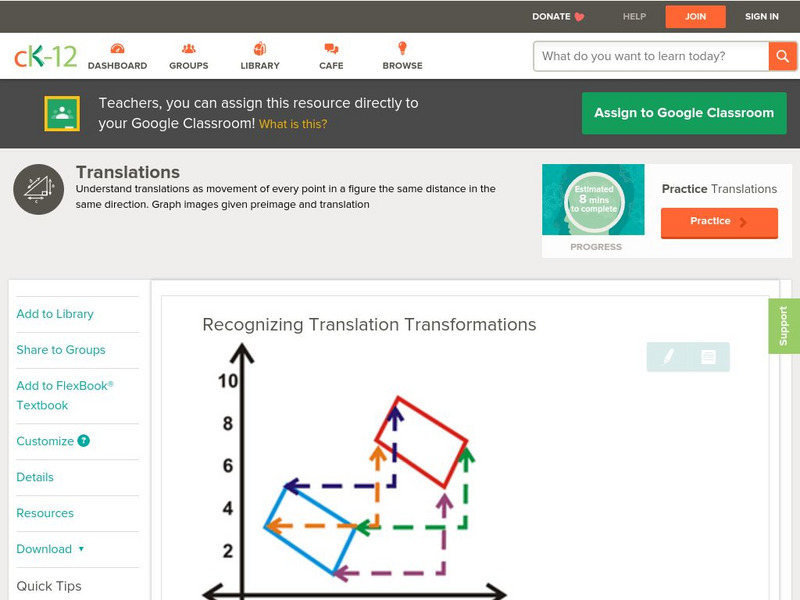
Ck 12: Geometry: Geometric Translations
[Free Registration/Login may be required to access all resource tools.] Recognizing translation transformations also called slides. Students can explore the concept of translations by studying notes, watching a video, looking at...
Better Lesson
Better Lesson: Coordinate Grid and Geometry
Students make connections between the coordinate grid and Geometry by finding the distance of line segments using the coordinate plane. This lesson includes a detailed lesson plan, slides containing notes and problems, and a...
Shodor Education Foundation
Shodor Interactivate: Lesson: Tessellations Geometry and Symmetry
This lesson plan deals with tessellations and their geometric concepts. Upper elementary and middle school young scholars will also explore polygons, symmetry, analyze patterns and explore the role of mathematics in nature and culture.
University of Cambridge
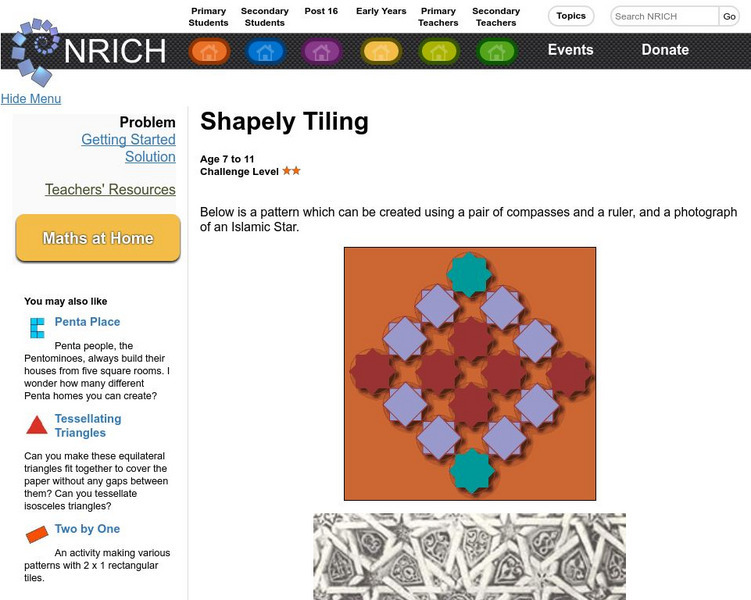
University of Cambridge: Nrich: Shapely Tiling
On this one page interactive website expand your logic, Motion Geometry and pattern recognition knowledge while working on this challenge. The solution is available to double check your solution.
University of Cambridge
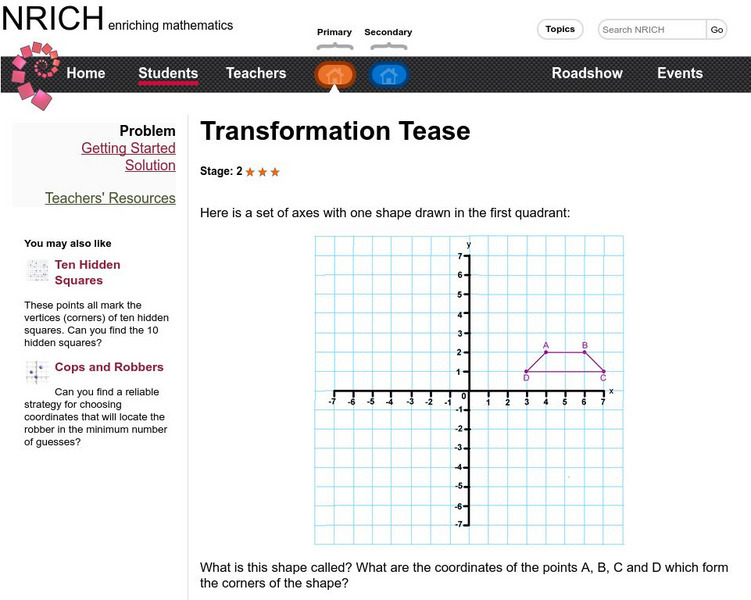
University of Cambridge: Nrich: Transformation Tease
Follow the directions at this one page website. You will get lots of practice plotting points on the coordinate grid and experience with transformational geometry.