Hi, what do you want to do?






Curated OER
Weightlessness
Students use a coffee cup to demonstrate weightlessness. After a lecture/demo, students read an article on free-fall. They perform a simple experiment which helps them explain the concept of weightlessness.

Curated OER
Newton's Laws: Making Simple Rockets
Students can use rocketry to understand Newton's Three Laws of Motion.

Curated OER
Constellations
Middle schoolers explore the major constellations. After reviewing the Earth's basic motions and their significance, students discuss the moon's orbit and revolutions. Using a Digitarium Alpha portable planetarium projector, they...

Curated OER
Exploring Pendulums
Middle schoolers observe the movement of pendulums, they begin to understand the relationship between gravitational forces and the mass of objects, the changes in speed and direction of objects, and the distance between objects. They...

Curated OER
Solar System: Let's Take a Trip
Third graders consider outer space. In this introductory solar system lesson, 3rd graders complete a KWL chart and listen to the story The Magic School Bus: Lost in the Solar System, by Joanna Cole & Bruce Degen. They will contribute...

Curated OER
Astronomy
Students complete a unit of lessons on our solar system, its stars, and astronomers. They record information in a space journal, design constellations, define key vocabulary, observe the phases of the moon, and create a group planet...

Curated OER
Kepler's Second Law
Students explore orbital velocities and how they vary along each orbit, according to Kepler's Second Law.

Curated OER
Kepler's Second Law
Students gain an understanding of Kepler's 2nd law--that planets (and satellites) move fastest at their closest approach to the center of attraction, and slow down when far away. They explore the concepts of "potential energy" and...

Curated OER
Falling
Students should describe the path that the motion would take as well as what might begin or stop the motion. The common characteristic of all the motions that students have experienced directly is that one or more forces are acting on...

NASA
Blinded by the Light!
Pupils learn of multiple ways astronomers look for planets outside of the solar system. By completing a hands-on activity, scholars discover that trying to see the planets directly because of the glare from the nearby star is nearly...

University of Colorado
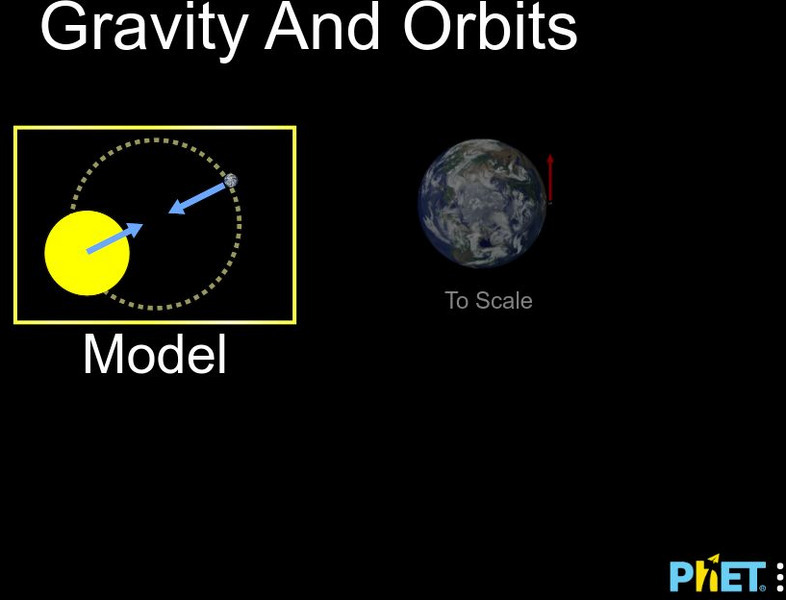
University of Colorado: Ph Et Interactive Simulations: Gravity and Orbits
An interactive simulation that teaches about gravitational force, circular motion, and astronomy by manipulating the sun, earth, moon, and a space station to observe the effects of gravity and orbital paths. This simulation can either be...
University of Colorado
University of Colorado: Ph Et Interactive Simulations: Gravity and Orbits
Move the sun, earth, moon, and space station to see how it affects their gravitational forces and orbital paths. Visualize the sizes and distances between different heavenly bodies, and turn off gravity to see what would happen without it.

Physics Classroom
The Physics Classroom: Satellite Motion
An animation depicting the path of projectiles launched at various launch speeds from the fictional Newton's Mountain. Accompanying text discusses satellite motion and the requirements of orbital motion. Links to further information is...
Physics Classroom
The Physics Classroom: Circular and Satellite Motion: Satellite Motion Math
In this interactive physics tutorial, students explore the variety of mathematical equations that describe the motion of satellites.
Physics Classroom
The Physics Classroom: Circular and Satellite Motion: Weightlessness in Orbit
Through illustrated examples and practice problems, this interactive physics tutorial helps students clear up their possible misconceptions about weightlessness.
Physics Classroom
The Physics Classroom: Circular and Satellite Motion: The Inverse Square Law
Through illustrated examples and interactive practice, students explore Newton's ability to relate the cause for heavenly motion (the orbit of the moon about the earth) to the cause for Earthly motion (the falling of an apple to the...
Physics Classroom
The Physics Classroom: Circular and Satellite Motion: Energy in Satellites
Through interactive practice problems and illustrated examples, students explore energy relationships for satellites.
NASA
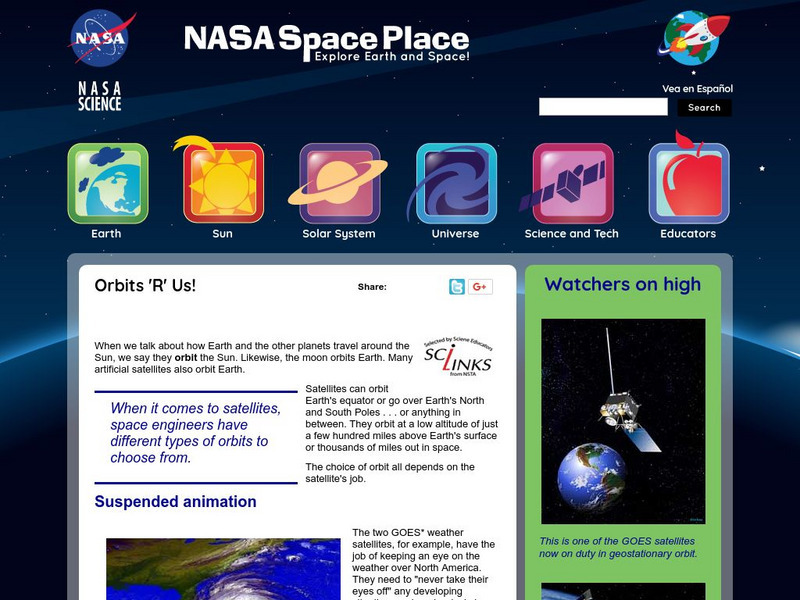
Nasa: The Space Place: Orbits 'R' Us
Learn about how Earth orbits the sun and how satellites orbit the Earth. Discover the different types of satellites such as GOES and POES and what they are used to monitor.
Texas Education Agency
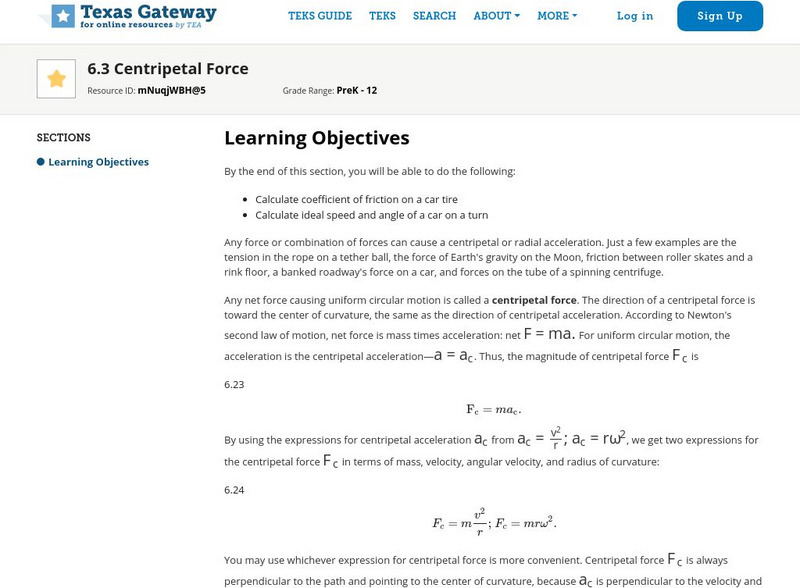
Texas Gateway: Uniform Circular Motion and Gravitation: Centripetal Forces
By the end of this section, you will be able to calculate coefficient of friction on a car tire and to calculate ideal speed and angle of a car on a turn.
CK-12 Foundation
Ck 12: Fifth Grade Science: Earth Science: Gravity
Do you know how gravity affects you? This module defines gravity and explains how gravity affects the motion of objects.

Cornell University
Cornell University: Astronomy: Orbital Motion and Kepler's Laws
At this site from the Astronomy Department of Cornell University, Kepler's three laws of planetary motion are stated. There are brief explanations of each, along with links to additional information on related subjects.
Georgia State University
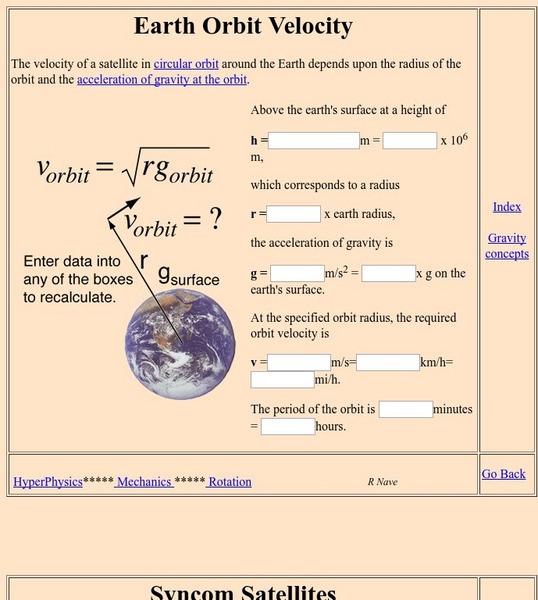
Georgia State University: Hyper Physics: Earth Orbit Velocity
A discussion and statement of an equation for orbital speed. An interactive JavaScript form allows the user to investigate the relationship between orbital height and orbital speed. A very good opportunity to practice and receive...

NASA
Nasa: Kepler and His Laws
This site from NASA provides biographical details about the lives of Tycho Brahe and Johannes Kepler. Discusses Kepler's successes at developing laws of planeatry motion. States the three laws and discusses each one individually....
Physics Classroom
The Physics Classroom: Circular Motion Principles for Satellites
From The Physics Classroom. Uses easy- to-understand language to discuss how circular motion principles apply to the motion of satellites. Describes the tangential velocity and centripetal acceleration of a satellite. Includes many...