Hi, what do you want to do?






Curated OER
Piglets
Students are asked have they ever seen a pig? They are asked what are young pigs called? Students are given the Pigs Display Sheet. They see that on the sheet there are two piglets and their mother. Students are told that mother pigs are...

Curated OER
Shake It Up!
Students shake a bottle of water to a CD of "Twist and Shout". They shake the bottle high, low, right, left, two hands, one hand, under the leg, etc.

Curated OER
Out Of Sight Air; Weather
Fourth graders conduct an experiment to get them thinking about the invisibility of air, and to prove that air has weight.

Curated OER
See It Settle
Students layer different types of soil in water. They are to keep a watch on how the soils react with one another in water.

Curated OER
Get the Dirt
Students investigate a variety of soil samples placed in cold water jars. Layers of soil are examined for the difference between organic matter and rock fragments.

Curated OER
Weighing In
Third graders use a Slinky, rubber bands, paper, coins and cups to experiment with weight and its relationship to gravity. They discuss their results and develop a consensus on conclusion statements derived from their experiments.

Curated OER
Flying the Friendly Skies
Students investigate aerodynamics by comparing and contrasting the flight of two gliders. They make prediction and observation charts and test a variety of hypotheses using paper gliders.

Curated OER
Clouds
Students explore the characteristics of clouds, their formation, symbols used in their identification, and the relationship of clouds to weather. The lesson focuses on how they are formed and their classification.

Curated OER
How Do Things Fall?
Students observe falling objects. They discover the rate of falling is based on air resistance and not the weight of the objects. They discuss how engineers use this type of information to design aerodynamic shapes.

Curated OER
Tower O'Power
Students work together to design a tower from a computer program. They manufacture the pieces with a laser cutter and compete in a competition to determine the best design for stress relief on towers. They discover the work engineers...

Curated OER
Bone Thickness
Students calculate the relative thickness of limb bones in five different species. They relate this to the strength and functions of the limbs by comparing and contrasting the values calculated from the bone measurements. They work in...

Curated OER
The Same But Different
Fourth graders identify the characteristics of a simple physical change. They describe objects by the properties of the materials from which they are made. Students discuss the different states of matter and their distinct physical...

Curated OER
Roller Coasters in the Classroom
Students define kinetic energy and know the effects of weight and speed on momentum. In this investigative lesson students get into groups and design a roller coaster.

Curated OER
ROLLER COASTERS IN THE CLASSROOM
Students define potential and kinetic energy and explain the relationship of height to potential energy. In this roller coaster lesson students construct a model of a roller coaster which will allow them to see the basic physical...

Curated OER
A Salty Experiment
Young scholars study salty and fresh waters. For this harbor estuary lesson students complete a lab activity on salinity and describe what happened.
Science and Mathematics Initiative for Learning Enhancement (SMILE)
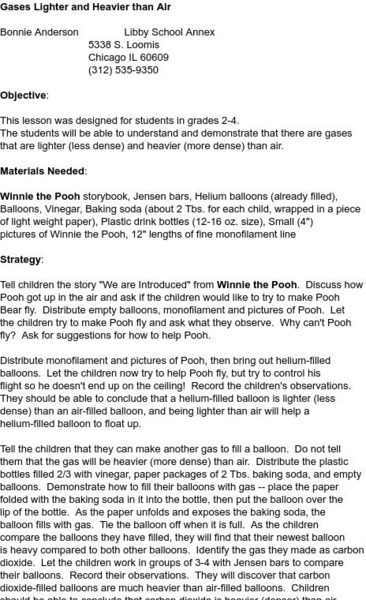
Smile: Gases Lighter and Heavier That Air
Teachers, to demonstrate to the elementary student that some gases are heavier than others, this experiment uses Winnie the Pooh and balloons to do just that.

E-learning for Kids
E Learning for Kids: Math: Amazon River Boat Trip: Mass
In this lesson, students will see which objects are heavier or lighter using the online arm balance.
Illustrative Mathematics
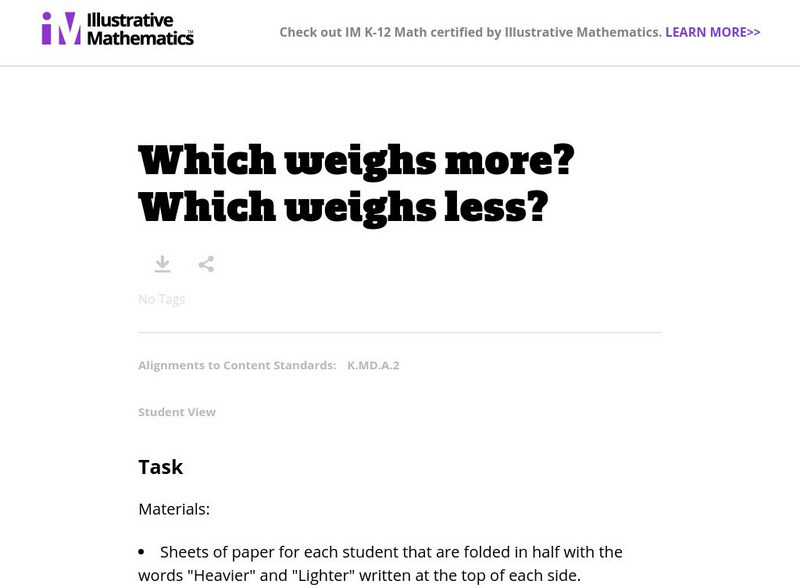
Illustrative Mathematics: Which Weighs More? Which Weighs Less?
Students will use a block to compare with other objects to decide which is heavier/lighter. They will fill in a chart by drawing a picture of it under "Heavier" or "Lighter" depending which applies.
Other
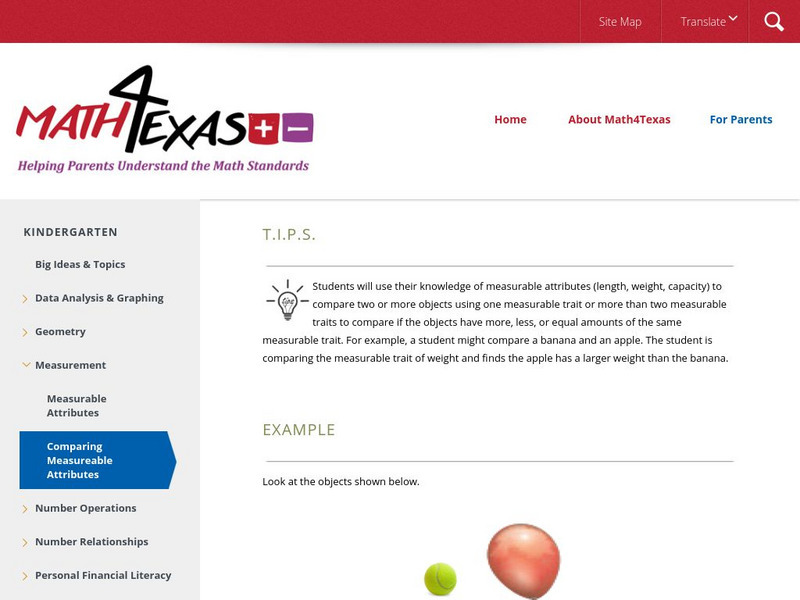
Math4 Texas: Comparing Measurable Attributes
Students will use their knowledge of measurable attributes (length, weight, capacity) to compare two or more objects using one measurable trait or more than two measurable traits to compare if the objects have more, less, or equal...

Physics Classroom
The Physics Classroom: Elephant and Feather: Air Resistance
The concept of air resistance is discussed in terms of why a heavier object falls faster than a lighter object when both dropped from the same height. In this discussion and animation, an elephant and feather are used as examples.

Concord Consortium
Concord Consortium: Stem Resources: Was Galileo Right?
Do heavier and lighter objects fall at the same rate? Galileo hypothesized that objects fall at the same rate regardless of their mass. Complete this module to find out if Galileo was right by comparing position-time and velocity-time...

TeachEngineering
Teach Engineering: How Do Things Fall?
Students learn that it is incorrect to believe that heavier objects fall faster than lighter objects. By close observation of falling objects, they see that it is the amount of air resistance, not the weight of an object, which...
Other popular searches
- Heavier Than Lighter Than
- Heavier and Lighter Objects
- Heavier or Lighter Objects
- Lighter and Heavier