Hi, what do you want to do?






Curated OER
What Teeth Tell Us
Students view pictures of a variety of animals. They examine the animals' teeth and discuss the differences in them. They experiment with staple removers (carnivore teeth) and two flat rocks (herbivore teeth) and determine which are most...

Curated OER
A Tooth for a Tooth
Learners classify mammals as carnivores or herbivores. They look at a set of pictures of animal skulls, observing the shape and size of the teeth, and identify herbivores and carnivores.

Curated OER
Skulls Tell It All
Skulls tell it all, and with this lesson plan, you will tell it all to your class! Youngsters view animal skulls, analyzing the shape of teeth and the placement of the eye sockets. They associate these adaptations with the types of food...

Curated OER
Animal Classification
Students watch video and slide shows as an introduction to animals. They discuss classifications of animals while moving from most common to least common of the animals. Types of classifications includes herbivores/carnivores;...

Curated OER
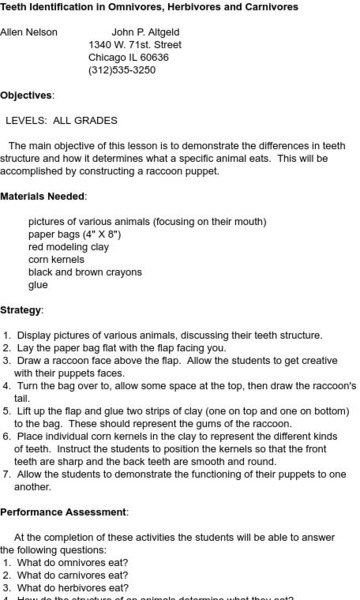
Teeth Identification in Omnivores, Herbivores and Carnivores
Students practice identifying teeth. In this biology lesson plan, students explore the differences in teeth structure and how it determines what a specific animal eats by constructing a raccoon puppet.

Curated OER
Dinosaur Paleoecology: Determining the Diet of Ancient Animals
Students study dinosaur teeth and bones to determine the creatures diet, size and shape.

Curated OER
Interdependence and Adaptation
Fifth graders construct a food web to illustrate how animals and plants are interdependent. For this interdependence lesson, 5th graders identify how consumers, producers, herbivores, carnivores and predators are related in a habitat....

Curated OER
Teeth and Eating
Students explore animal diets and teeth. For this animal science lesson, students view photos of animals and their teeth. Students identify the type of diet the animal has based on the teeth. Students are introduced to the terms...

Curated OER
Who Eats Who?
Students recognize that some animals eat plants, some eat meat and some both. In this who eats who lesson, students chart animals in a food chain. Students research information from reading articles. Students chart what...

Curated OER
Habitats
Students complete food chains for organisms in three environments. They use copies of the Habitat worksheet. Students review the food chain terms with the teacher. They research related food chains, and interlink these to form a food...

Curated OER
Interdependence and Adaptation
Pupils construct a food web to identify producer, consumer, herbivore, carnivore and predator. They complete an online activity collecting plants and animals and arranging them in the web. They describe the interdependence between plants...

Desert Discoveries
What's For Dinner?
Youngsters compare the teeth of plant-eating dinosaurs with those of meat-eating dinosaurs. The concepts of herbivore vs. carnivore are also introduced. There is an excellent worksheet embedded in the plan which shows five skulls of...

Curated OER
Skull Science
What can your class learn from a skull? With proper facilitation, they can learn about diet, physical adaptations, special differences, and even the environment. Pupils will examine a series of mammal skulls and pelts to help them...

Curated OER
What Animals Eat
First graders organize animals according to what they eat. They compare the teeth of plant eaters and meat eaters.

Curated OER
Wildlife Animal Skulls
Students observe skulls of wild animals and determine their characteristics for survival. They evaluate the skuylls to discover the diets, and if the animals were predators or prey. They complete worksheets on mystery skulls.

Curated OER
Survival Features
Third graders identify features of producers, herbivores and carnivores. They discuss the features that aid in survival for those animals. They organize animals into categories to complete the lesson.


Curated OER
Water's Edge Café
Learners observe water birds feeding at a local wetland, record what they see, and construct an appropriate menu for a "Waterfowl Cafe." They also play a "flocking" game.

Curated OER
Prairie Predator and Prey
Fifth graders brainstorm a list of animals that live on the prairie, and classify them as predators and prey. They conduct interviews where they ask the animals what they need to look out for to sustain life on the prairie.

Curated OER
What Do We Learn From Fossils?
Students investigate what a fossil is and how it came to be. In this fossil lesson, students examine pictures of skeletons and identify characteristics that can and cannot be determined by a fossil. Students complete diagrams...

Curated OER
How Big is a Dinosaur?
Fourth graders create enlarged replica of a stegosaurus drawing, using a grid to practice coordinates.

Curated OER
Learn About Dinosaurs
Students read facts about dinosaurs and then participate in a variety of dinosaur activities. In this dinosaur lesson plan, students paint dinosaur eggs, play dinosaur bingo, and more.
Science and Mathematics Initiative for Learning Enhancement (SMILE)
Smile: Teeth Identification in Omnivores, Herbivores and Carniv
In this lesson plan, students make puppets out of paper bags and use corn to give their animal (dinosaur, raccoon, etc.) the correct type of teeth based on the animal's diet.