Hi, what do you want to do?






American Museum of Natural History
Differentiate! The Stem Cell Card Game
Let the games grow. Groups play a card game to grow cells. Players start growing cells from stem cells to create specialized cells in the human body. Learners use full-grown cells from the human body to create stem cells in the lab to...

Open Colleges
Your Brain Map: Strategies for Accelerated Learning
The brain is a complex organ with many different structures and functions. An interactive diagram allows learners to explore the different structures while pop-ups describe their functions. Secondary interactives show the structures of...

Howard Hughes Medical Institute
Central Dogma and Genetic Medicine
Scientists work every day to find solutions to genetic diseases. Scholars learn about the process of gene sequencing, mutations, and the results. They explore genetic diseases and therapies to intervene and help and, through case...

Curated OER
Classification of Life
For this classification of life worksheet, students use an on line source to answer questions about how species are classified, named and grouped. They give the classification of a bear, an orchid and a sea cucumber.
Cells Alive
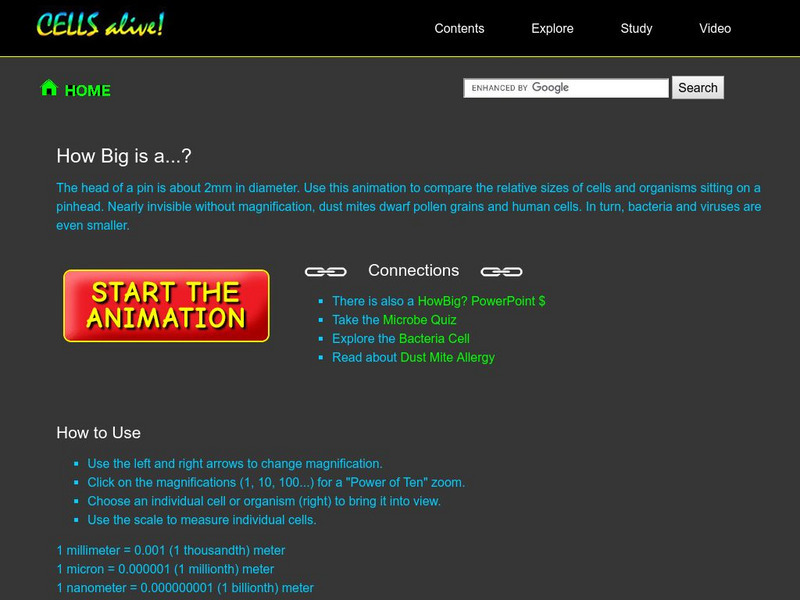
Cells Alive!: How Big Is A
"Use this animation to compare the relative sizes of cells and organisms sitting on a pinhead. See the size of these nearly invisible without magnification" View dust mites dwarf pollen grains and human cells. In turn, bacteria and...

South Carolina Educational Television
Etv: Kids Work!: Hospital: Medical Lab Technician
Follow this interactive to identify the differences between bacteria and viruses. Look through the lens of a microscope to observe how each functions and impacts humans.