Hi, what do you want to do?






Core Knowledge Foundation
The Human Body—Systems and Senses Tell It Again!™ Read-Aloud Anthology
Nine lessons over three weeks explore the human body through read-alouds. Third graders listen to and discuss a reading followed by extension activities, including word work and comprehension practice. Learners draft a narrative essay.

Amnesty International
Respect My Rights, Respect My Dignity: Module One – Poverty and Human Rights
Creating an environment where learners feel both educated and empowered challenges any teacher when discussing a sometimes bleak topic. A respectful resource provides them with the details and permits them to make a plan of action....

New York City Department of Education
Grade 5 Literacy in Science: Ecosytems
How do humans affect ecosystems? Learners read two articles and interpret a graph to develop essays on the human impact on ecosystems. They read about human impact on tigers and manatees as a basis for their overarching papers.

Mathematics Vision Project
Module 3: Arithmetic and Geometric Sequences
Natural human interest in patterns and algebraic study of function notation are linked in this introductory unit on the properties of sequences. Once presented with a pattern or situation, the class works through how to justify...

National Endowment for the Humanities
American Diplocmacy in World War II
The end of World War II saw the world deeply changed over the last few years. Four thorough lessons explore post-war Europe, America, and Asia through reading assignments and discussion questions about the Grand Alliance and the signing...

Penguin Books
Teacher's Guide: Kindred by Octavia E. Butler
A teacher's guide for Kindred provides instructors with a wealth of materials to enrich either a full-class reading or independent study of Octavia E. Butler's popular science fiction novel. The activities are designed to...

Curated OER
Early Presidents
Students are introduced to the lives and contributions of the first seven presidents of the United States. They, in groups, conduct further research on one of these president and his political platform and design a presentation for the...

Curated OER
News to the Core Reported by Very Special Students
Students create news articles that help them build their knowledge, skills, and academic confidence. In this special education lesson, students use previous knowledge to write a newsletter and demonstrate their understanding of various...
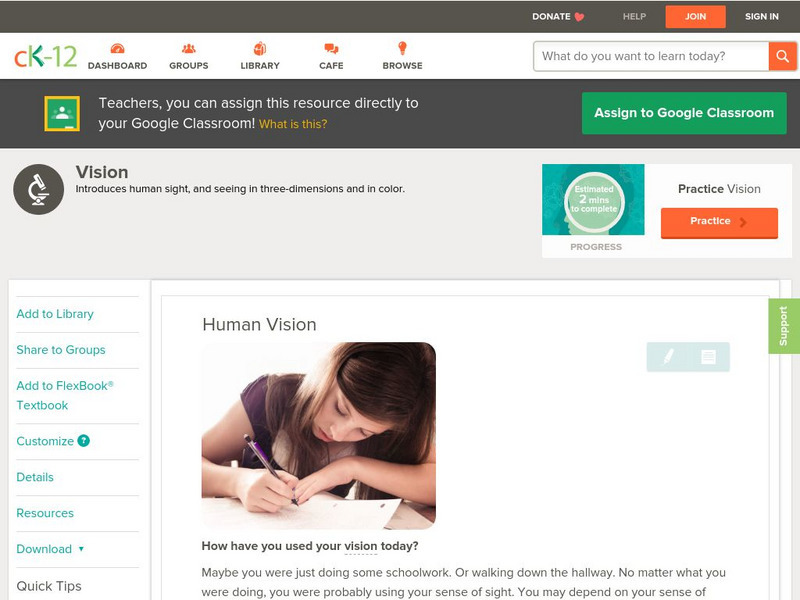
CK-12 Foundation
Ck 12: Life Science: Human Vision
[Free Registration/Login may be required to access all resource tools.] Sight, or vision, is the ability to see light. It depends on the eyes detecting light and forming images. It also depends on the brain making sense of the images, so...
TED Talks
Ted: Ted Ed: The Evolution of the Human Eye
The human eye is an amazing mechanism, able to detect anywhere from a few photons to a few quadrillion, or switch focus from the screen in front of you to the distant horizon in a third of a second. How did these complex structures...
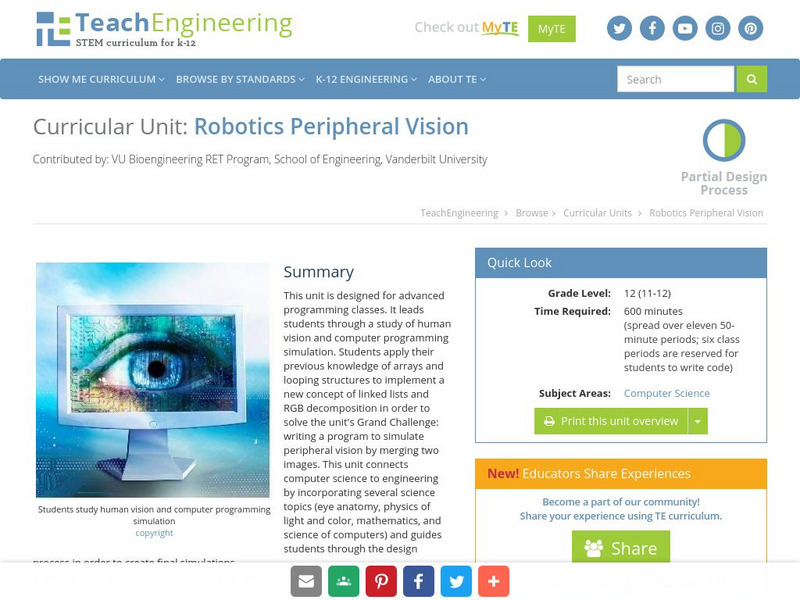
TeachEngineering
Teach Engineering: Robotics Peripheral Vision
This unit is designed for advanced programming classes. It leads students through a study of human vision and computer programming simulation. Students apply their previous knowledge of arrays and looping structures to implement a new...
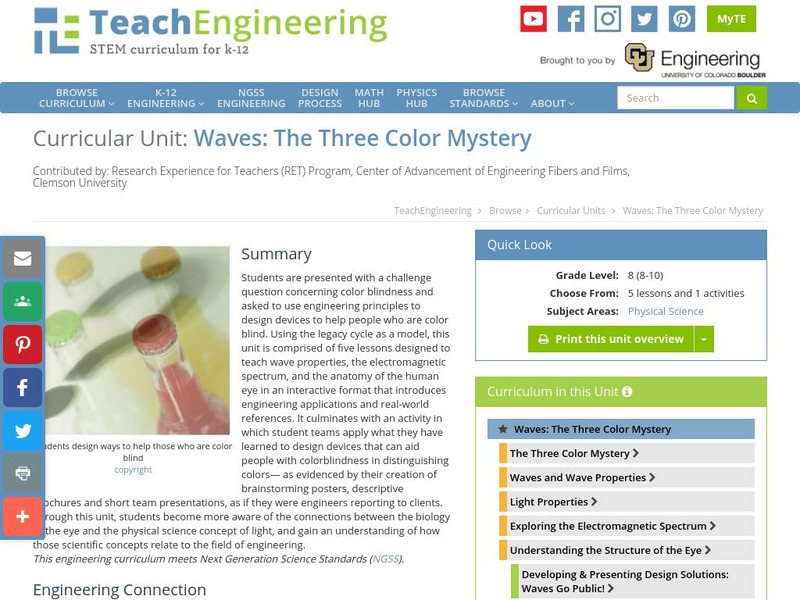
TeachEngineering
Teach Engineering: Waves: The Three Color Mystery
Students are presented with a challenge question concerning color blindness and asked to use engineering principles to design devices to help people who are color blind. Using the legacy cycle as a model, this unit is comprised of five...
Georgia Department of Education
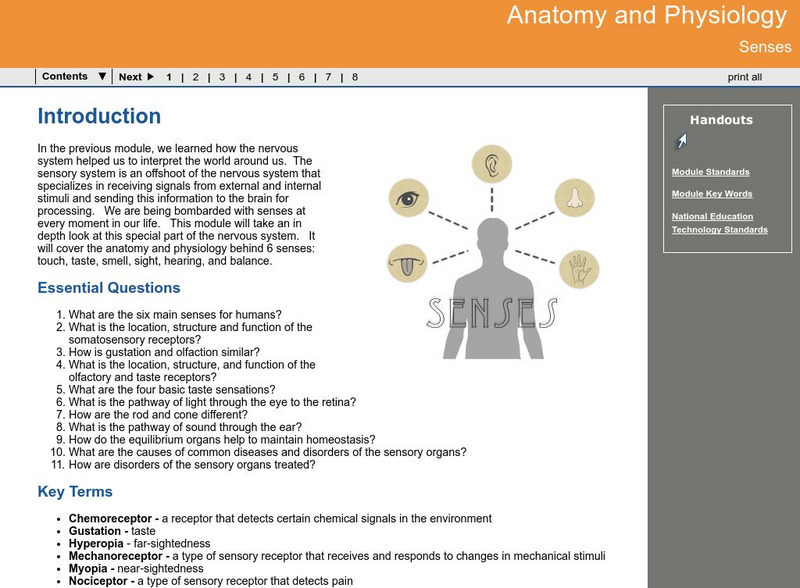
Ga Virtual Learning: Anatomy and Physiology: Senses
Through informational text with printable notes, animations, video clips, and practice problems students discover the function of the sensory structures in the human body.
TED Talks
Ted: Ted Ed: How We See Color
There are three types of color receptors in your eye: red, green and blue. But how do we see the amazing kaleidoscope of other colors that make up our world? The following learning module explains how humans can see everything from...
TED Talks
Ted: Ted Ed: How Do Animals See in the Dark?
To human eyes, the world at night is a formless canvas of grey. Many nocturnal animals, on the other hand, experience a rich and varied world, bursting with details, shapes, and colors.Anna Stockl uncovers the science behind night...

PBS
Pbs Learning Media: Collection: Becoming Helen Keller
Rediscover the complex life and legacy of the author, advocate and human rights pioneer. Helen Keller (1880-1968), who was deaf and blind since childhood, used her celebrity and wit to advocate for social justice, particularly for women,...
SEDL
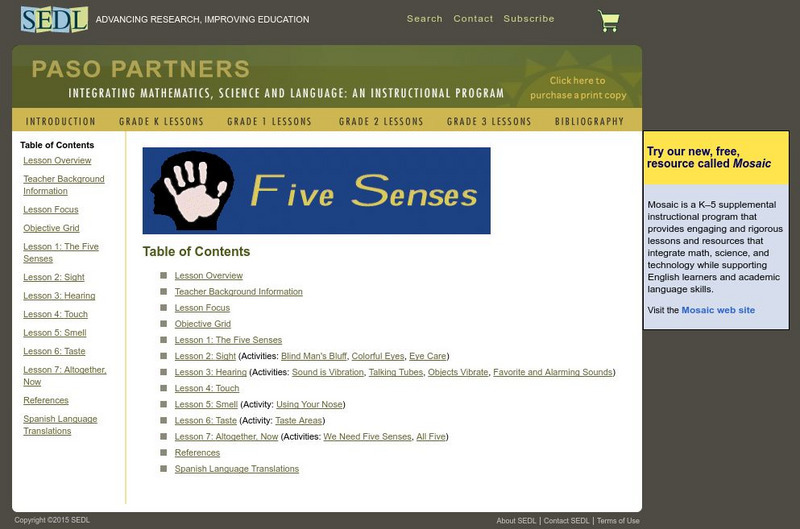
Sedl: Five Senses
Elementary students will gain great insight into the workings of our five senses through this collection of detailed, integrated lesson plans for grades K-3. Each lesson contains a list of needed materials, hands-on explorations...