Hi, what do you want to do?






Let's Tute
Understanding Reflection of Light in Plane Mirrors
This video explains the technical process behind the formation of images in plane mirrors, and justifies the characteristics of those images. It covers the laws of reflection, the formation of point images, and the fact that the image in...
Let's Tute
Light Reflection in a Plane Mirror
This video explains the science behind reflection in plane mirrors, including the formation of virtual and real images, lateral inversion, and the properties of upright and erect images. It also includes an activity to identify letters...
Curated Video
Images Plane Mirror
This video focuses on where and why plane mirrors are used and image formation. Students will come to understand that plane mirrors form virtual images, and that that image is the same size as the object it reflects and is as far behind...
Be Smart
The Magic (and Mystery) of Mirrors
How many times do you look in a mirror every day? Have you ever stopped to wonder how they actually work? Mirrors do strange things to our world, seemingly flipping everything so that what was right is left and what was left is right....
Bozeman Science
Ray Diagrams - Mirrors
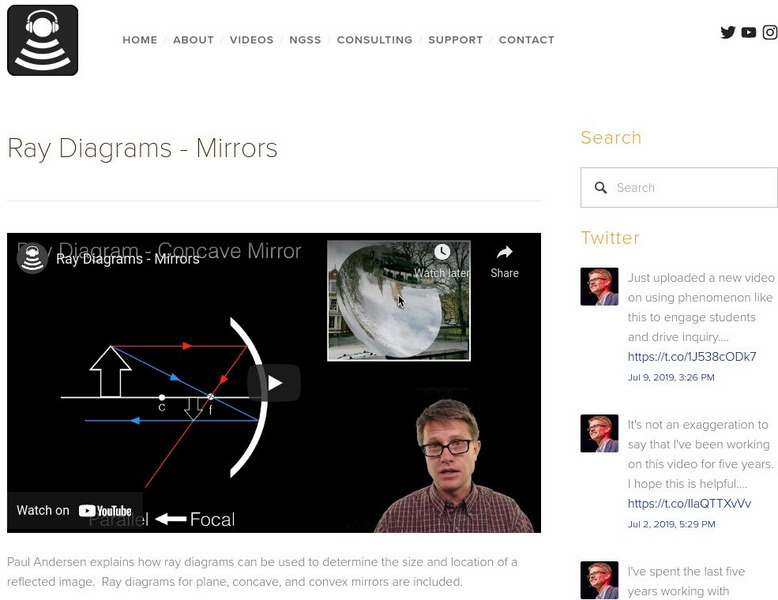
In this video Paul Andersen explains how ray diagrams can be used to determine the size and location of a reflected image. Ray diagrams for plane, concave, and convex mirrors are included.
Curated Video
Reflections: The Mathematical Flip
In this video lesson we will learn how to reflect images in the coordinate plane over the x and y axis. We will first identify the line of reflection given in the instructions. We will then determine the distance the original point is...
Curated Video
Reflected images
Pupil outcome: I can describe and explain the properties of reflections in a plane mirror, and draw diagrams to show how reflections form. Key learning points: - Reflections are the same size as the object, upright, and the same distance...
Curated Video
Optical Isomerism: The Chemistry of Mirror Images
Optical isomerism occurs in molecules that are chiral, meaning they cannot be superimposed on their mirror images. These isomers, known as enantiomers, differ in their optical activity—they rotate plane-polarized light in opposite...
Professor Dave Explains
Organization and Symmetry in Kingdom Animalia
How are the contents of animals organized? How does this differ from animal to animal? Are all animals symmetrical, and in the same ways? Just a bit more information to get through before diving into all the animal phyla, I promise!
Curated Video
Reflections The Mathematical Flip
This video lesson is the second video in the playlist or unit of videos on transformations. The first video explained translations. This video explains reflections as the mathematical flip over the line of reflection. Real world...
Curated Video
Focus
In optics, the point at which rays of light converge after refraction or reflection, and so the point at which a sharp image will be produced. A Twig Science Glossary Film. Key scientific terms defined in just 60 seconds using stunning...
Curated Video
Biphenyls & Optical Isomerism: When Planes Matter
Biphenyls are compounds consisting of two benzene rings connected by a single bond. In certain biphenyls, bulky substituents on the ortho positions of the rings can prevent free rotation around the bond, locking the rings in different...
Curated Video
Finding the Axis of Symmetry and Vertex of a Quadratic Function
In this video, you will learn how to find the axis of symmetry and vertex of a quadratic function by solving part of the quadratic formula. The axis of symmetry is a vertical line that divides the graph into two symmetrical parts, while...
Curated Video
Lactic Acid: A Case Study in Chirality
Lactic acid (2-hydroxypropanoic acid) is a classic example of a chiral molecule. It contains a chiral center at the second carbon atom, bonded to a hydroxyl group (-OH), a hydrogen atom, a carboxyl group (-COOH), and a methyl group...
Crash Course
Stereochemistry - Crash Course Organic Chemistry
The shape of molecules is super important to life as we know it. In this episode of Crash Course Organic Chemistry we’re learning about stereochemistry and how to identify molecules as chiral or achiral. And as always, we’ll be doing a...
Curated Video
Allenes and Optical Activity: A Surprising Twist!
Allenes are compounds with a unique structure characterized by two adjacent double bonds (C=C=C). Despite having no traditional chiral centers, certain substituted allenes can exhibit chirality and optical activity due to their rigid,...
Curated Video
Symmetry and Optical Activity: Do Your Molecules Have It?
Symmetry and optical activity are intricately linked in organic molecules. A molecule is optically active if it can rotate the plane of polarized light. Optical activity arises from the molecule’s lack of symmetry—specifically, its...
Curated Video
Conditions for Optical Activity: When Molecules Twist Light
For a molecule to exhibit optical activity, it must be chiral, meaning it has no internal plane of symmetry. Additionally, the solution or compound should not contain equal amounts of enantiomers (racemic mixture), as these cancel out...
Curated Video
Stereoisomerism: Unlocking the Secrets of Molecular Twins
Stereoisomerism refers to isomers that have the same molecular formula and connectivity but differ in the three-dimensional arrangement of their atoms. This type of isomerism includes both geometrical isomers and optical isomers....
NASA
The Doubly Warped World of Binary Black Holes
A pair of orbiting black holes millions of times the Sun’s mass perform a hypnotic dance in this NASA visualization. The movie traces how the black holes distort and redirect light emanating from the...

Curated OER
Physics 11.1.2a - Image Formation
Derek Owens sketches as he teaches image formation in a plane mirror. When you look at an image in a mirror, it appears as if it is behind the mirror. Mirrors create a virtual image as opposed to a real image. This educational resource...

Curated OER
What is a Line of Reflection?
Line of reflection is basically a geometry term used in the transformation of figures. It identifies the line on the graph that you reflect a figure over. The line can be vertical, horizontal, and diagonal. Actually, it can be any line...

Curated OER
What is a Reflection?
There are many ways to transform geometric figures. This lesson will illustrate how to reflect figures over a line to get a mirror image of the figure. The teacher will draw three different reflections: one as reflected over the y-axis,...
Bozeman Science
Bozeman Science: Physics: Ray Diagrams Mirrors
In this video, Paul Andersen explains how ray diagrams can be used to determine the size and location of a reflected image. Ray diagrams for plane, concave, and convex mirrors are included. [11:44]