Hi, what do you want to do?






EngageNY
An Appearance of Complex Numbers 2
Help the class visualize operations with complex numbers with a lesson that formally introduces complex numbers and reviews the visualization of complex numbers on the complex plane. The fifth installment of a 32-part series reviews...

EngageNY
Complex Number Division 1
Conjugating in the math classroom — and we're not talking verbs! The seventh lesson in a series of 32 introduces the class to the building blocks of complex number division. During the instruction, the class learns to find the...

EngageNY
An Appearance of Complex Numbers 1
Complex solutions are not always simple to find. In the fourth lesson of the unit, the class extends their understanding of complex numbers in order to solve and check the solutions to a rational equation presented in the first lesson....

EngageNY
Complex Numbers as Vectors
Show your math class how to use vectors in adding complex numbers. Vectors represent complex numbers as opposed to points in the coordinate plane. The class uses the geometric representation to add and subtract complex numbers and...

EngageNY
The Geometric Effect of Some Complex Arithmetic 2
The 10th lesson in a series of 32, continues with the geometry of arithmetic of complex numbers focusing on multiplication. Class members find the effects of multiplying a complex number by a real number, an imaginary number, and another...

EngageNY
Complex Number Division 2
Individuals learn to divide and conquer complex numbers with a little help from moduli and conjugates. In the second instructional activity on complex number division, the class takes a closer look at the numerator and denominator of the...

EngageNY
Exploiting the Connection to Trigonometry 1
Class members use the powers of multiplication in the 19th installment of the 32-part unit has individuals to utilize what they know about the multiplication of complex numbers to calculate the integral powers of a complex...

EngageNY
End-of-Module Assessment Task — Precalculus (Module 1)
A transformational assessment determines how far pupils are advancing toward mastering complex and matrix standards. The assessment checks the learners' understanding of linear transformations, complex numbers and the complex plane,...

EngageNY
Mid-Module Assessment Task - Precalculus (module 1)
Individuals show what they know about the geometric representations of complex numbers and linearity. Seventeen questions challenge them to demonstrate their knowledge of moduli and operations with complex numbers. The assessment is...

EngageNY
The Geometric Effect of Some Complex Arithmetic 1
Translating complex numbers is as simple as adding 1, 2, 3. In the ninth lesson in a 32-part series, the class takes a deeper look at the geometric effect of adding and subtracting complex numbers. The resource leads pupils into what it...

Illustrative Mathematics
Complex number patterns
Start off with the definition of the imaginary number i, then have your class practice simplifying expressions involving powers of i and look for patterns. See how the cyclic nature of powers of i translate to sums of powers of i.

Illustrative Mathematics
Assessing Counting Sequences Part II
Access the instructional counting level of your class by prompting them to recall consecutive numbers within a given number range. Working one-on-one with your students and starting with the number range of 1-10, and working toward the...

Khan Academy
Khan Academy: Simplify Roots of Negative Numbers
Rewrite square roots of negative numbers as imaginary numbers.
Khan Academy
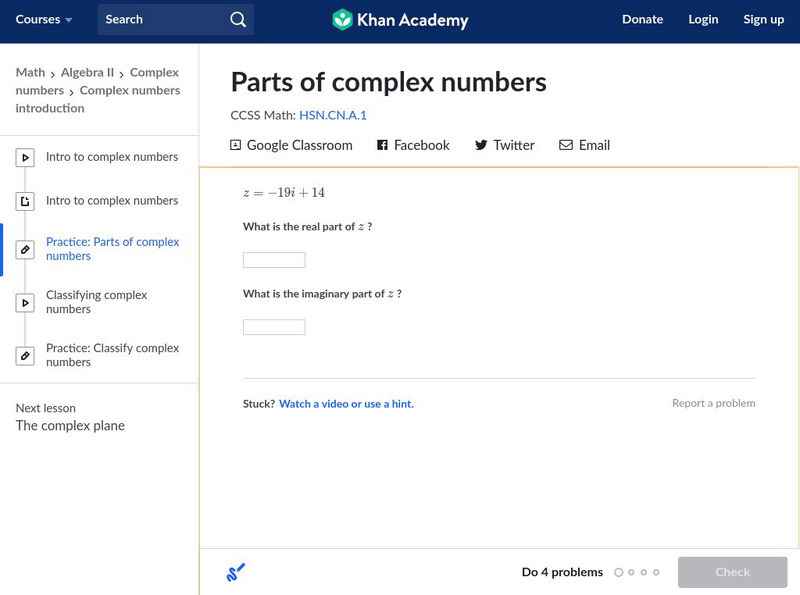
Khan Academy: Parts of Complex Numbers
Determine the real and the imaginary parts of complex numbers. Students receive immediate feedback and have the opportunity to try questions repeatedly, watch a video or receive hints.
Khan Academy
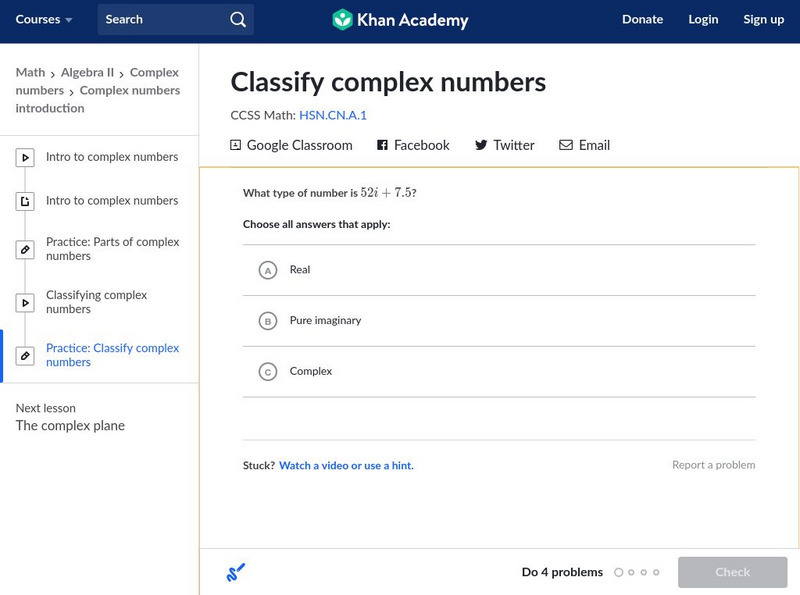
Khan Academy: Classify Complex Numbers
Classify numbers as real, pure imaginary, or complex. Students receive immediate feedback and have the opportunity to try questions repeatedly, watch a video or receive hints.

Khan Academy
Khan Academy: Classify Complex Numbers
Classify numbers as real, pure imaginary, or complex.

Khan Academy
Khan Academy: Parts of Complex Numbers
Determine the real and the imaginary parts of complex numbers.
Khan Academy
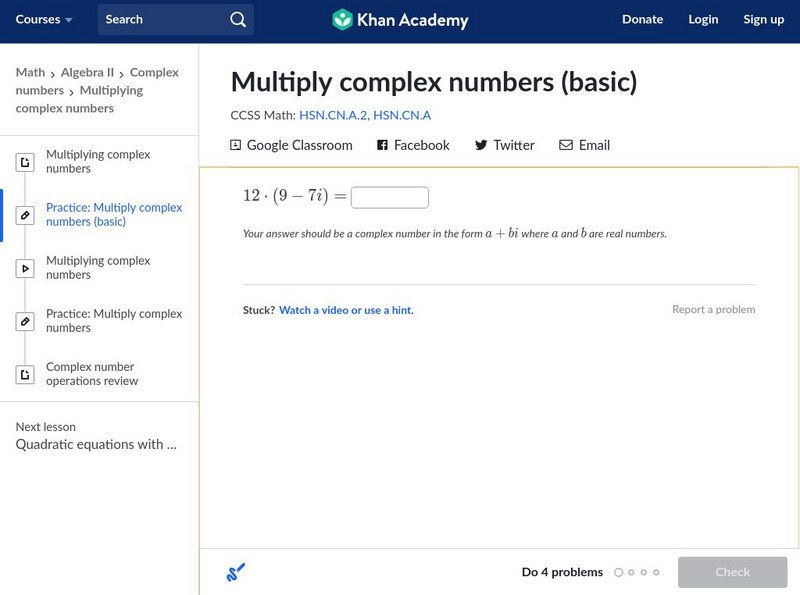
Khan Academy: Multiply Complex Numbers (Basic)
Multiply complex numbers by single terms that are either real or imaginary. Students receive immediate feedback and have the opportunity to try questions repeatedly or receive hints.

Khan Academy
Khan Academy: Multiply Complex Numbers (Basic)
Multiply complex numbers by single terms that are either real or pure imaginary.

Khan Academy
Khan Academy: Powers of the Imaginary Unit
Simplify expressions with base i (the imaginary unit) raised to a positive exponent.
Other popular searches
- Imaginary Numbers Quadratic
- Imaginary Numbers I
- Algebra Imaginary Numbers
- Math Whit Imaginary Numbers
- Algebra 2 Imaginary Numbers
- Complex Imaginary Numbers
- Adding Imaginary Numbers
- Math Wiht Imaginary Numbers
- Dividing Imaginary Numbers