Hi, what do you want to do?






Independence Hall Association
U.s. History: Britain in the New World: Joint Stock Companies
A very good explanation of how early English settlements were financed, and why the English government refused to invest in such ventures. See who led such companies, who were willing to go to the New World, and why English colonies were...
Independence Hall Association
U.s. History: Gold in California
The gold rush in California accelerated the western migration of thousands of young American men, who streamed into California to find riches. See who else arrived in California and find out what they did. In addition, there is a map...
Independence Hall Association
U.s. History: Harriet Beecher Stowe Uncle Tom's Cabin
Harriet Beecher Stowe threw gas on the fire of the slavery issue with the publication of her novel, Uncle Tom's Cabin. Read about her background as an abolitionist, and find out the influence her book had in the North and even in Great...
Independence Hall Association
U.s. History: The Underground Railroad
A brief look at the Underground Railroad and how it operated. Find some of the code words used to help runaway slaves find their way, and read about some of the "conductors" who led slaves along the routes to the North.
Independence Hall Association
U.s. History: African American Abolitionists
Read about three African-American abolitionists who worked alone and in concert with white abolitionists. The most radical was David Walker, who was the founder of radical abolitionism.
Independence Hall Association
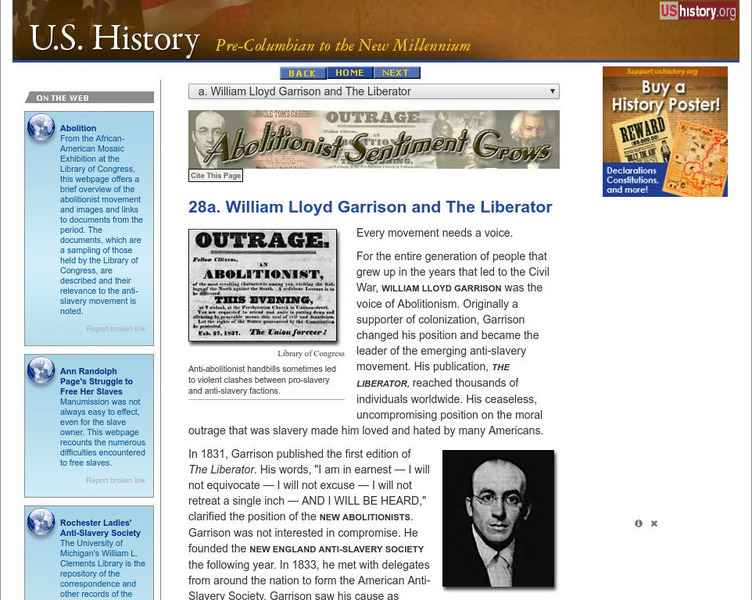
U.s. History: William Lloyd Garrison and the Liberator
Read a good biography of William Lloyd Garrison, who was one of the new, radical abolitionists who thought slavery was absolutely immoral and should be ended immediately. He was the publisher of the abolitionist newspaper, The Liberator....
Independence Hall Association
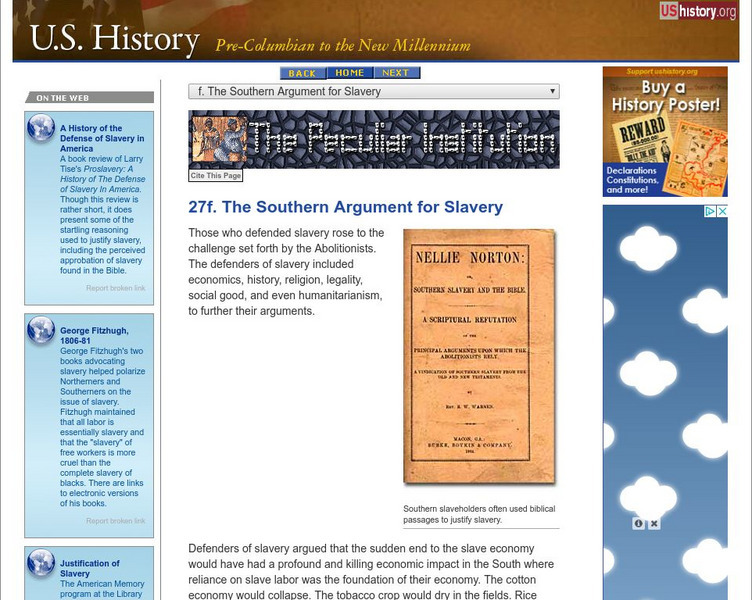
U.s. History: The Southern Argument for Slavery
In order to convince oneself that owning another was defensible, Southerners aruged that there were economic, religious, historical, and legal reaons that slavery was a good thing. Read about some of these justifications in more detail,...
Independence Hall Association
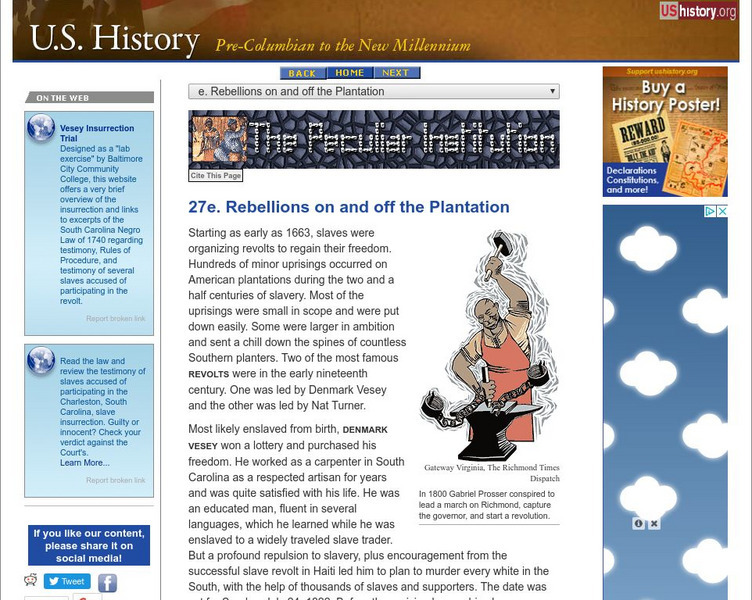
U.s. History: Rebellions on and Off the Plantation
Slaves resisted their bondage in many ways. Read about the revolts planned and executed by Denmark Vesey and Nat Turner, the southern reactions to those revolts, and the ways slaves individually resisted their enslavement.
Independence Hall Association
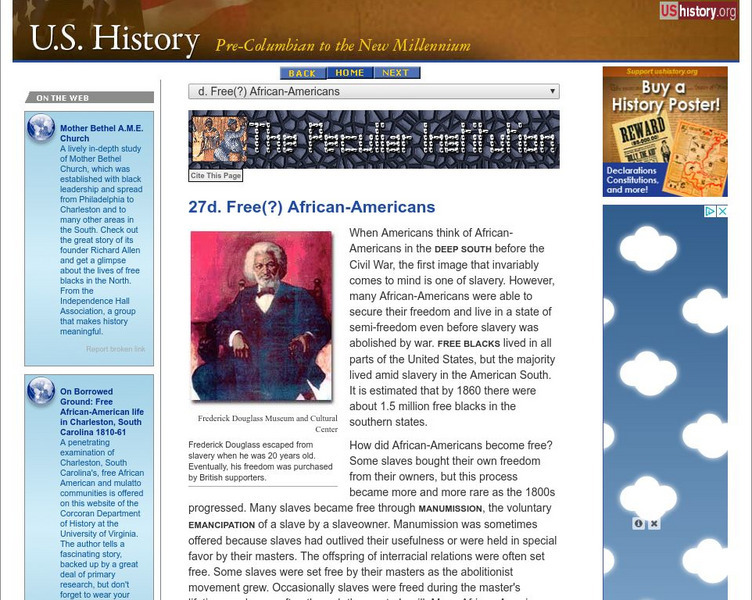
U.s. History: Free (?) African Americans
Not all African-Americans were slaves in the South. Some were freed by their owners, others escaped, but none had the same rights as free whites. Read about their restrictions that were put into law. Find out about the church...
Independence Hall Association
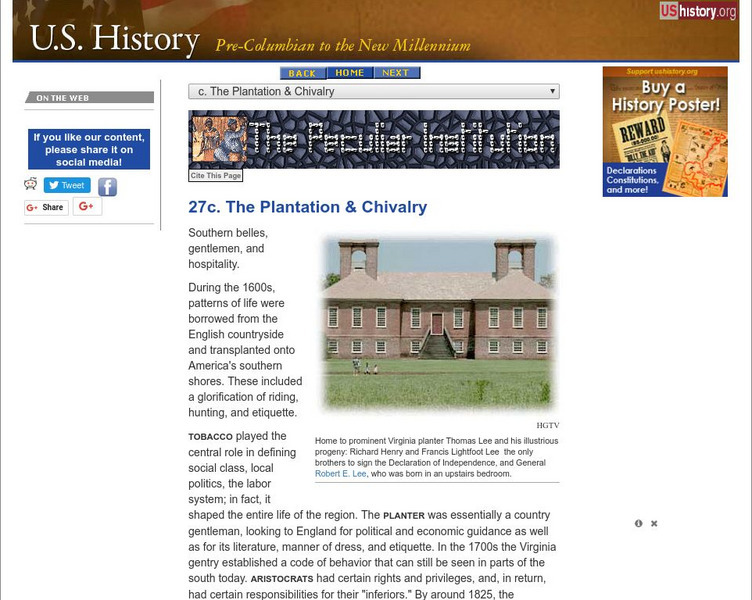
U.s. History: The Plantation and Chivalry
The Southern way of life fostered a social code of chivalry and genteelism. Read about what was considered honorable and proper for both aristocratic men and women.
Independence Hall Association
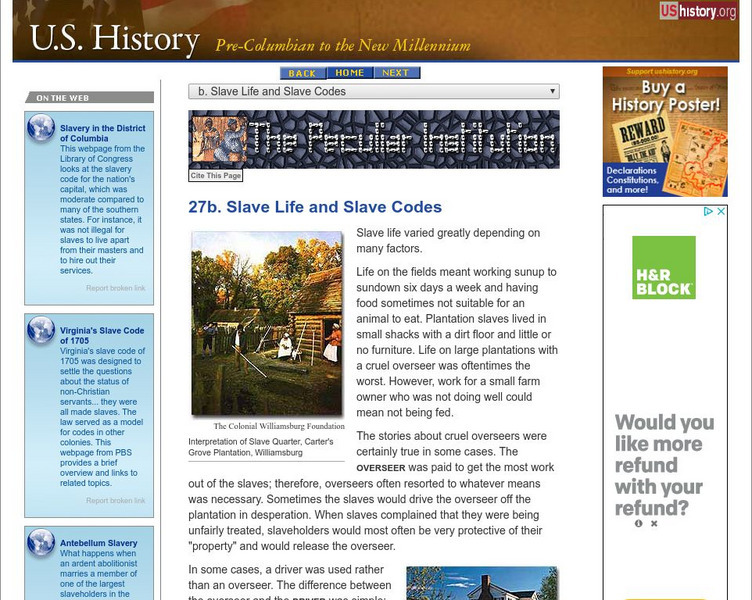
U.s. History: Slave Life and Slave Codes
A description of what life was like for slaves on plantations in the South. See the difference in treatment betwee field slaves and domestic slaves. and find examples of laws enacted under slave codes in several states.
Independence Hall Association
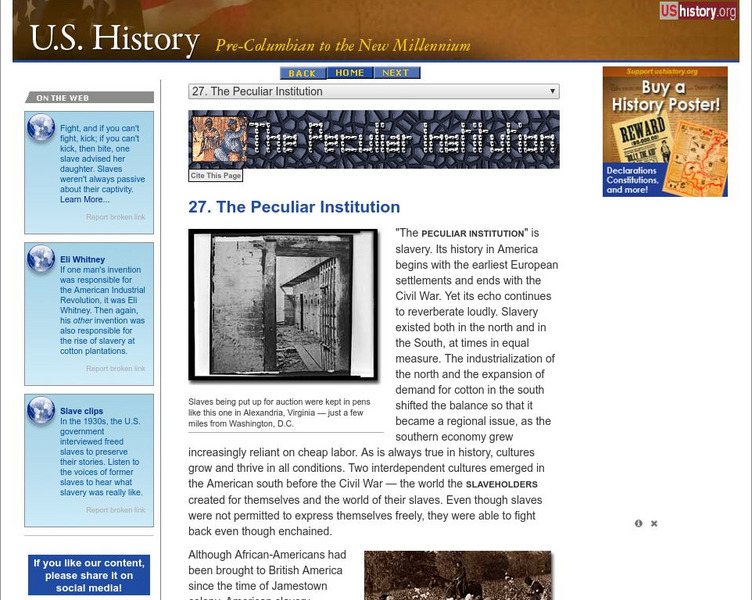
U.s. History: The Peculiar Institution
A very brief look at the "Peculiar Institution" of slavery in the South before the Civil War. Read about how slavery became so entrenced and why it drove a wedge between the North and South.
Independence Hall Association
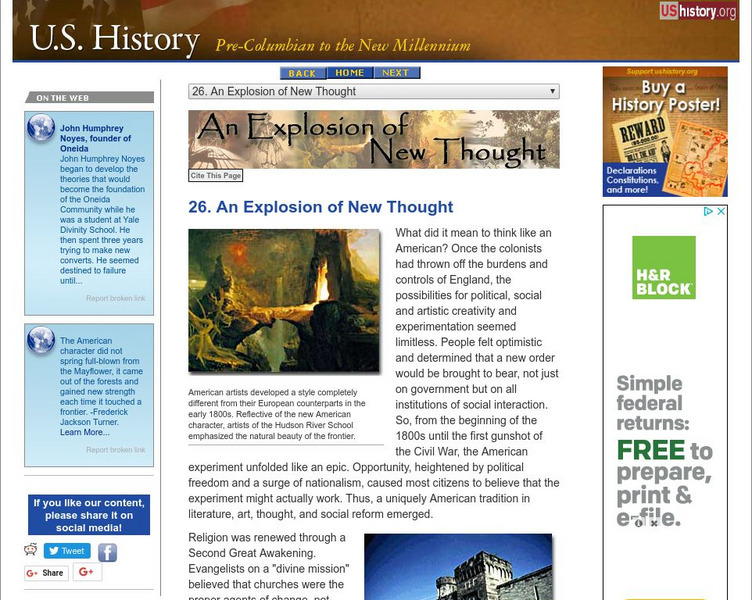
U.s. History: An Explosion of New Thought
The 19th century brought an Americanization of literature, art, thought, and social reform. Read about how the Second Great Awakening brought a revival in religion and sparked reform movements in suffrage, slavery, and treatment of...

Independence Hall Association
U.s. History: The Emergence of "Women's Sphere"
The Cult of Domesticity and the Women's Sphere pertained to upper-middle class white women, but the ideals spread out into American culture. Read about how such women were supposed to behave, and see what privileges these women might...
Independence Hall Association
U.s. History: The First American Factories
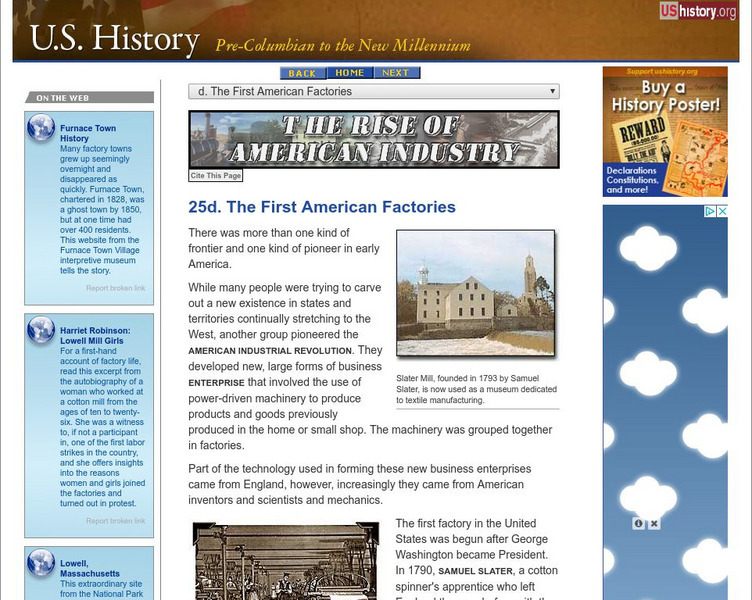
The growth of cities and the American economy in the first half of the 19th century was driven by the growth of factories. Read about the textile industry in New England and how manufacturing spread throughout the north.
Independence Hall Association
U.s. History: Early American Railroads
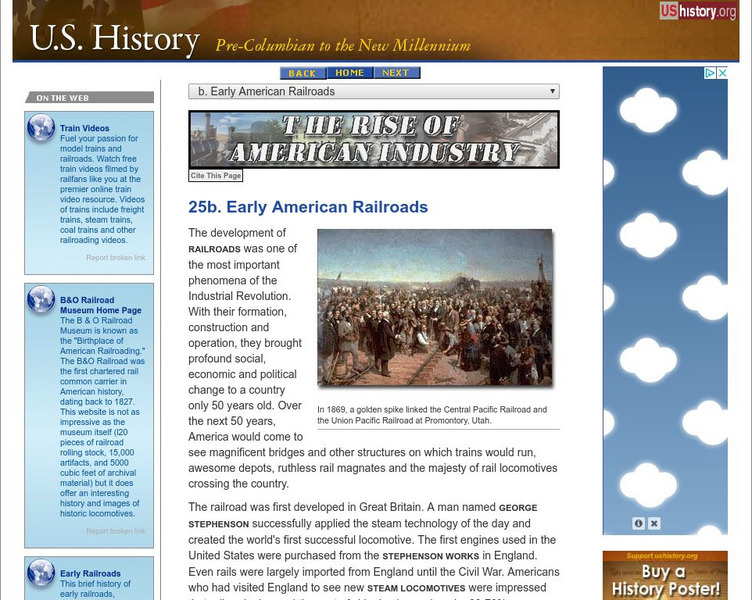
Read about the growth of railroads throughout the eastern part of the United States, which greatly reduced transportation costs. See why there was opposition to railroads from many groups. Be sure to look at the stereograph of the...
Independence Hall Association
U.s. History: The Canal Era
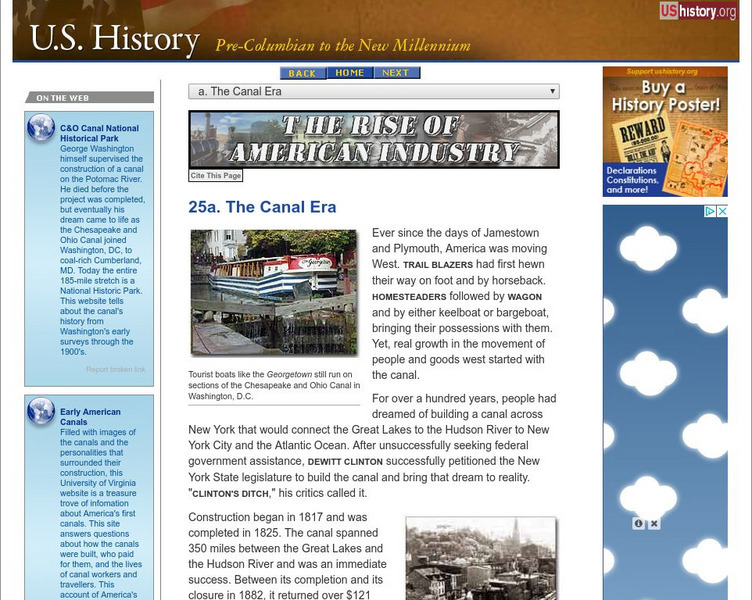
See how the building of canals in New York, Pennsylvania, and Ohio not only opened up the west by making travelling easier and joining western territories to northern states, but also transformed cities from small burgs to major...
Independence Hall Association
U.s. History: The Rise of American Industry
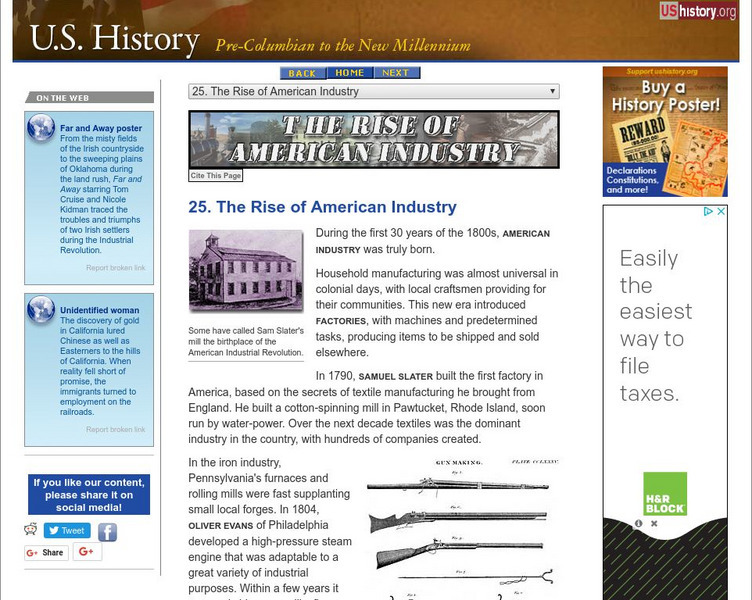
The Industrial Revolution came to America, smuggled in by Samuel Slater, who brought plans for a cotton-spinning mill. See how the growth of industry led to the growth of corporations, the growth of the nation geographically, and the...
Independence Hall Association
U.s. History: Jackson vs. Clay and Calhoun
Two very important politicians in the Age of Jackson were Henry Clay and John C. Calhoun. Andrew Jackson detested both for personal and political reasons. Read about the relationship between these two men individually and Andrew Jackson.

Independence Hall Association
U.s. History: Age of Jackson: The Rise of the Common Man
Describes how Andrew Jackson emerged as the first populist president to appeal to the common man.
Independence Hall Association
U.s. History: John Quincy Adams
John Quincy Adams was an enigmatic figure. Find out about the progressive ideas he had for the federal government under his presidency, but also read some quotes about how he felt about true democracy.
Independence Hall Association
U.s. History: The 1824 Election and the "Corrupt Bargain"
The two-party system in presidential elections fell apart in the election of 1824. See what happened when five men, all from the Democratic-Republican Party, ran against each other. Find out why the choice of John Quincy Adams was called...
Independence Hall Association
U.s. History: The Missouri Compromise
A good look at the issues debated about the admission of new states, particularly those that would be made from the Louisiana Purchase. Read about why the issue of allowing slavery in the new states was such a hard decision for Congress....
Independence Hall Association
U.s. History: The Era of Good Feelings and the Two Party System
The Era of Good Feelings lasted about a decade, spanning the administration of James Monroe. Read about the policies followed during his administration, and find out why, after the demise of the Federalist Party, there arose another...