Hi, what do you want to do?






Curated OER
The Science of Tsunamis: Seeking Understanding in the Wake of Tragedy
Pupils use Internet research, articles, discussion and models to explore the dynamics of a tsunami. They focus on the 2004 Asian Tsunami and create posters illustrating their understanding of this phenomenon.

Curated OER
Tsunami - Five Years On
Young scholars explore the issues of rebuilding after the Indonesian tsunami. In this reconstruction lesson, students investigate the reconstruction that followed the devastating event.

Curated OER
Ocean Planet: Sea Secrets
Students identify ocean features and draw a profile using data points on a map. Through discussion and research, they discover the importance of oceanography and plot a profile of the ocean floor in search for a vessel full of precious...

Curated OER
Bank on it! Worksheet
For this sentence completion worksheet, students fill in the blanks to a paragraph about a tsunami with words in a word bank. Students fill in 20 words.

Curated OER
Waves Lesson Plan
Students demonstrate an understanding of tsunamis and possible causes. In this investigative lesson students view a video and explore earthquakes and movement of tectonic plates.

Curated OER
How Did This Happen?
Students use websites and discussion to investigate the 2004 Asian Tsunami. Students identify the Indian Ocean coastline's physical, political and human geography features and consider how they affected loss of life and property in those...

Curated OER
Disaster Strikes
Students examine the devastation caused by the tsunami of 2005. In this current events lesson, students consider the effects of natural disasters as they research tsunamis and the worldwide response to the December 26, 2005 tsunami....

Curated OER
The Tell-Tale Plume
High schoolers examine hydrothermal vents. In this ocean lesson, students identify changes in physical and chemical properties of sea water caused by hydrothermal vents.

Curated OER
Hunt the Fact Monster #30
In this search engine worksheet, 3rd graders will need to use factmonster.com to discover answers. Students will respond to 10 short answer questions using the given website.

Curated OER
The Chemosynthetic Cafe
High schoolers study photosynthesis and chemosynthesis. In this chemosynthetic lesson students explain the processes of these and define terms.

Curated OER
A Hydrothermal Adventure
Students analyze hydrothermal vents. In this hydrothermal vents lesson plan, students discover the effects of hydrothermal vents on tectonic plates. Students make model hydrothermal vents to understand how they form and operate.

Curated OER
Learning from history: can it save lives?
Students research and document lessons learned from this disaster, then compile and synthesize information. They write effectively for public education purposes and use visual communications tools

Curated OER
Erosion: Slip Sliding Away
Fourth graders investigate the causes of erosion. Through several demonstrations including one using sugar cubes and warm water, they observe the effects of erosion. In groups, 4th graders conduct similar experiments and record their...

Curated OER
Production Possibilities & Opportunity Cost
In this economics instructional activity, 12th graders respond to 15 multiple choice questions about production possiblities and opportunity costs.

University of Southern California
Usc Tsunami Research Center: The Indian Ocean Tsunami December 26, 2004
Captivating coverage of the 2004 tsunami disaster. Find a firsthand account, many photos, and a map. (The videos and animations were no longer working at the time of writing this.)

The Guardian
Guardian: Indian Ocean Tsunami Disaster
A Special Report from the Guardian provides the latest news and reports from the tsunami-afflicted countries. Includes animation of the tsunami.
Food and Agricultural Organization of the United Nations
Food and Agriculture Org.: Tsunami Reconstruction
The waves have retreated, but what lies in the destruction zone and how do people put their lives back together? The Food and Agriculture arm of the UN lists updates on the reconstruction going after the 2004 Indian Ocean tsunami.
Columbia University
Scientific Background on the Indian Ocean Earthquake and Tsunami
This site features information and related links that can be used by students and scientists to understand the events that led to the December 2004 Indian Ocean tsunami.
Other
Oxfam International: 2004 Indian Ocean Tsunami [Pdf]
This web page offers information on Oxfam's program to aid those impacted by the 2004 tsunami in South Asia. PDF
PBS
Wave That Shook the World
This resource focuses on the December 26th Indian Ocean tsunami. It explains the anatomy of the Indian Ocean tsunami, as well as what is being done to prepare for future tsunamis. In addition, it shows potential hot spots for future...

Woods Hole Oceanographic Institution
Woods Hole Oceanographic Institution: Tsunami: An Interactive Guide
A complete, interactive learning activity covering the science of tsunamis, preparedness, research, and historical tsunamis. Excellent animations and real, historical recordings of survivors allow the learner to experience what happens...
NPR: National Public Radio
Npr: Tsunami Devastates Asian Nations
The main page for NPR coverage of the Asian Tsunami of December, 2004. Stories from Sri Lanka, India, Thailand, as well as coverage on other aspects of this disaster. 12/2004
PBS
Pbs: Anatomy of a Tsunami
Scientists used maps and seismic data to produce a computer simulation that accurately shows the creation of the wave that shook the world. In this interactive, examine some of the models and images that reveal details of the tsunami...
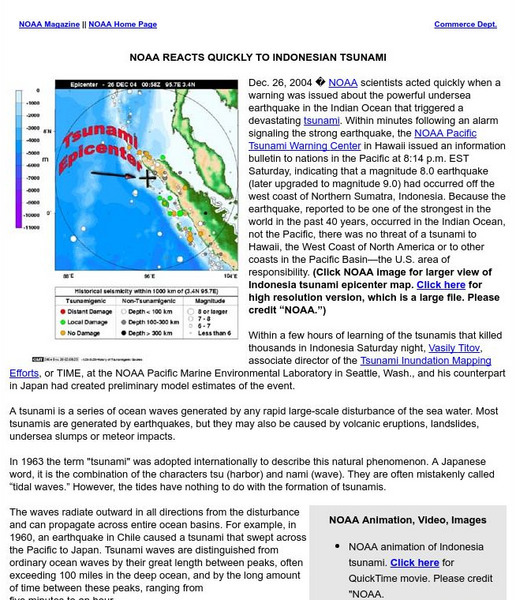
NOAA
Noaa: Reacts Quickly to Indonesian Tsunami
NOAA discusses its reaction to the tsunami that rocked South Asia in 2004 and gives a scientific explanation to why it happened. Interesting animated map of the tsunami.