Hi, what do you want to do?






Rainforest Alliance
Who Takes Care of the Maya Forest Corridor?
Who keeps animals safe? Who keeps us safe? Discover the helpers that make learning and growing possible through a medley of activities that focus on habitats—ours and those in the rainforest. Scholars are asked to identify one...

College Board
AP® English Language Special Focus: Using Sources
What is the most effective way to teach scholars how to write a research paper? Educators explore the topic with the AP® English Language and Composition exam resource. The reference material guides teachers in best practices for...

Vanderbilt University
Healthy Bodies for Boys
Create an inclusive space for scholars to gain milestone information about their growing bodies with a unit designed to meet the needs of learners with disabilities. Topics include the onset of puberty, hormones, hygiene, and more!...

College Board
Is That an Assumption or a Condition?
Don't assume your pupils understand assumptions. A teacher resource provides valuable information on inferences, assumptions, and conditions, and how scholars tend to overlook these aspects. It focuses on regression analysis, statistical...

New York State Education Department
TASC Transition Curriculum: Workshop 11
You'll C-E-R a difference in classroom achievement after using a helpful lesson. Designed for economics, civics, government, and US history classes, participants practice using the CER model to craft arguments about primary and secondary...

New York State Education Department
TASC Transition Curriculum: Workshop 10
How have educational standards evolved? Educators of adults examine expectations in the 10th workshop out of 15 to better determine how standards have grown. Participants respond to a variety of sample questions to determine how they...

EngageNY
TASC Transition Curriculum: Workshop 12
How can opinions slant facts? Workshop participants learn how to examine primary and secondary sources and identify the author's point of view. They also examine how visual art impacts the meaning and rhetoric of sources. Full of...
Colorado State University
Csu Writing Guides: Working in Groups
Resource includes helpful advice and information about working together and writing in groups (collaborative writing). Provides nodes on such topics as purpose, ideas, decision-making, and more.
Education Development Center
Making Mathematics: Mathematics Research Teacher Handbook: Getting Information
Information for teachers on teaching students how to research and write on mathematical topics. Includes tips for active reading, researching online and journal sources, and conducting interviews to gather information.
AdLit
Ad lit.org: Analytical Writing in the Content Areas
Because writing is thinking, the organization of students' writing reflects both the structure of their thinking and the depth of their understanding. Students should be writing in all their classes, explaining what they know and how...
LD Online
Ld Online: Your Child's Iep: Practical and Legal Guidance
A complete and extensive parent guide to the IEP process, laws and regulations, and components of an IEP. The article provides pages of information on IEP's, and serves as an excellent reference for parents.
AdLit
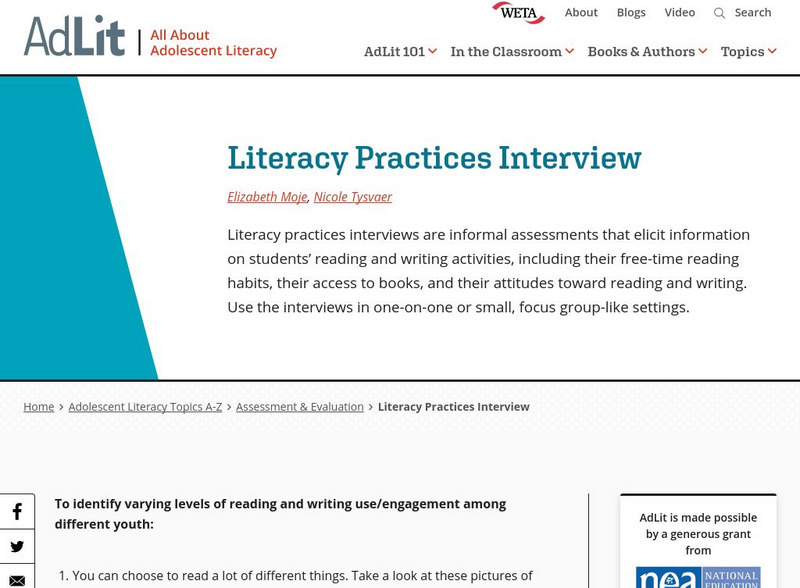
Ad lit.org: Literacy Practices Interview
Literacy practices interviews are informal assessments that elicit information on students' reading and writing activities, including their free-time reading habits, their access to books, and their attitudes toward reading and writing....
LD Online
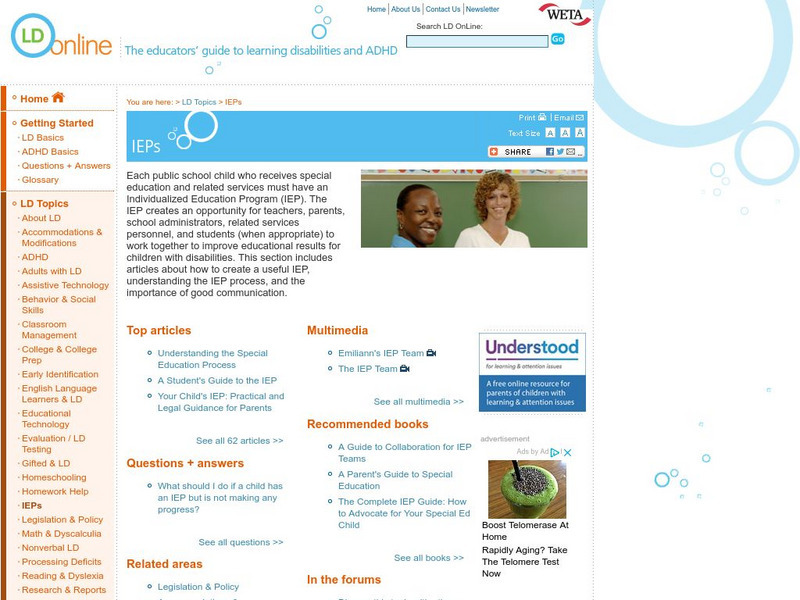
Ld Online: Ie Ps
The Educational Resources Information Center provides a guide to writing the IEP. Beginning with the child's evaluation results, and also including specific information about the child's needs and goals.
AdLit
Ad lit.org: Engaging Family & Community in Afterschool and Summer Programs
Informal literacy experiences often serve to shape young people's identity as readers and writers as much as or more than formal schooling.Community and family support can emphasize the importance of reading and writing, build...
AdLit
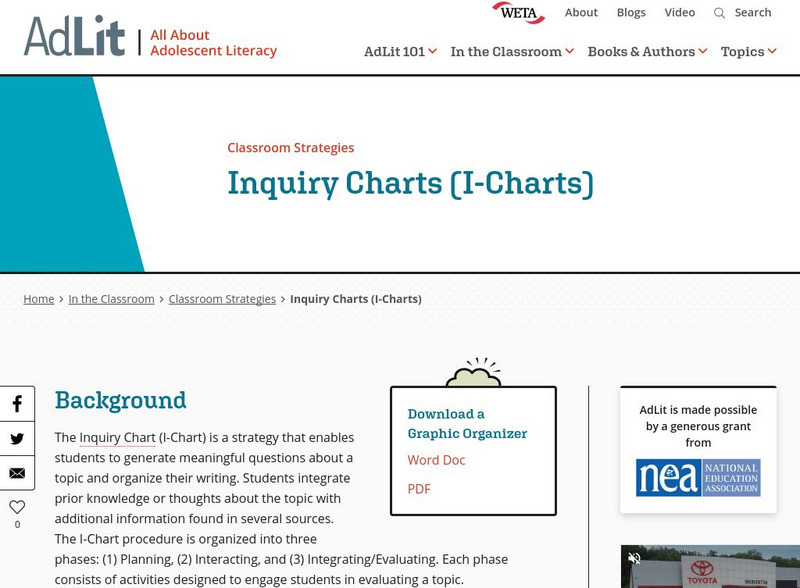
Ad lit.org: Classroom Strategies: Inquiry Charts (I Charts)
The Inquiry Chart (I-Chart) is a strategy that enables students to generate meaningful questions about a topic and organize their writing. Students integrate prior knowledge or thoughts about the topic with additional information found...