Hi, what do you want to do?






Other
Ccsso: The Interstate Teacher Assessment and Support Consortium (In Tasc)
The Interstate Teacher Assessment and Support Consortium (InTASC) is a consortium of state education agencies and national educational organizations dedicated to the reform of the preparation, licensing, and on-going professional...
TeachEngineering
Teach Engineering: Energy Conversions
Students evaluate various everyday energy conversion devices and draw block flow diagrams to show the forms and states of energy into and out of the device. They also identify the forms of energy that are useful and the desired output of...
TeachEngineering
Teach Engineering: Catching the Perfect Sar Waves!
Students learn the importance of the Pythagorean theorem as applied in radar imaging. They use a sensor unit with IRED (infrared emitting diode) to measure triangle distances and the Pythagorean theorem to calculate and verify distances....
TeachEngineering
Teach Engineering: I Can't Take the Pressure!
Students develop an understanding of air pressure by using candy or cookie wafers to model how it changes with altitude, by comparing its magnitude to gravitational force per unit area, and by observing its magnitude with an aluminum can...
TeachEngineering
Teach Engineering: Dripping Wet or Dry as a Bone?
Students use a sponge and water model to explore the concept of relative humidity and create a percent scale.
TeachEngineering
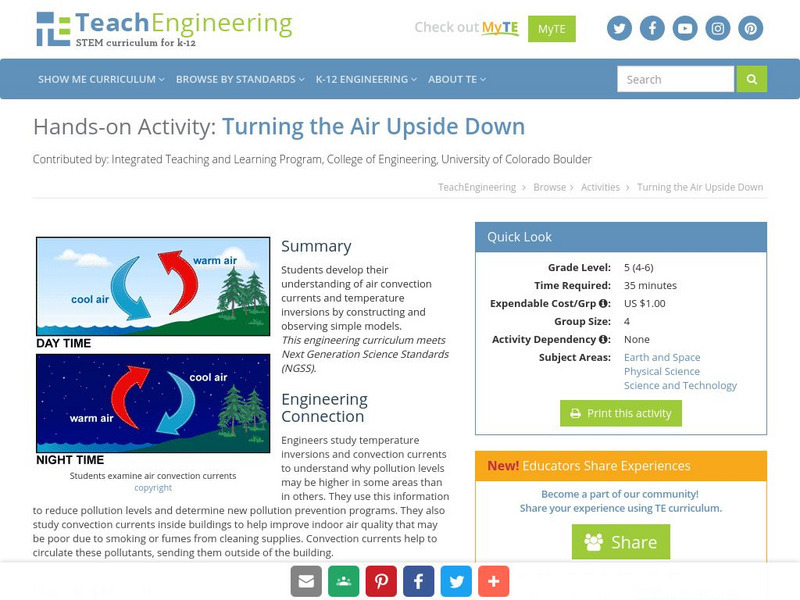
Teach Engineering: Turning the Air Upside Down
Students develop their understanding of air convection currents and temperature inversions by constructing and observing simple models.
TeachEngineering
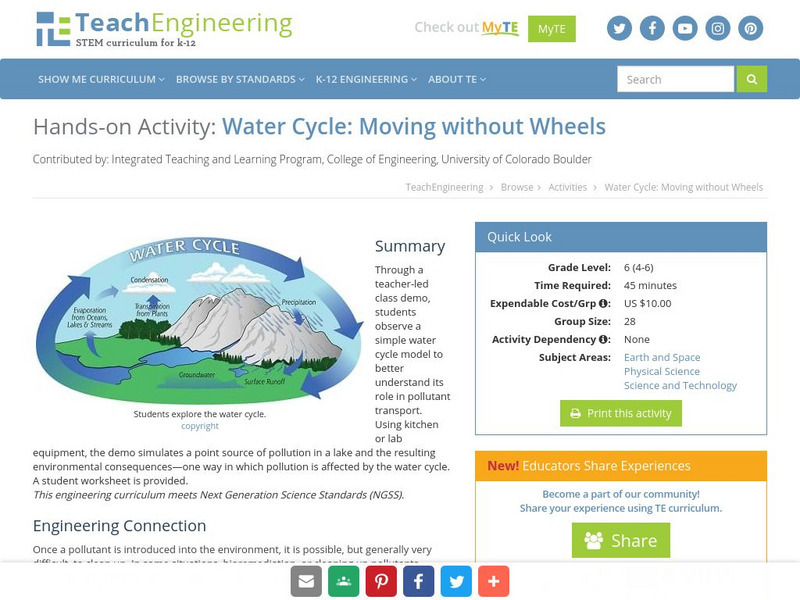
Teach Engineering: Moving Without Wheels
In a class demonstration, students observe a simple water cycle model to better understand its role in pollutant transport. This activity shows one way in which pollution is affected by the water cycle; it simulates a point source of...
TeachEngineering
Teach Engineering: Hot Stuff!
Students observe demonstrations, and build and evaluate simple models to understand the greenhouse effect and the role of increased greenhouse gas concentration in global warming.
TeachEngineering
Teach Engineering: Battling for Oxygen
Using gumdrops and toothpicks, students conduct a large-group, interactive ozone depletion model. Students explore the dynamic and competing upper atmospheric roles of the protective ozone layer, the sun's UV radiation and harmful...
TeachEngineering
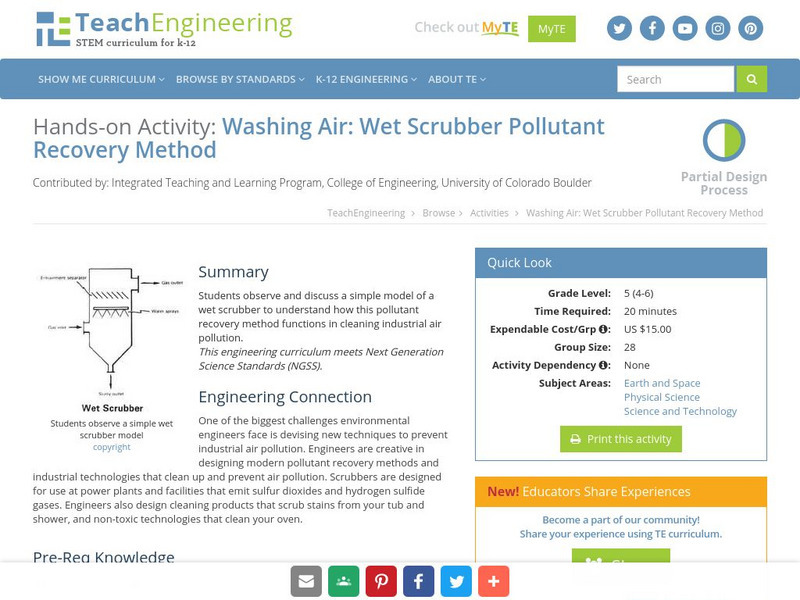
Teach Engineering: Washing Air
Students observe and discuss a simple model of a wet scrubber to understand how this pollutant recovery method functions in cleaning industrial air pollution.
TeachEngineering
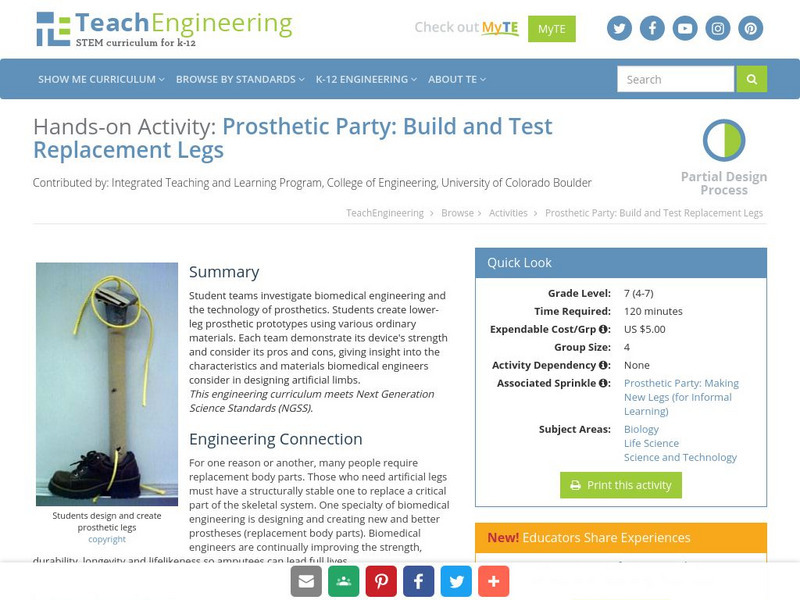
Teach Engineering: Prosthetic Party
Student teams investigate biomedical engineering and the technology of prosthetics. Students create a model prosthetic lower leg using various materials. Each team demonstrate its prosthesis' strength and consider its pros and cons,...
TeachEngineering
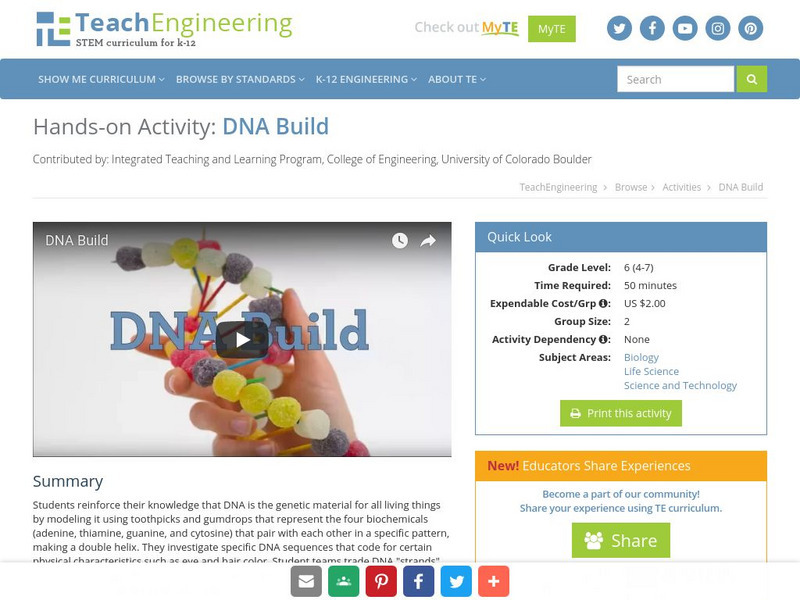
Teach Engineering: Dna Build
Students reinforce their knowledge that DNA is the genetic material for all living things by modeling it using toothpicks and gumdrops that represent the four biochemicals (adenine, thiamine, guanine, and cytosine) that pair with each...
TeachEngineering
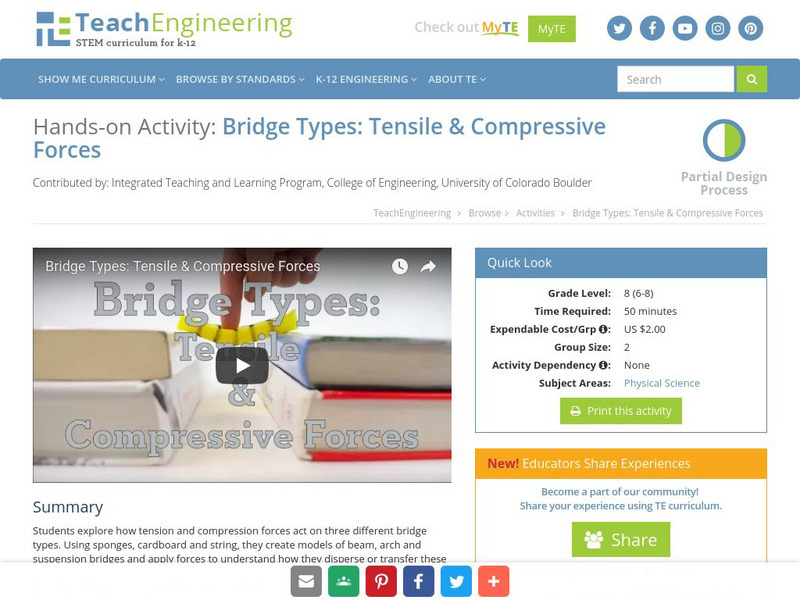
Teach Engineering: Bridge Types: Tensile & Compressive Forces
Students explore how tension and compression forces act on three different bridge types. Using sponges, cardboard and string, they create models of beam, arch and suspension bridges and apply forces to understand how they disperse or...
TeachEngineering
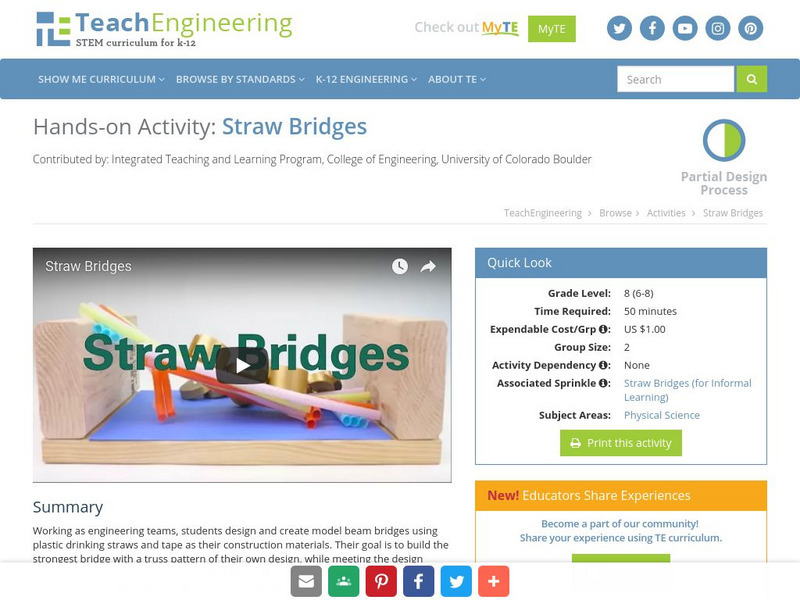
Teach Engineering: Straw Bridges
Working as engineering teams, students design and create model beam bridges using plastic drinking straws and tape as their construction materials. Their goal is to build the strongest bridge with a truss pattern of their own design,...
TeachEngineering
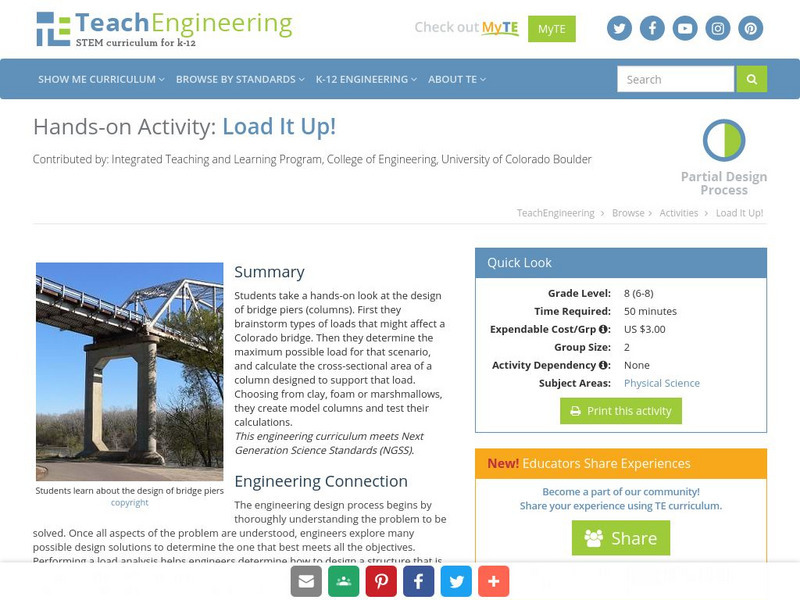
Teach Engineering: Load It Up!
Students take a hands-on look at the design of bridge piers (columns). First they brainstorm types of loads that might affect a Colorado bridge. Then they determine the maximum possible load for that scenario, and calculate the...

TeachEngineering
Teach Engineering: Shallow & Deep Foundations
Students investigate the critical nature of foundations as they learn differences between shallow and deep foundations, including the concepts of bearing pressure and settlement. Using models representing a shallow foundation and a deep...
TeachEngineering
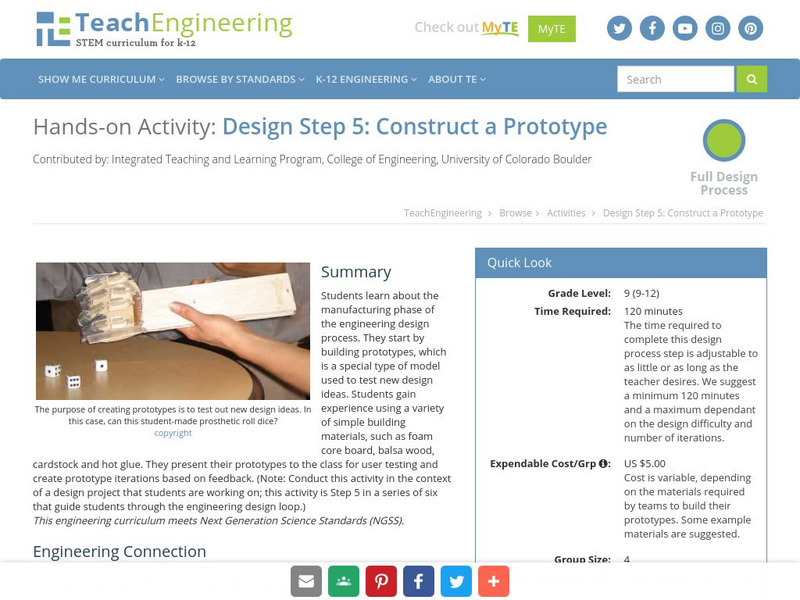
Teach Engineering: Design Steps 5 and 6: Create and Test a Prototype
Students learn about the importance of creating and testing prototypes during the engineering design process. They start by building prototypes, which is a special type of model used to test new design ideas. Students gain experience...
TeachEngineering
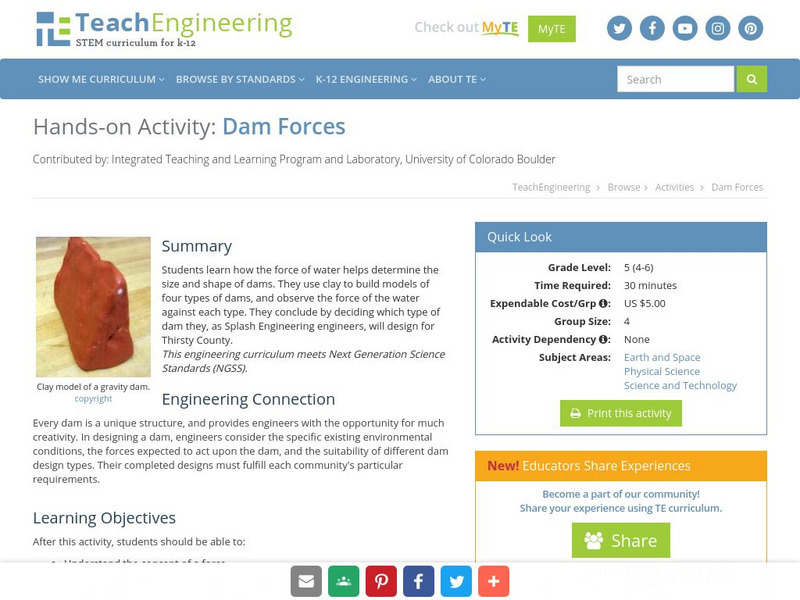
Teach Engineering: Dam Forces
Students learn how the force of water helps determine the size and shape of dams. They use clay to build models of four types of dams, and observe the force of the water against each type. They conclude by deciding which type of dam...
TeachEngineering
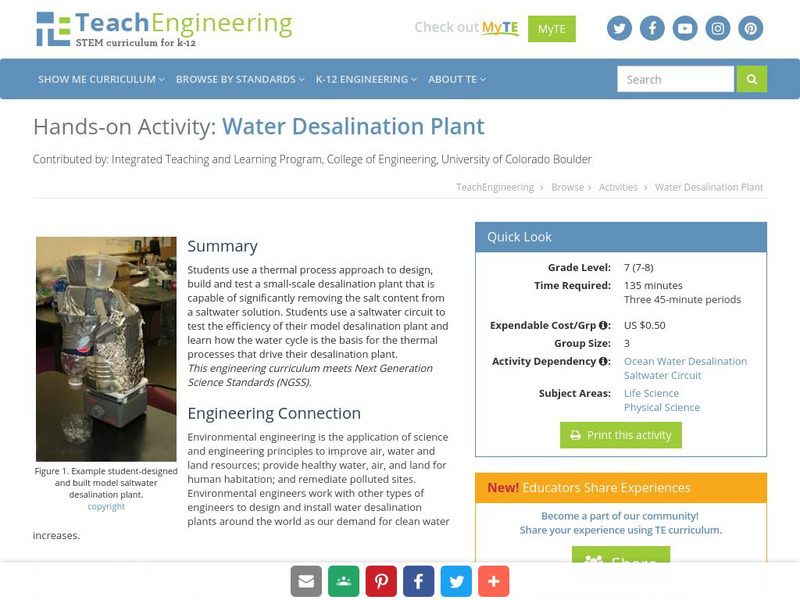
Teach Engineering: Water Desalination Plant
Students use a thermal process approach to design, build and test a small-scale desalination plant that is capable of significantly removing the salt content from a saltwater solution. Students use a saltwater circuit to test the...
TeachEngineering
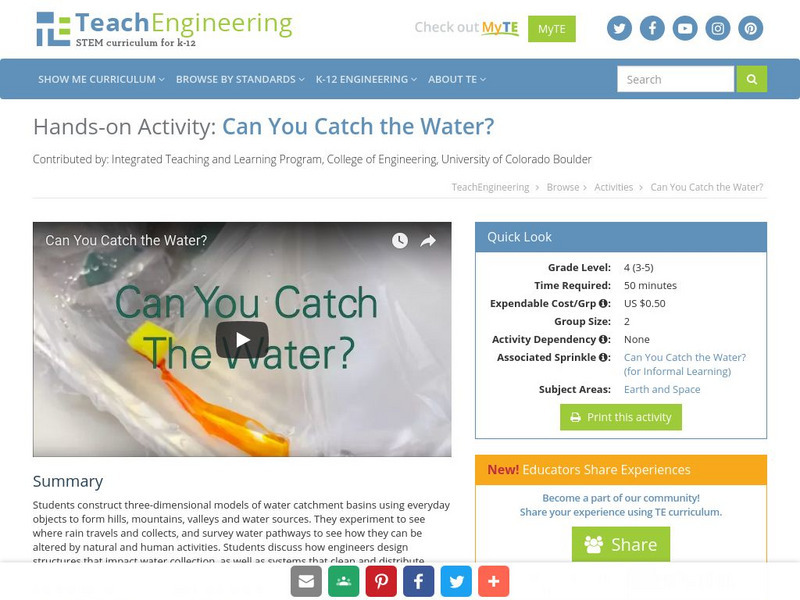
Teach Engineering: Can You Catch the Water?
Students construct a three-dimensional model of a water catchment basin using everyday objects to create hills, mountains, valleys and water sources. They experiment to see where rain travels and collects, and survey water pathways to...
TeachEngineering
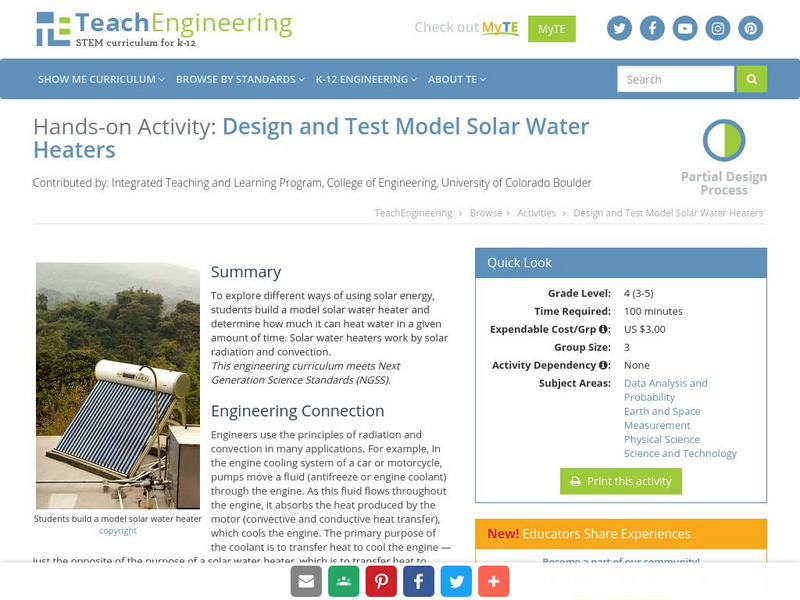
Teach Engineering: You're in Hot Water
To explore different ways of using solar energy, students build a model solar water heater and determine how much it can heat water in a given amount of time. Solar water heaters work by solar radiation and convection.
TeachEngineering
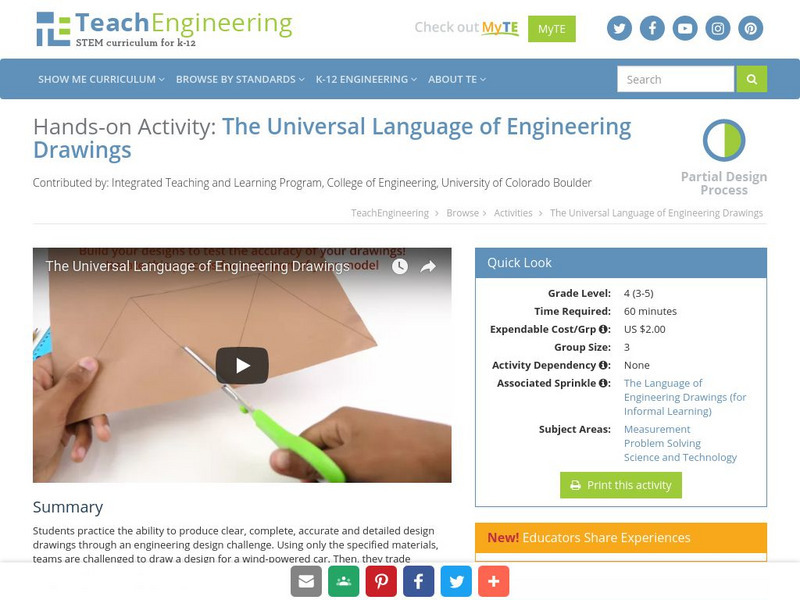
Teach Engineering: The Universal Language of Engineering Drawings
Students practice the ability to produce clear, complete, accurate and detailed design drawings through an engineering design challenge. Using only the specified materials, teams are challenged to draw a design for a wind-powered car....
TeachEngineering
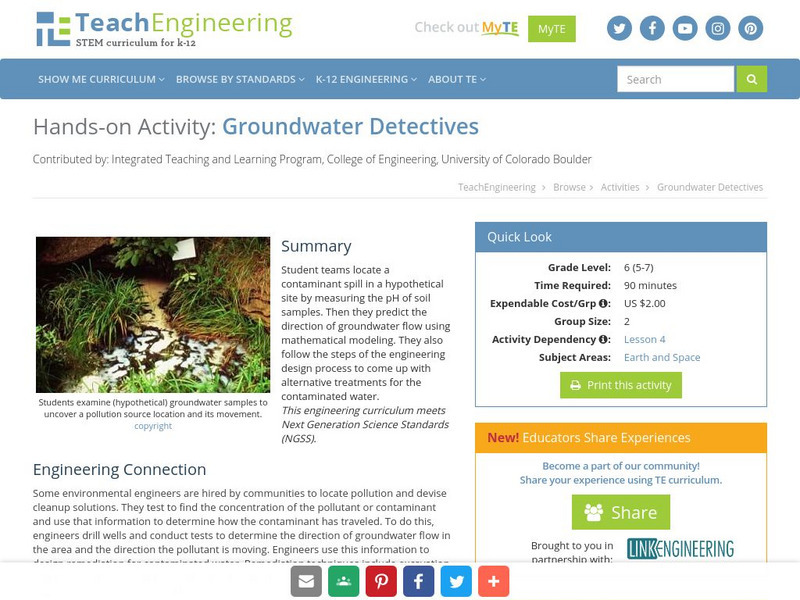
Teach Engineering: Groundwater Detectives
Student teams locate a contaminant spill in a hypothetical site by measuring the pH of soil samples. Then they predict the direction of groundwater flow using mathematical modeling. They also use the engineering design process to come up...
TeachEngineering
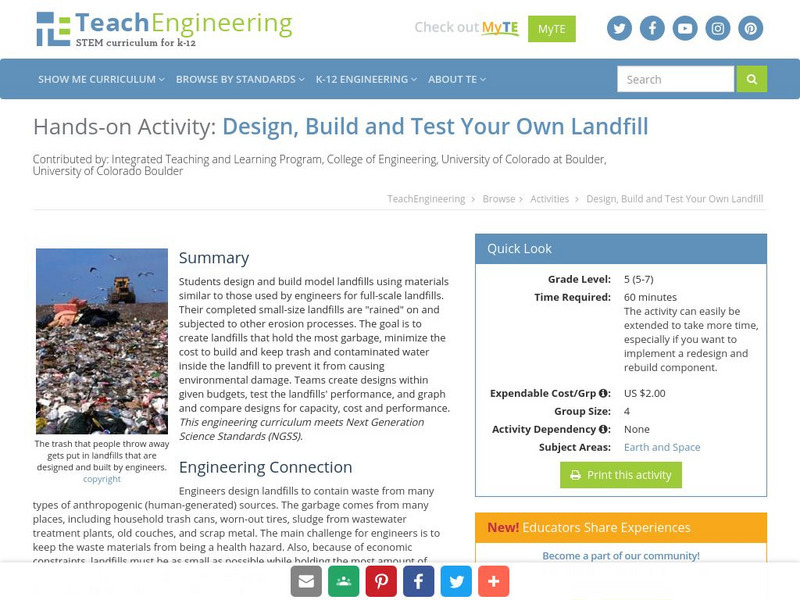
Teach Engineering: Design, Build and Test Your Own Landfill
Students design and build model landfills using materials similar to those used by engineers for full-scale landfills. Their completed small-size landfills are "rained" on and subjected to other erosion processes. The goal is to create...