Hi, what do you want to do?






Livaudais-Baker English Classroom
Kindred
This first in a series of four resources is designed for instructors to use Octavia E. Butler's Kindred in their classes. The packet includes an overview of the unit, a day-to-day calendar, links to background articles, and reading...

Curated OER
Heroes, Kindness and "To Kill A Mockingbird"
Students read To Kill a Mockingbird and relate the action sof the characters to behaviors in students lives. In this heroism, bullying, kindness and compassion lesson, students identify characters who are heroes in the story....

Curated OER
Sticks and Stones
Students explore bullying. In this character development activity, students discuss verbal and nonverbal bullying. Using the "sticks and stones" adage, students write a sentence describing a hurtful act on a gray piece of paper,...

Teaching Tolerance
Jim Crow as a Form of Racialized Social Control
Just because slavery was illegal doesn't mean it went away ... Jim Crow Laws took its place. An eye-opening lesson focuses on how Jim Crow Laws were used as a form of racial social control against African Americans in the United States....

Teaching Tolerance
Mass Incarceration as a Form of Racialized Social Control
Mass incarceration: A result of a tough stance on crime or racial discrimination, you decide. Academics explore the history and reasons behind mass incarcerations in the United States and its impact on ethnic communities. The...

Teaching Tolerance
The War on Drugs—Mechanisms and Effects
The war on drugs doesn't have definite results. An interesting lesson examines the social, political, and economic effect of the war on drugs. Academics learn how the war on drugs has led to mass incarcerations and negatively affected...

Teaching Tolerance
Racial Disparity in the Criminal Justice System
Explore the impact of the war on drugs in a thought-provoking lesson for high school academics. Young historians delve into the world of the criminal justice system and the racial disparity that occurs in the US. The resource provides...

Teaching Tolerance
Understanding the Prison Label
Break the chain. An engaging lesson examines why it is so hard to break free of the prison system in the US. Academics participate in a reader's theater, read primary sources, and discuss their thoughts. The lesson explains the hardships...

Teaching Tolerance
Dismantling Racial Caste
It's time to end racism. The final installment of the series encourages scholars to consider what is needed to ended the racial caste system in the U.S. Young historians complete group discussion, written prompt, and a hands-on-activity...

Curated OER
Colors and Trouble
Students discuss what it would be like if there weren't enough resources by reading " The Land of Many Colors." In this tolerance lesson, students identify the differences between tolerant and intolerant behavior. Student volunteers try...

Curated OER
Johnny Tremain for the 21st Century
Seventh graders complete a unit of lessons on the American Revolution based on the novel, 'Johnny Tremain.' They define key vocabulary terms, develop a timeline, write a report on a colonial craft, make a colonial flag, and create a...

Curated OER
Candide: A Herber Readiness Activity
“Everything will end up okay if you believe hard enough.” “People create their own luck, good or bad.” Prior to reading Candide, class members respond to an anticipation guide that focuses on the issues of optimism, prejudice, and...

Curated OER
Stonewall and Beyond: Gay and Lesbian Issues
Help learners understand their own biases and how their perspectives may have been influenced by biased media sources. They keep a journal while viewing videos, exploring websites, and engaging in class discussions related to gay and...

Curated OER
Candide: Problematic Situation
"Would a rational and well-regulated world include human suffering?" "If the plight of human suffering is the 'best of all possible worlds' do humans have freewill?" Class members develop their position on an issue raised by Candide,...

Curated OER
Independent - To Be or Not Top Be - Day 1, Lesson 2: Scavenger Hunt
Fifth graders research the thirteen significant events that lead to the start of the American Revolution.

Curated OER
Sparking a Revolution!
Students investigate the causes and events that lead to the US Revolutionary War. They use a number of study techniques in this unit to discuss why the colonies wanted freedom from Britain.

Curated OER
Tolerance and Non-Violence in Civil Society
Students explore the concept of philanthropy. In this Oklahoma City bombing lesson, students submit public responses to the event in order to consider how the tragedy prompted a positive reaction. Extension activities are included.

Curated OER
Racism and the Box
High schoolers examine racism and how it relates to self-deception. They identify the effect of racism on society. They reflect on the lesson by writing a paragraph about discrimination and racism.

Curated OER
Heroes, Kindness, and "To Kill a Mockingbird"
Pupils explore the concept of heroism. In this character education instructional activity, students reflect on the actions of the characters in Harper Lee's To Kill a Mockingbird as they create mission statements for Atticus Finch and...

Curated OER
Advanced Sentence Completion 12
In this sentence completion worksheet, students choose the best word(s) to complete each sentence from five possible answer choices.

Curated OER
Advanced Sentence Completion Exercise 13
In this online interactive grammar skills worksheet, students examine 10 sentences that are missing words and select the appropriate words to complete each of the sentences and match them to the sentences. Student answers are...
Read Works
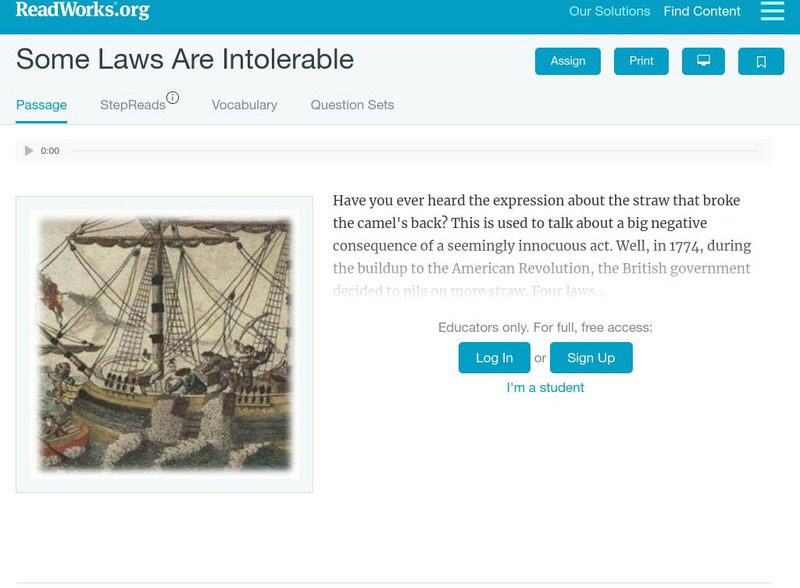
Read Works: Some Laws Are Intolerable
[Free Registration/Login Required] An informational text about the British Acts that lead to the Boston Tea Party and to the writing of the Declaration of Independence. A question sheet is available to help students build skills in...

Alabama Learning Exchange
Alex: Where Can I Find That Book?
This lesson allows students to use current topics of study (e.g. the Stamp Act, the Boston Tea Party, the Intolerable Acts) to learn about the Library of Congress Classification System (LCC).