Hi, what do you want to do?






Lincoln-Sudbury Regional High School
WWII Position Paper
There are some historical events that may warrant greater reflection and more in-depth analysis, and the decision to intern Japanese-Americans in the United States during World War II, as well as to drop the atomic bomb on Hiroshima and...

Digital Public Library of America
The American Whaling Industry
When thinking about the American whaling industry most imagine Moby Dick and Nantucket sleigh rides, harpoons and scrimshaw, whale-oil lamps and baleen in women's corsets. But it may come as a surprise that the industry was also...

Japan Society
Changing Times, Changing Styles: New Japanese Literary Styles of the Late Nineteenth Century
Focusing on Doppo's "Unforgettable People" and late nineteenth century Japanese literature, this resource also leads to discussions of form being dictated by content. Explore the development of new literary styles first-hand by...

Shaker Junior High School Library Media Center
WWII Project Outline
Work together as a class and get to know the ins and outs of World War II with this engaging collaborative project. Class members are broken into groups to research particular war topics, from life on the home front to the Holocaust and...

Franklin D. Roosevelt Presidential Library & Museum
Pearl Harbor Activity #1: Newspaper or Radio Account
After listening to President Franklin D. Roosevelt's "Day of Infamy" speech, young historians research information about the Japanese attack on Pearl Harbor, possible motives for the attack, and the consequences of the attack. Scholars...

Franklin D. Roosevelt Presidential Library & Museum
Role Playing Relating to Big Decisions
While most high schoolers are too young to vote, they still need to learn the skills needed to solve problems. The ninth resource in a 10-part civics series presents class members with four "What Would You Do?" scenarios that have them...

Franklin D. Roosevelt Presidential Library & Museum
Pearl Harbor Activity #7: Pop Up Video Activity
A pop-up video version of FDR's "Day of Infamy" speech engages scholars in depending their understanding of the attack on Pearl Harbor. After watching the video, class members select five new things that they learned and research how...

Japan Society
Akutagawa Ryunosuke and the Taisho Modernists
Japan's Taisho Period was a time when authors like Akutagawa and other Japanese modernists began to experiment with point of view and literary form, making the literature produced during this time period a natural choice for teaching...

Japan Society
National Identity and Literature from Okinawa
A lesson plan originally designed around the short story "Mr. Saito of Heaven Building" by Yamanokuchi Baku, this resource provides historical background, discussion questions, and brief writing assignments that help your class explore...

PBS
Document This
Being a historian requires serious sleuthing. They examine primary source documents and look for evidence, for clues that reveal who wrote the document, when, and why. After watching two historians model the process, young history...

Humanities Texas
A President's Vision: Theodore Roosevelt
Through an engaging, interactive experience analyzing primary sources, invite your young historians to take a closer look at the presidency of Theodore Roosevelt.

Education World
Every Day Edit - Hiroshima Bombing
In this everyday editing instructional activity, students correct grammatical mistakes in a short paragraph about the Hiroshima bombing. The errors range from punctuation, spelling, grammar, and capitalization.

Curated OER
WWI Propaganda Choice Activity
World War I propaganda techniques employed by the United States government are the focus of this lesson plan. The resource includes an excellent handout of propaganda techniques, ranging from appealing to authority to repetition, lying,...

Constitutional Rights Foundation
The Cold War: How Did It Start? How Did It End?
What is the difference between a Cold War and a Hot War? Scholars research the beginning of the Cold War. They analyze diary entries as well as excerpts from various events during the 45-year standoff. To finish, they prepare final...

Poetry4kids
How to Write a Cinquain Poem
A lesson challenges scholars to create a cinquain poem. Writers begin by choosing a topic and brainstorm details, then compose their original poem making sure to count syllables.

Curated OER
Cultures of Our World
Students eat food, make crafts, read books, and wear costumes all to learn about another culture. In this culture lesson plan, students can also go to a museum.
![National Museum of American History: Leaving Things Behind [Pdf] Activity](https://statictemp.lp.lexp.cloud/images/attachment_defaults/resource/large/FPO-knovation.png "National Museum of American History: Leaving Things Behind [Pdf] Activity")
Smithsonian Institution
National Museum of American History: Leaving Things Behind [Pdf]
This resource provides information about Japanese-Americans who were forced to relocate to interment camps during World War II.
Scholastic
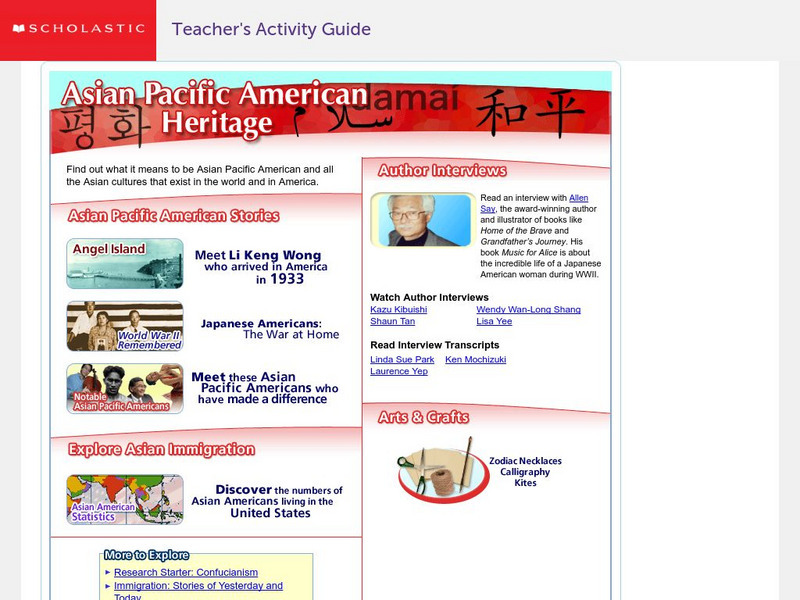
Scholastic: Asian Pacific American Heritage
Nice Scholastic site that looks at what it means to be an Asian Pacific American. Includes stories from Angel Island, Japanese Americans during WWII, and background on and interviews with notable Asian Americans.
Read Works
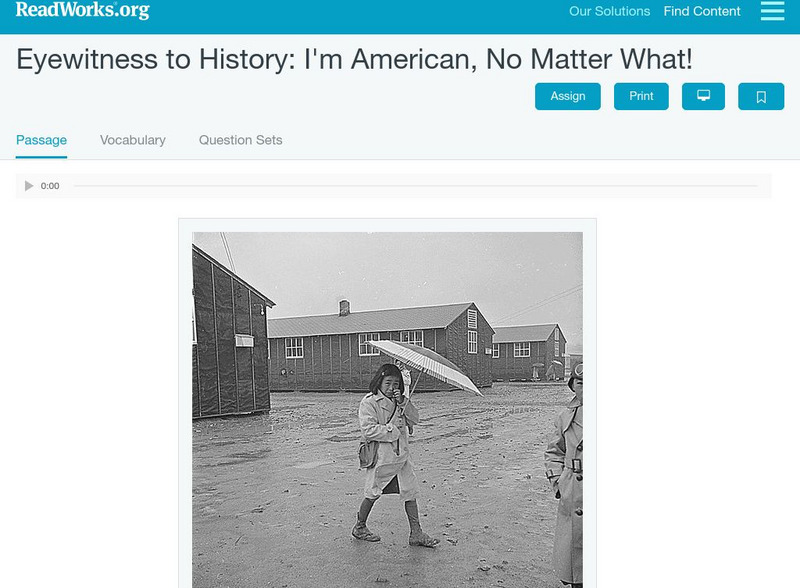
Read Works: Eyewitness to History: I'm American No Matter What
[Free Registration/Login Required] TThis passasge contains a first person account of a child who was rounded up and placed in a Japanese internment camp after the bombing of Pearl Harbor. This passage is a stand-alone curricular piece...
Cornell University
Cornell University: Roper Center for Public Opinion Research
This site is useful because it offers a database of over 300,000 questions asked on surveys since the 1930s. Also contains Latin American and Japanese data bank retrieval system as well. Listing of general social surveys 1972-1998.
Other
Database of Award Winning Children's Literature
This is a phenomenal resource. It allows the user to create a reading list of quality children's literature based of choices such as reading level, type of book, genre, ethnicity, gender, etc. In addition, one can determine if a book won...
Other
Propaganda Critic
A comprehensive site that offers student information on: Name Calling, Glittering Generalities, False Connections, Bad Logic or Propaganda, Wartime Propaganda and more! Site also offers the Propaganda Gallery - short video clips that can...
Ibis Communications
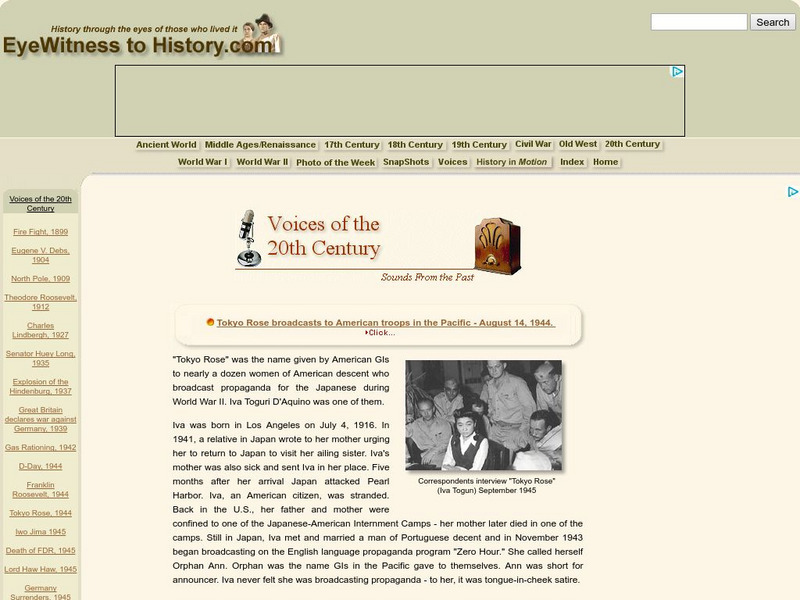
Eyewitness to History: Tokyo Rose
Students investigate ?Tokyo Rose? the name given by American GIs to nearly a dozen women of American descent who broadcasted propaganda for the Japanese during World War II. The resource consists of an audio clip of Tokyo Rose broadcasts...
Other popular searches
- Japanese Americans in Wwii
- Famous Japanese Americans
- Japanese Americans Ww Ii
- Japanese Americans Wnw Ii