Hi, what do you want to do?






Curated OER
Comparing Time Periods in U.S. History: The Ashford Project
Fifth graders use a "fact book" comparing periods in American history then students create a picture to illustrate their assigned periods. # # students use their pictures and concept maps to write expository paragraphs about their...

Curated OER
Food in History
Students research, predict and offer solutions regarding factors that affect current or future food crops could result in economic, political or social changes.

Curated OER
Citizens for Responsible Change
Third graders write a petition to a school figure, get signatures from other students, share the petition with the appropriate authority, and then work as leaders to carry out the group's solution.

Curated OER
Ideas for Elementary Language Arts and Social Studies
Students read a newspaper, then draw a picture.


Curated OER
Adventures in Wonderland: A Genre Study
Students explore the concepts of fantasy writing through this nine lessons unit. The unit presents semantic mapping, discussions, comparisons of various works of fantasy, and the opportunity to create their own fantasies.

Curated OER
A Funny Happened on the Way to Monticello
Third graders examine the Journey of Lewis and Clark and how it relates to Thomas Jefferson and Monticello. They read about, discuss and complete worksheet pertaining to the Lewis and Clark expedition.

Curated OER
Japan: A Cultural Study
Third graders "take a trip" to Japan. They discover what life is like for a typical Japanese child and compare/contrast it to life in America. They give an oral presentation of Japanese holidays and festivals.

Curated OER
Job Interview
Eighth graders write a multi paragraphed, expository composition that explanins how one would conduct themself before, during, and after a job interview. In order to be prepared for the interview, 8th graders complete a thesis, have an...

Curated OER
The Study of the Spanish-Speaking People of Texas: Understanding Primary Sources
Students analyze Russell Lee's photo essay as a sign of segregation in Texas. They consider the differences between primary and secondary sources and how historians use these sources.

Curated OER
Paint Plus
Using the computer and the Paint program, Students explore the different tools available in the paint program, and then create a picture showing two sets of pictures and an equation.

Curated OER
Still More Lollies
Fourth graders listen to the problem to the class and think about how they solve the problem and to discuss it with their friends using number sentences in their written record of the solution.

Curated OER
Wisconsin Heritage Timeline
Fourth graders explore why groups of immigrants settled in Wisconsin. Through intervies with family members, printed materials, and internet research, 4th graders discover the contributions early residents made to the state. Students...

Curated OER
The Thrill of Big-Wave Surfing
Students view a PBS Nature program about big-wave surfing and participate in a class discussion about their experiences with surfing, body boarding, or body surfing. Students create a drawing based on a reading and post their art around...

Curated OER
KWL on flags
Third graders engage in a writing activity in order to research and establish meaning for the subject of the American Flag. They use a graphic organizer known as a KWL Chart in order to progress through the lesson plan.

Curated OER
A Day in the Life
High schoolers, while studying the "day-in-the-life photographs" of a Deai student, compare and contrast the lives and activities of Kojiro, one other Deai student and themselves. Sequential order plays an important role within this...

Curated OER
Classic Storytelling with a Technology Twist
Students use technology to improve their knowledge of literary terms, math, and technology skills. In this technology storytelling lesson, students learn about character, plot, and setting in various stories by using technology like...

Curated OER
The Polar Express Writing Report
In this grade 2 writing prompt activity, learners are give a writing prompt from the book The Polar Express about using their senses to write about going on a trip around the world with Santa Claus. Pages include a rubric and teacher...

Curated OER
Anatomy of the Brain
Pupils explore the brain. In this science lesson, students view a diagram of the brain and discuss the various regions of the brain. Pupils discuss the importance of protecting the brain and design a protective covering.

TED Talks
Ted: Ted Ed: How to Sequence the Human Genome
Your genome, every human's genome, consists of a unique DNA sequence of A's, T's, C's and G's that tell your cells how to operate. Thanks to technological advances, scientists are now able to know the sequence of letters that makes up an...

Starfall
Starfall: Letters of the Alphabet
This site features activities for the letters of the alphabet. Students have an opportunity to click on a letter and hear a story about that letter.

ClassFlow
Class Flow: Letter Sequences Algebra
[Free Registration/Login Required] In this flipchart, students learn to identify patterns in a sequence of shapes used to create letters. Students then use logic to extend the pattern and extrapolate further shapes.

BBC
Bbc Skillswise: Reading: Recognizing Letters and Words
Learn the importance of alphabetic sequence and using common letter patterns to support fluency. For adult learners.
Free Reading
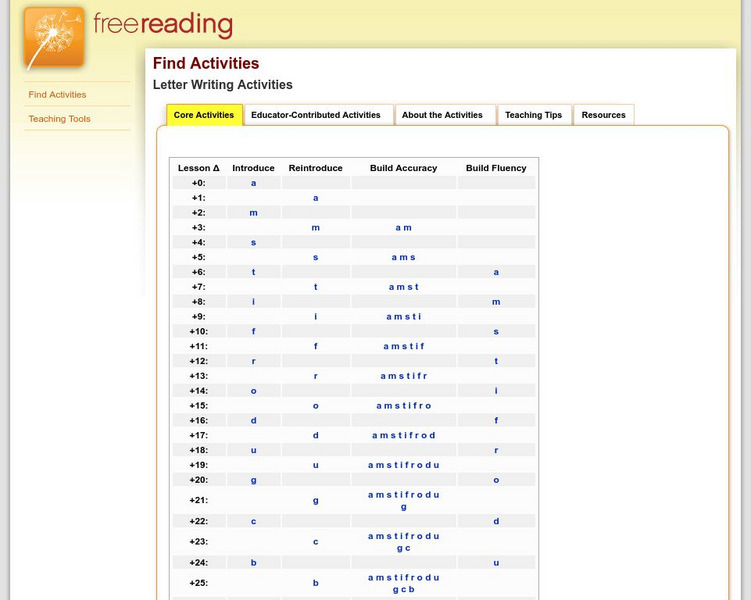
Free Reading: Letter Writing Activities
This invaluable site helps instructors teach students how to handwrite each letter of the alphabet. It includes the amsti sequence to introduce letters, followed by fluency-building activities and accuracy-building activities. Additional...