Hi, what do you want to do?






Teach Engineering
Energy Forms and States Demonstrations
Does a tennis ball have energy? What about a bowling ball? Demonstrate concepts of different forms of energy forms and states with a variety of objects. Using the equations for potential and kinetic energy,...

Exploratorium
Give and Take
Heat-sensitive liquid crystal sheets are available in a variety of sizes and temperature ranges. Purchase a class set of hand-held sheets and color half of each with a silver permanent marking pen. Learners of light can hold them under a...

University of Waikato
Māui and the Sun
Using a Maori legend, How Maui Tamed the Sun, youngsters are introduced to the importance of sunlight to civilization. Teach them about nuclear fusion that occurs to produce the solar energy we later receive on Earth as...

Teach Engineering
Light vs. Heat Bulbs
Careful, that light bulb is hot! Compare heat and light energy using a simple light bulb. The exercise addresses energy conservation and presents actual calculations to determine the most cost-effective light bulb.

American Chemical Society
Energy and Entropy of a Stretched Rubber Band
Stephen Perry invented and patented the modern rubber band in 1845. Young scientists put his discovery to work as they use rubber bands to observe entropy and enthalpy. They determine the change in free energy to figure out if it...

Teach Engineering
Optimize! Cleaner Energy Options for Rural China
What are the trade-offs when looking to get the most benefit from an energy source? Small groups compare the cost-to-emission levels of several energy sources by looking at the information graphically. The groups utilize this...

PBS
Light Bulb Challenge
Efficiency equals money where homes are concerned. A comparative lesson asks learners to measure heat output of incandescent and compact fluorescent light bulbs. They follow their investigation with calculating the cost of using the two...

Curated OER
The BEAM Project: Building Efficient Architectural Models
Technology or engineering teams are given a task to design, construct, and test the efficiency of a structure that will foster an even temperature throughout an entire sunny day. Intended as a long-term project, pupils research, plan,...

US Department of Energy
Solar Cooking
Who needs a barbecue grill to cook hot dogs when you have the amazing power of the sun at your disposal? Engage young scientists in learning about solar energy with this fun activity that turns a used Pringles can into a solar...

Teach Engineering
Beating the Motion Sensor
I bet I can cross the room without having the lights come on. Class members set up an experiment in which they try to determine what materials will mask motion detected by a sensor. Groups predict how materials will interact with...

Trash For Teaching
The Light-House Project
Groups work together to design a lighthouse, from designing and drawing the wiring diagram, to creating prototypes of the switch and circuit, to envisioning and building a scale model along with a blueprint. By including different...

Teach Engineering
Human Power
How many humans does it take to power a light bulb? The 10th part of a 25-lesson Energy Systems and Solutions unit has learners conduct an experiment to calculate power. They then use the results to determine how many classmates they...

Exploratorium
Hot Spot
Not only does a concave mirror focus light waves, it can also concentrate infrared radiation into a hot spot. If you have a small electric heater and such a mirror, demonstrate this for your physical science class.

National Heart Association
Cold Weather Fitness Guide
Don't sacrifice physical activity every time cold winter weather arrives. From walking or circuit training to warm, healthy recipes and safety reminders, this resource will help encourage learners to prioritize their fitness and stay...

Curated OER
The Bio-fuel Project: Creating Bio-diesel
Students investigate bio-fuel. In this investigative lesson, students create bio-fuel from vegetable oil waste. Students will analyze, predict, collect and synthesize data from their experiments with bio-fuel.
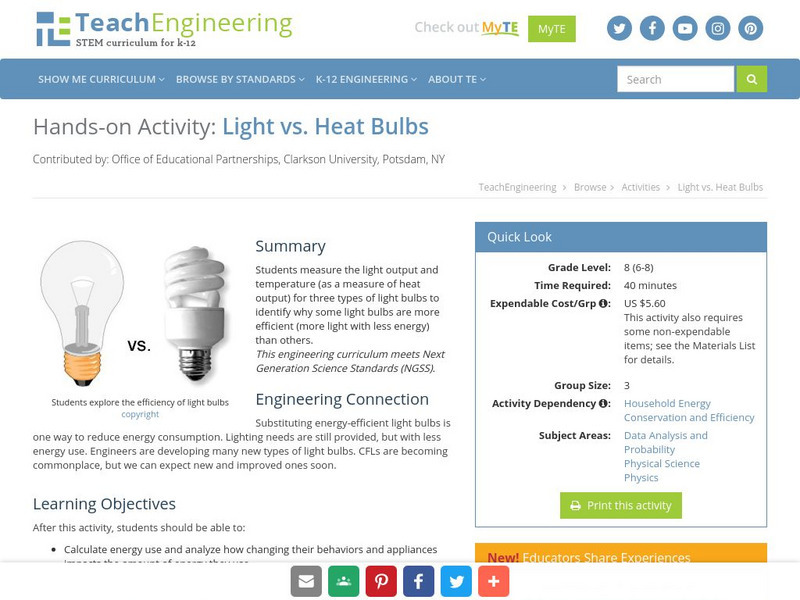
TeachEngineering
Teach Engineering: Light vs. Heat Bulbs
Students measure the light output and temperature (as a measure of heat output) for three types of light bulbs to identify why some light bulbs are more efficient (more light with less energy) than others.
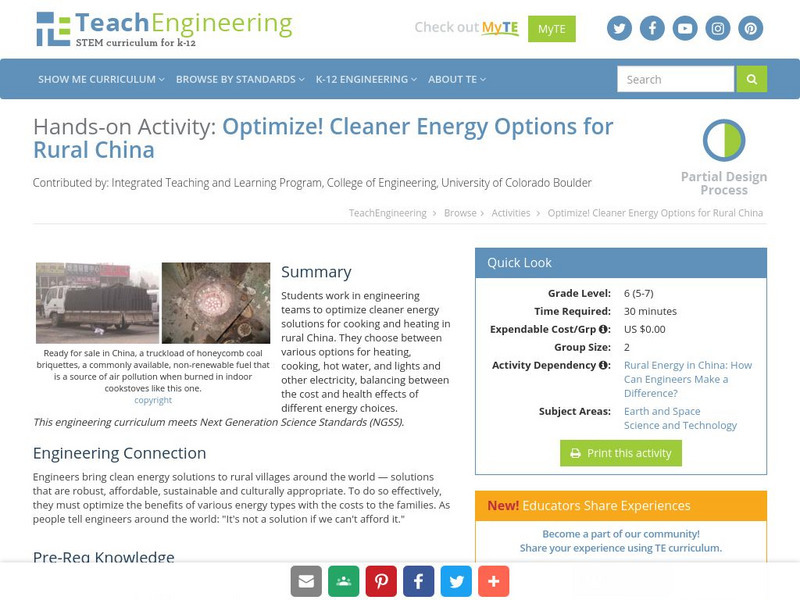
TeachEngineering
Teach Engineering: Optimize! Cleaner Energy Options for Rural China
Students work in engineering teams to optimize cleaner energy solutions for cooking and heating in rural China. They choose between various options for heating, cooking, hot water, and lights and other electricity, balancing between the...
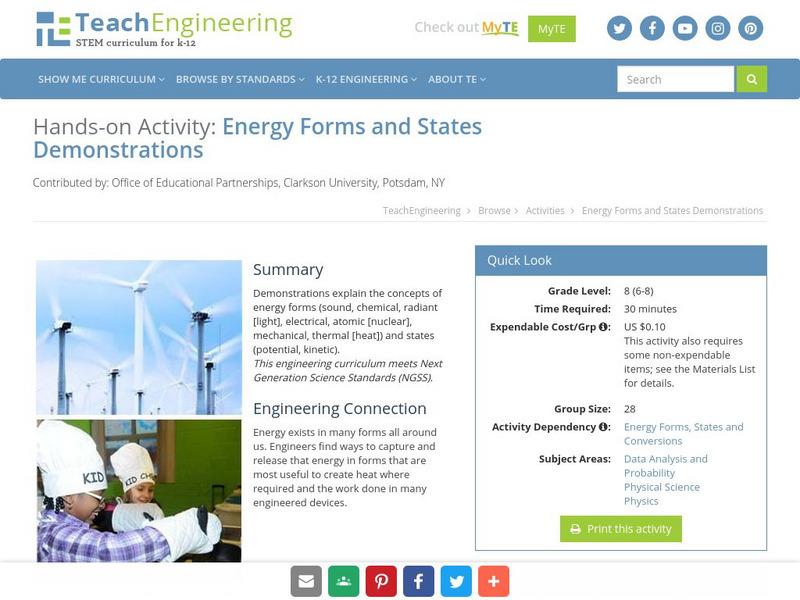
TeachEngineering
Teach Engineering: Energy Forms and States Demonstrations
Demonstrations explain the concepts of energy forms (sound, chemical, radiant [light], electrical, atomic [nuclear], mechanical, thermal [heat]) and states (potential, kinetic).

TeachEngineering
Teach Engineering: Do Different Colors Absorb Heat Better?
Students test whether the color of a material affects how much heat it absorbs. Students will place an ice cube in a box made of colored paper (one box per color; white, yellow, red and black), which they will place in the sun. The...
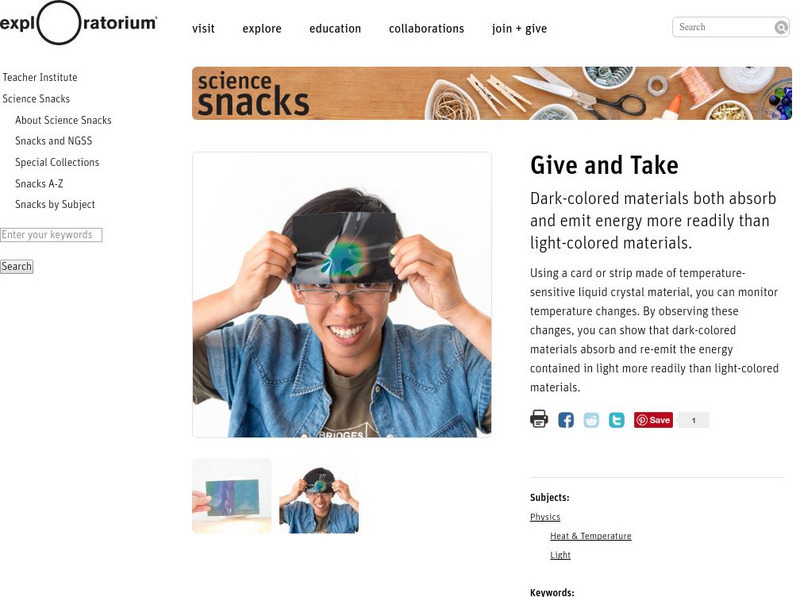
Exploratorium
Exploratorium: Science Snacks: Give and Take
An activity for students to explore how dark-colored materials absorb and emit more energy vs. light-colored material.
Science Buddies
Science Buddies: Radiant Radish Seeds
We all know that plants need sunlight and water to grow big and tall. But did you know that inside seeds are baby plants, and that the fragile baby plant inside the seed needs to be protected? If you've ever had a sunburn, you also know...