Hi, what do you want to do?






Curated OER
Weighing In
Third graders use a Slinky, rubber bands, paper, coins and cups to experiment with weight and its relationship to gravity. They discuss their results and develop a consensus on conclusion statements derived from their experiments.

Curated OER
Flying the Friendly Skies
Students investigate aerodynamics by comparing and contrasting the flight of two gliders. They make prediction and observation charts and test a variety of hypotheses using paper gliders.

Curated OER
How Do Things Fall?
Young scholars observe falling objects. They discover the rate of falling is based on air resistance and not the weight of the objects. They discuss how engineers use this type of information to design aerodynamic shapes.

Curated OER
The Same But Different
Fourth graders identify the characteristics of a simple physical change. They describe objects by the properties of the materials from which they are made. Students discuss the different states of matter and their distinct physical...

Curated OER
Weighted Eggs
Students order five weighted plastic eggs in order from lightest to heaviest.

Curated OER
The Ultimate Roller Coaster Contest
Students explain how conservation of energy applies to roller coasters. In this physics lesson plan, students construct their own coasters according to a specified criteria. They make modifications to their design when necessary.

Curated OER
How Long is a Hot Dog? Weight, Weight! Don't tell me!
Primary learners participate in activities that help them explain how different things are measured. They create their own access number chart.

Curated OER
Step Into My Shoes
Students order their classmates from smallest to largest foot length. In this ordering their classmates from smallest to largest foot length lesson plan, students trace each of their classmates foot. Students read a story...

Curated OER
The Weight of Water
Students examine how salt water is more dense than fresh water through experimentation with eggs.

Curated OER
Graham's Law Of Diffusion
Students demonstrate Graham's Law by observing a gaseous diffusion. After a lecture/demo, students perform an experiment then complete a write up activity which is imbedded in this plan to reinforce what they have observed during the...

Curated OER
Exploring the Solar System
Your students can learn more about our solar system with these lesson plan ideas.

Curated OER
The Separation Problem
In this mixture separation worksheet students problem solve a variety of ways to separate mixtures. After generating solution ideas to separating mixtures of solids prompts on the one page sheet students are prompted to respond in short...

Curated OER
See It Settle
Learners layer different types of soil in water. They are to keep a watch on how the soils react with one another in water.
Science and Mathematics Initiative for Learning Enhancement (SMILE)
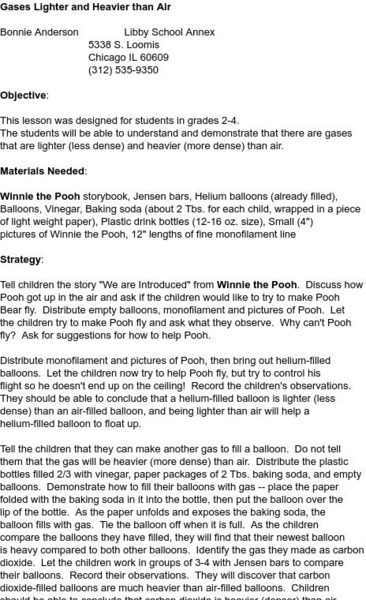
Smile: Gases Lighter and Heavier That Air
Teachers, to demonstrate to the elementary student that some gases are heavier than others, this experiment uses Winnie the Pooh and balloons to do just that.

Physics Classroom
The Physics Classroom: Elephant and Feather: Air Resistance
The concept of air resistance is discussed in terms of why a heavier object falls faster than a lighter object when both dropped from the same height. In this discussion and animation, an elephant and feather are used as examples.

TeachEngineering
Teach Engineering: How Do Things Fall?
Students learn that it is incorrect to believe that heavier objects fall faster than lighter objects. By close observation of falling objects, they see that it is the amount of air resistance, not the weight of an object, which...

Concord Consortium
Concord Consortium: Stem Resources: Was Galileo Right?
Do heavier and lighter objects fall at the same rate? Galileo hypothesized that objects fall at the same rate regardless of their mass. Complete this module to find out if Galileo was right by comparing position-time and velocity-time...