Hi, what do you want to do?





![De Paul University: Center for Urban Education: Making Progress [Pdf] Unknown Type](https://statictemp.lp.lexp.cloud/images/attachment_defaults/resource/large/FPO-knovation.png "De Paul University: Center for Urban Education: Making Progress [Pdf] Unknown Type")
Polk Brothers Foundation Center for Urban Education at DePaul University
De Paul University: Center for Urban Education: Making Progress [Pdf]
"Making Progress" is a one page, fictional, reading passage about students clearing the trash from a vacant lot near the school and planting a garden to beautify the neighborhood and show they care. It is followed by constructed-response...
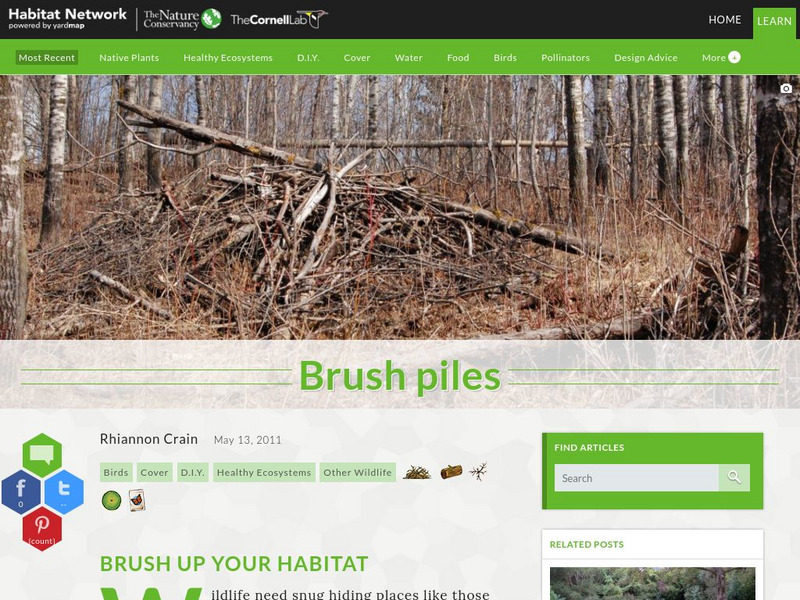
Cornell Lab of Ornithology
Habitat Network: Brush Piles
Find out why brush piles are beneficial to a habitat.
Read Works
Read Works: A Clean Park
[Free Registration/Login Required] A literary text about a boy named Tyler who realized that he needed to pitch-in and help keep the park clean. A question sheet is available to help students build skills in reading comprehension.
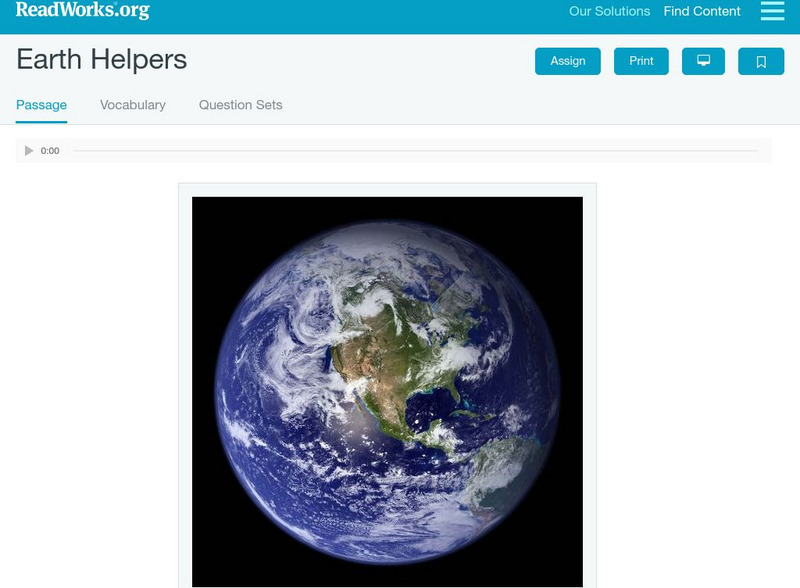
Read Works
Read Works: Earth Helpers
[Free Registration/Login Required] An informational text about working together to make the Earth a better place. A question sheet is available to help students build skills in reading comprehension.
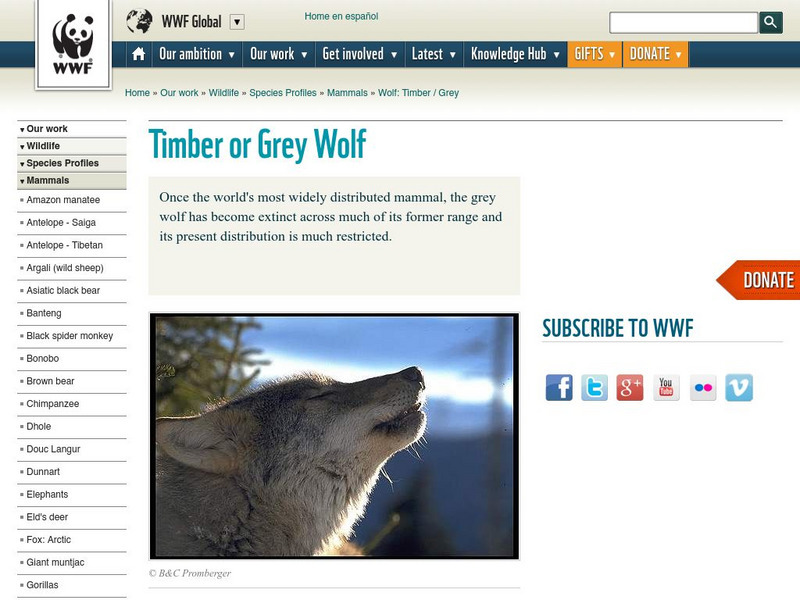
World Wildlife Fund for Nature
World Wildlife Fund: Wolf (Timber)
This resource provides basic information and photos of the Timber Wolf.
Curated OER
Residents Walk Through a Street Littered With Debris in Pangandaran
From July, 2006, photographic slideshow graphically detailing the tsunami that hit the Indonesian island of Java.
Smithsonian Institution
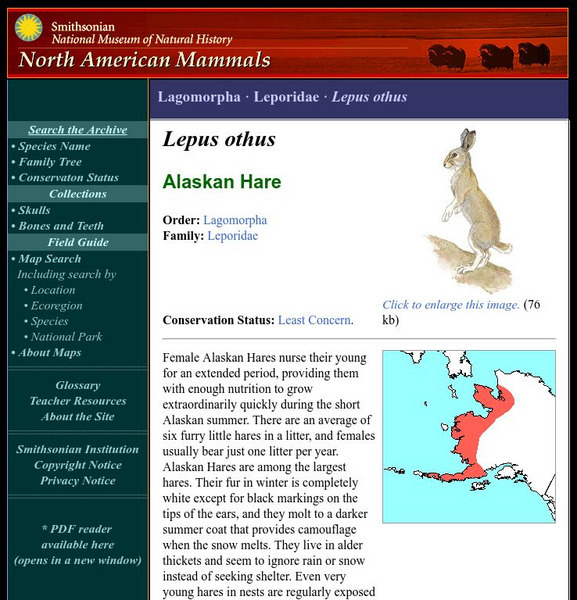
National Museum of Natural History: American Mammals: Alaskan Hare
Female Alaskan Hares nurse their young for an extended period, providing them with enough nutrition to grow extraordinarily quickly during the short Alaskan summer. There is an average of six furry little hares in a litter, and females...
Better Planet Productions
Earth Care: Good Garbage vs Bad Garbage [Pdf]
Kindergarten students will participate in schoolyard cleanup and learn to tell the difference between safe and unsafe litter.
Better Planet Productions
Earth Care: Sort and Sift [Pdf]
In this lesson, learners will examine the litter they produce in their classroom and that their families produce at home, and identify ways they can reduce waste and recycle more.
Other
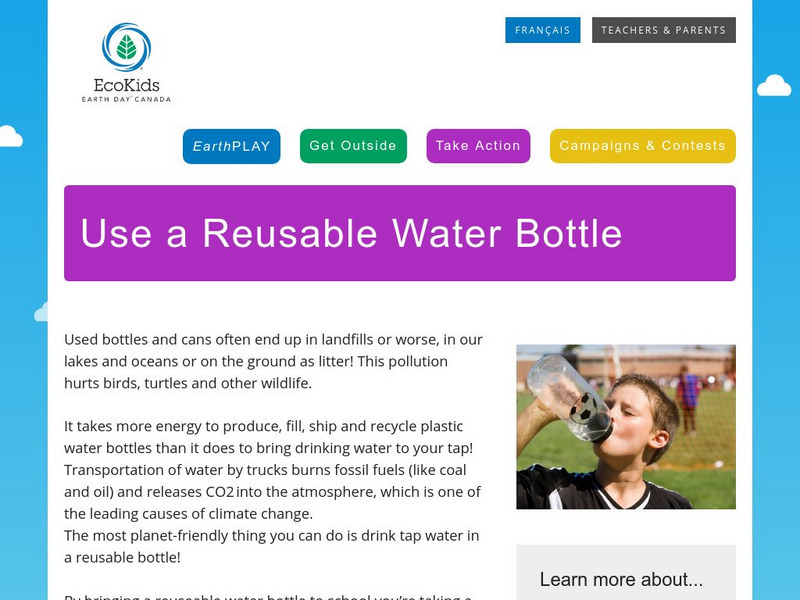
Earth Day Canada: Eco Kids: Use a Reusable Water Bottle
Did you know that used bottles and cans often end up in landfills or worse, in our lakes and oceans or on the ground as litter! This pollution hurts birds, turtles, and other wildlife. These are some of the reasons why we should use...

ClassFlow
Class Flow: Changes in Habitats
[Free Registration/Login Required] A 2nd grade unit on how people and weather can change habitats. Topics include too much and too litter rain (flooding and drought), lightning and fire, and land, water, and air pollution. This flipchart...
Smithsonian Institution
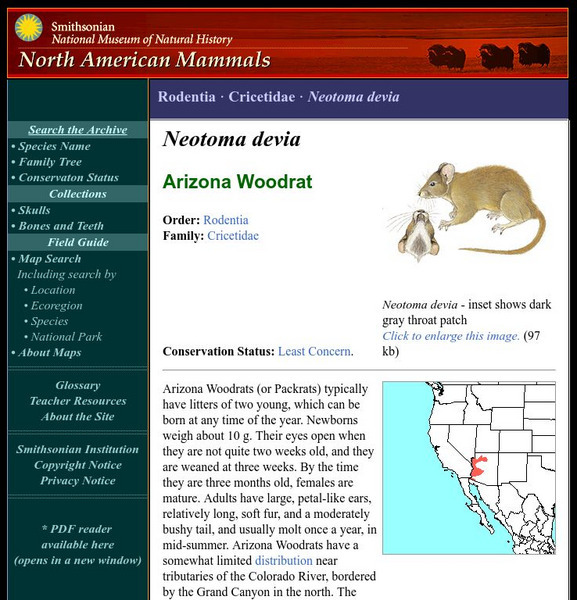
National Museum of Natural History: American Mammals: Arizona Woodrat
Arizona Woodrats (or Packrats) typically have litters of two young, which can be born at any time of the year. Newborns weigh about 10 g. Learn more about the Neotoma devia, more commonly known as an Arizona Woodrat, in this easy-to-read...
Smithsonian Institution
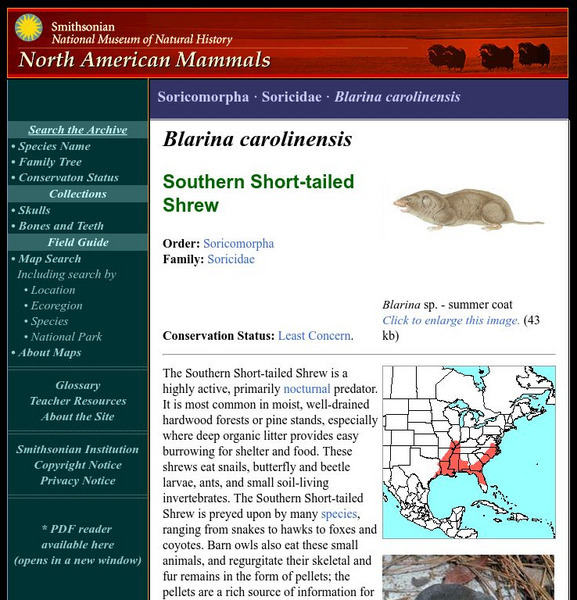
National Museum of Natural History: American Mammals: Southern Short Tailed Shrew
The Southern Short-tailed Shrew is a highly active, primarily nocturnal predator. It is most common in moist, well-drained hardwood forests or pine stands, especially where deep organic litter provides easy burrowing for shelter and...
Smithsonian Institution
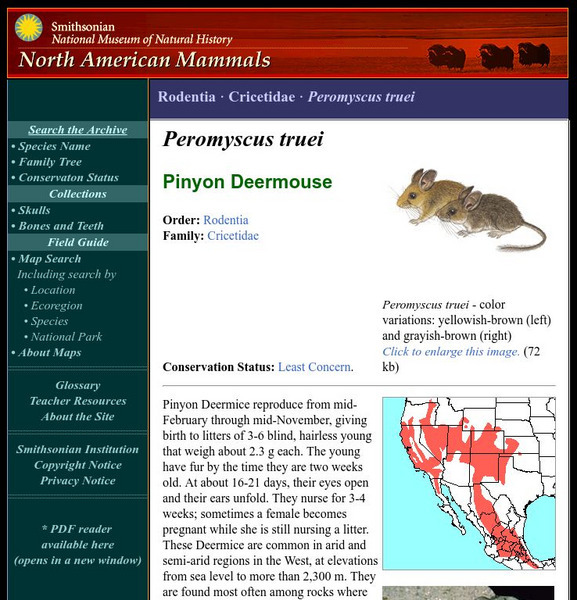
National Museum of Natural History: American Mammals: Pinyon Deermouse
Pinyon Deermice reproduce from mid-February through mid-November, giving birth to litters of 3-6 blind, hairless young that weigh about 2.3 g each. Learn more about the Peromyscus truei, more commonly known as a Pinyon Mouse, in this...
Smithsonian Institution
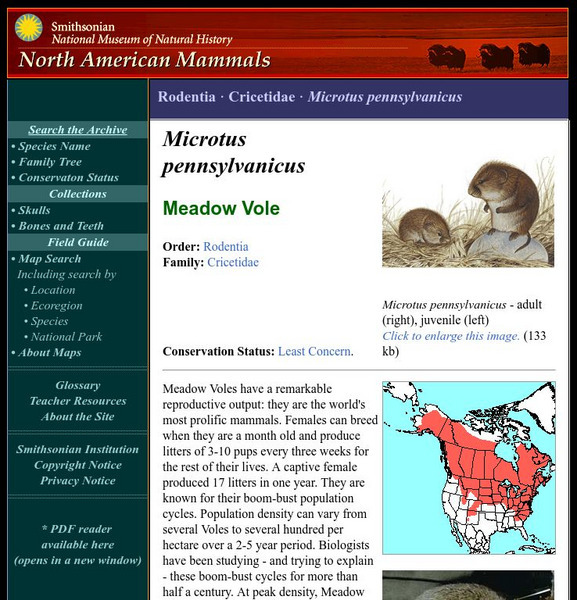
National Museum of Natural History: American Mammals: Meadow Vole
Meadow Voles have a remarkable reproductive output: they are the world's most prolific mammals. Females can breed when they are a month old and produce litters of 3-10 pups every three weeks for the rest of their lives. Learn more about...
Smithsonian Institution
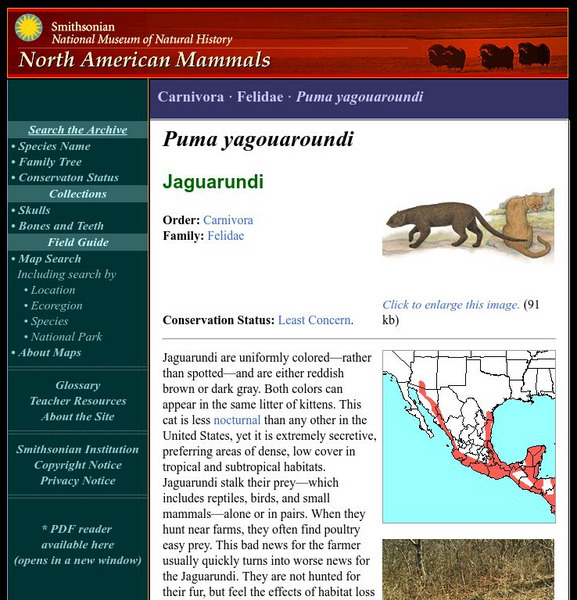
National Museum of Natural History: American Mammals: Jaguarundi
Jaguarundi are uniformly colored, rather than spotted, and are either reddish brown or dark gray. Both colors can appear in the same litter of kittens. Learn more about the Puma yaguarondi (Herpailurus yaguarondi), more commonly known as...
Read Works
Read Works: A Clean Park
[Free Registration/Login Required] A literary text about a boy named Tyler who decides to do his part to help keep his community park clean. A question sheet is available to help students build skills in reading comprehension.
PBS
Pbs Teachers: Helping Kids Help the Environment
Define and explore the concept of environmental citizenship through a series of literacy-based multimedia, online and hands-on learning experiences. Discover how responsible citizens can help protect their local communities by...
Kidport
Pollution
A short discussion of several different types of pollution and of the harm that it can do to the Earth. Includes a two-question reading-comprehension quiz.
HotChalk
Hot Chalk: Lesson Plans Page: Aquatic Wildlife and Pollution
This lesson plan is designed to teach young children about healthy and hazardous marine and freshwater environments and be able to describe the effects of the pollution of plastics on wildlife.
Other
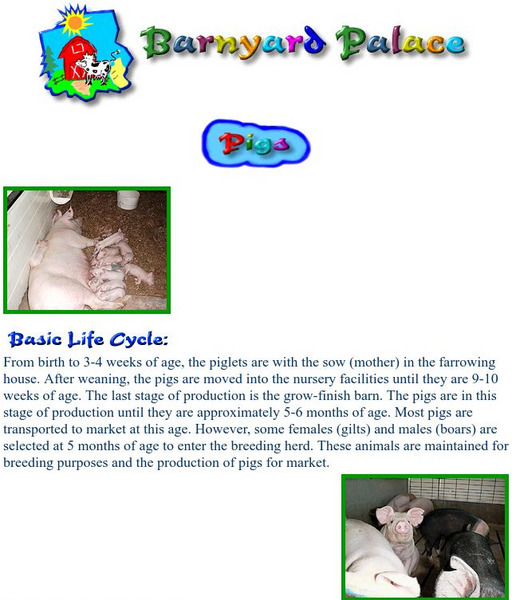
Barnyard Palace: Pigs
This is a site for the basic information on pigs. It gives you the life cycle, why they are raised, facts about their diets, the different species. Along with all that there are a few more interesting facts.
Curated OER
Educational Technology Clearinghouse: Clip Art Etc: Lectica
Lectica was a kind of couch or litter, in which persons, in a lying position, were carried from one place to another. They were used for carrying the dead as well as the living. The Greek lectica consisted of a bed or mattress, and a...
Discovery Education
Discovery Education: Scientific Inquiry, Episode 1
In this classroom activity, students discuss how people and pollution affect the environment. Then they demonstrate ways to recycle, reduce, and reuse.
HotChalk
Hot Chalk: Lesson Plans Page: Causes of Pollution
This lesson plan is designed to teach young children identify the types of pollution, the sources of the pollution, and how they can protect the environment from further pollutants.
Other popular searches
- Litter Bug
- Pick of the Litter
- Litter in the Environment
- Ocean Litter
- Litter Critters
- Litter Survey
- Beach Litter
- Litter Management
- Litter Science
- Litter Minimization
- Photo Essay on Littering
- Identifying Litter