Hi, what do you want to do?





BioEd Online
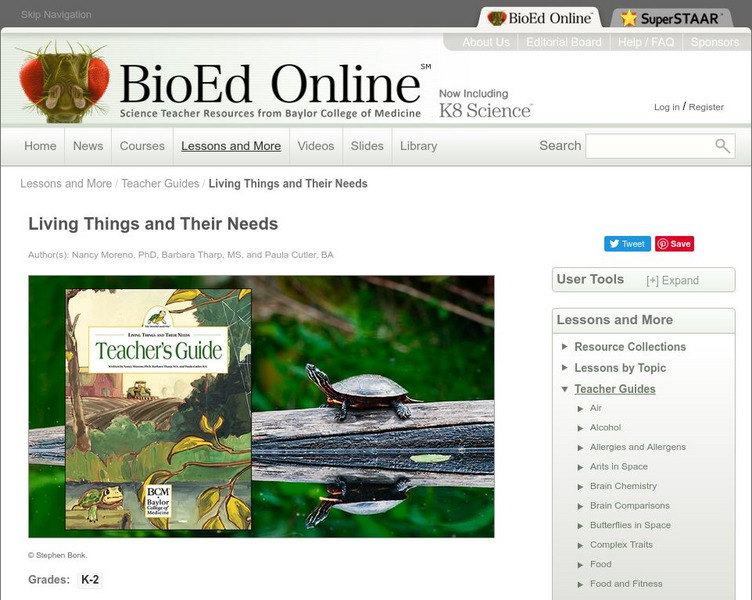
Bio Ed Online: Living Things and Their Needs Teacher's Guide
This is a free downloadable teacher's guide (PDF) to teach young children (grades K-2) about living things and their needs.
BioEd Online
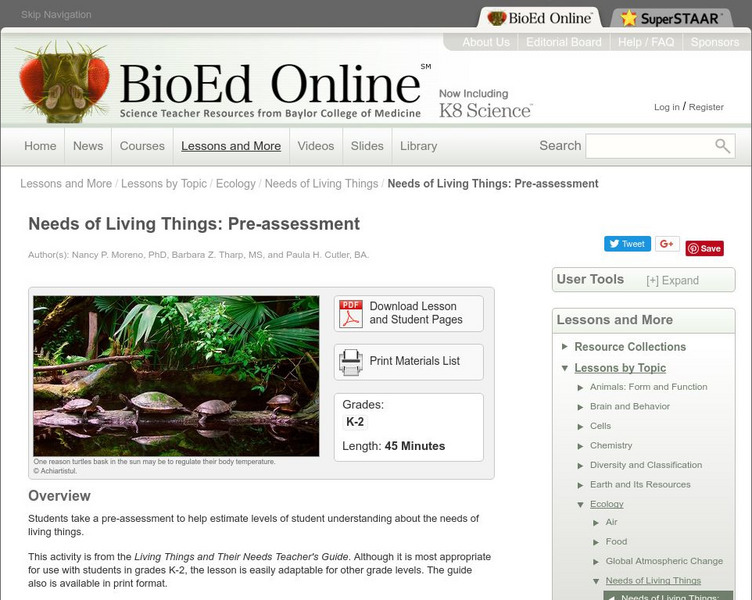
Bio Ed Online: Needs of Living Things: Pre Assessment
This is a pre-assessment to be done at the beginning of a unit on the needs of living things. Students draw themselves and what they need to survive. The lesson can be downloaded in PDF format.

Other
Science4 Us: Living/nonliving
Students explore the similarities and differences between living and nonliving things and learn four characteristics that all living things share (they have needs, they are made up of parts, they respond to change, they reproduce)....
Other
Biology at Shaw High School: What Do Living Things Need to Survive?
Discusses the interrelatedness of all living things and of ecosystems and biomes, and what organisms need to survive and to maximize the carrying capacity of an ecosystem. This explanation is followed by a series of activities including...
BioEd Online
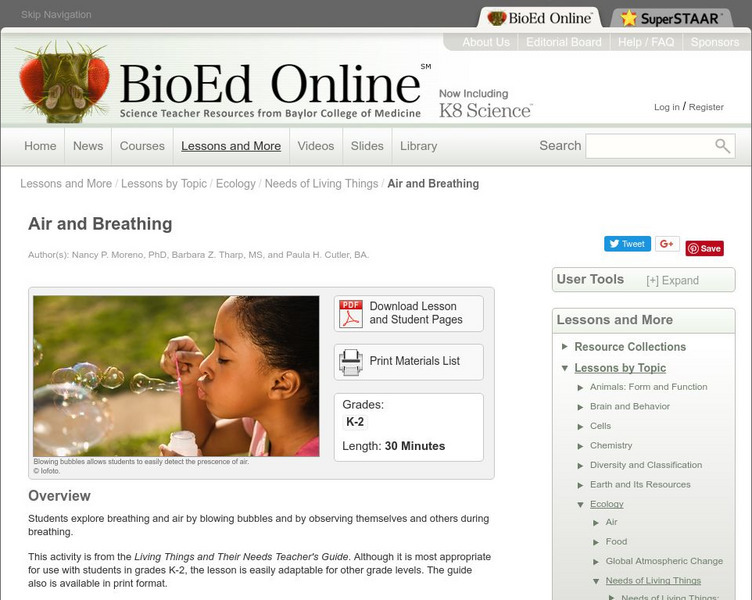
Bio Ed Online: Living Things and Their Needs: Air and Breathing
Students participate in a bubble blowing activity where they learn about air and breathing. The instructional activity can be downloaded in PDF format.
BioEd Online
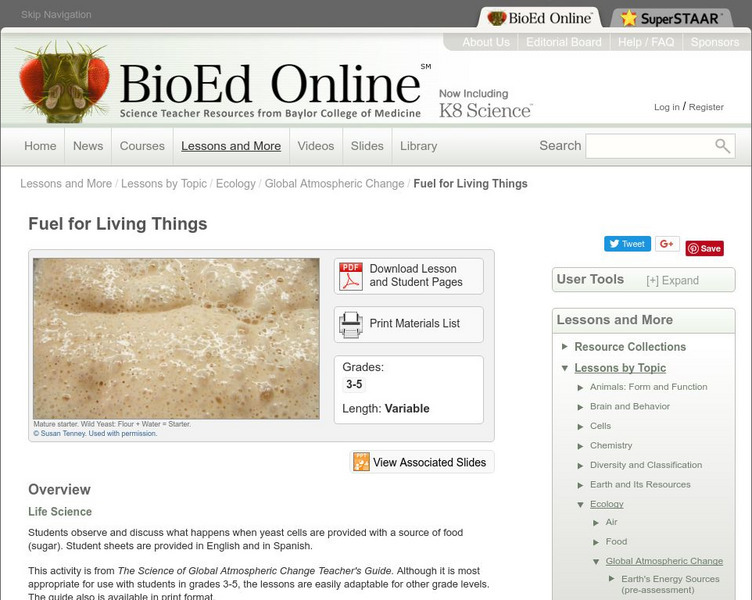
Bio Ed Online: Fuel for Living Things
Students learn about how cells fuel themselves by examining how carbon dioxide is produced by yeast cells when the cells feed on sugar. The carbon dioxide is detected through the use of a red cabbage indicator that reacts in the presence...
BioEd Online
Bio Ed Online: Living Things and Their Needs: Plant or Animal?
For this lesson, students investigate and compare the needs of plants and animals. The lesson can be downloaded in PDF format.
Utah Education Network
Uen: Trb 3:2 Investigation 2 Greenhouses
Set up a miniature greenhouse to help with understanding how nonliving things affect the growth of living things.
BiologyWise
Biology Wise: The Levels of Organization of Living Things
Explains the importance of systems of organization in biology and describes the thirteen levels of organization, from the atom up to the biosphere.
Utah Education Network
Uen: How Do I Survive?
Compare and contrast the characteristics of living things in different habitats.
Globe
The Globe Program: Earth System Module
Activities help students experiment with what plants need in terms of water, sunlight, and soil, explain how the Earth's processes and components are interconnected, and demonstrate their knowledge of how water, air, soil, and living...

Alabama Learning Exchange
Alex: Beanie Baby Habitats Collaborative Project
With the booming market of "Beanie Baby" type stuffed animals being so prominent in students' lives, this project brings that interest into the classroom through the use of research, science, hands-on experiences, and technology. The...
American Institute of Biological Sciences
Action Bioscience: Evidence of Evolutionary Transitions
Charles Darwin's theory that all living organisms are connected in some way has been confirmed through intense studies over centuries. Understand the similarities that bond all things living to the same family tree by checking out this...
Other
Monumental Trees: General Sherman: The Biggest Tree in the World
Learn about the oldest living thing on planet Earth, an ancient Sequoia tree.
BioEd Online
Bio Ed Online: Tillena Lou's Day in the Sun
Tillena Lou and her siblings spend a lazy day imagining what it might be like if they were other types of animals. What would they need to survive? Synopsis: Tillena Lou explores her home and discovers interesting things about the...

City University of New York
Brooklyn College: Exploring Life @ Bi Odot Edu: Signs of Life: Complexity
A nice introduction to the idea that living things are highly organized at several different levels. Great as an introduction to biological complexity.
Utah Education Network
Uen: Trb 4:5 Investigation 2 Elevation, Plants & Animals
Fourth graders will understand that elevation is one of the things that affect where and how plants and animals live.
Other
Gapminder: Dollar Street
In this collection of 30,000 photos from 46 countries, students will be assess "how people really live" around the world. Students can compare bathrooms, toys, and more. Students will explore different cultures, economics, geography,...
Utah Education Network
Uen: What's Different About These Worms?
Observe three different worm models and identify characteristics.
Utah Education Network
Uen: Making a Mini Worm Habitat
Activity shows the process of converting organic waste into usable fertilizer.
BioEd Online
Bio Ed Online: Needs of Plants
Each student will make his/her own mini-garden and will observe the growth and development of radishes. To help learners learn about requirements for plant growth, the teacher will make four experimental gardens and place them in...

Alabama Learning Exchange
Alex: What Is Alive?
This lesson plan is the opening lesson plan for a unit of study entitled "Why Doesn't A Caterpillar Grow Up To Be An Oak Tree?" during which learners take a look at life cycles of plants and animals. This lesson plan will encourage...
Utah STEM Foundation
Utah Stem Action Center: Backyard Organisms
Utah is a beautiful state with a rich and diverse population of living creatures. This activity challenges you to spend a few minutes outside thinking about and observing the organisms living in your backyard.
American Institute of Biological Sciences
Action Bioscience: The Challenge of Living at High Altitudes
Physical anthropologists are studying the ongoing evolution of modern humans. This article features research done on those living in high altitudes over thousands of years with the intention to discover things such as the role of natural...