Hi, what do you want to do?






Weber State University
The Sun and the Seasons
Why is there more daylight in June than in December if you live above the equator? How does the angle of sunlight shift throughout the year? Answer these questions and more with an interactive article about the sun, its path through the...

American Museum of Natural History
What is Biodiversity?
Not all dogs are the same just like not all finches are the same. An interactive online lesson helps individuals learn about the causes and limitations to biodiversity. The clickable sections describe the basics of the genetics of...

American Museum of Natural History
What is Marine Biology?
A marine environment covers the majority of the earth but is arguably the least understood. Teach young scientists about the characteristics of oceans and ocean species using an interactive online lesson. The in-person or remote learning...

American Museum of Natural History
What's This? Feeding
Some species have pretty creative methods for catching food. Young scientists learn about some interesting ways organisms get the nutrients they need by navigating an online interactive lesson that would be suitable for a remote learning...

American Museum of Natural History
What's This? Reproduction
Attracting the right mate is as important for humans as any other species. An interesting lesson teaches individuals about several strategies that animals and plants have adapted to attract their mates. From colorful nests to powerful...

American Museum of Natural History
Being An Anthropologist: Laurel Kendall
Imagine studying Korean culture, especially the role of women, as well as marriage and religious rituals from home! Anthropologist Laurel Kendall shares what she has learned from her many trips to this fascinating country half a world away.

American Museum of Natural History
What is Anthropology
A colorful resource introduces learners to the four major fields of anthropology: cultural anthropology, linguistic anthropology, biological anthropology, and archaeology. Explanations are provided for what each field studies, the kinds...

American Museum of Natural History
They Glow!
Would you believe marine animals can make their own light? An online resource describes the process of bioluminescence and how animals in the ocean use it to survive. The lesson features a catchy tune that describes the behavior of ocean...

University of North Carolina
Oral History
There's no better way to learn something than to hear it straight from the horse's mouth. A handout on oral history, part of a larger series on specific writing assignments, explains how to conduct interviews and use the information...

Judicial Learning Center
Law and the Rule of Law
We hear a lot about the importance of the rule of law, but most people do not really know what those words mean. The lesson is a webpage that defines the rule of law, explains why it is important in a democratic society and provides...

Anne Frank House
Who Was Anne Frank?
Set the stage for a study of The Diary of a Young Girl with a resource that includes background information about Anne Frank's early years, the Nazi invasion of the Netherlands, her Secret Annex hiding place, and her capture and...

American Museum of Natural History
Light, Matter and Energy
Let Einstein's work shine the way. Pupils read about Einstein's iconic equation, E=mc^2, using a remote learning resource and see how ideas from other scientists such as Kepner, Curie, Galilei, and Newton led to its discovery. They...

American Museum of Natural History
Global Grocery
A walk through the grocery store is like a walk around the world. An interactive activity shows popular grocery items and where the ingredients originate. Perfect as a remote learning resource, the lesson connects groceries to the...

American Museum of Natural History
Trip Up Your Brain
Sometimes different parts of the brain disagree. See what this disagreement looks like using a remote learning resource to experience how brains often take shortcuts. Pupils complete the activity, observe their results, and then read...
BBC
Bbc Schools: Ks2 Bitesize: Science: Living Things: Plant and Animal Habitats
Place the aliens in the habitats where they can survive the best. Following the activity, read more about plant and animal habitats, and then take a quick quiz to check for understanding.
Other
Live and Learn: Swimming Pool Safety
Find a comprehensive list of things that can be done around household pools to prevent injuries and accidents.

Utah Education Network
Uen: Themepark: Systems: Ecosystem
Find a large collection of internet resources organized around ecosystems. Links to places to go, people to see, things to do, teacher resources, and bibliographies.
The Wonder of Science
The Wonder of Science: K Ess3 1: Environmental Relationships
This NSTA vetted source includes resources to teach about the relationship between the needs of different plants and animals and the places they live. Included are assessment ideas, videos, examples, lesson plans, and photos of student...
University of California
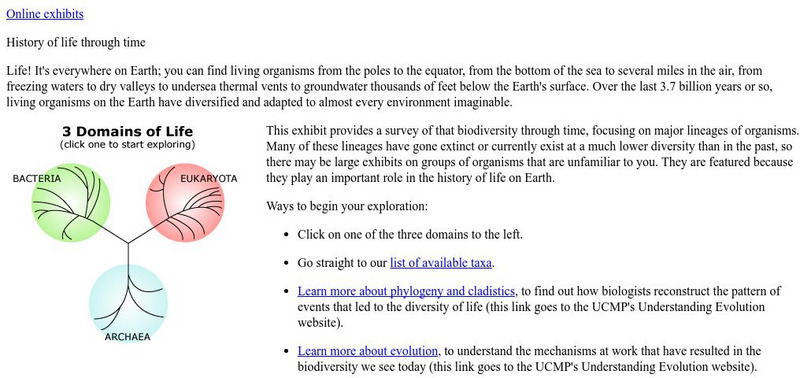
Ucmp: The Biosphere: Life on Earth
Learn about different forms of life that coexist with us on Earth. This Berkeley article provides links to brief write-ups on the three domains of living organisms: Eukaryota, Bacteria, and Archaea.

PBS
Nova: Into Living Things
Paleoclimatologists use information from tree rings, corals and ice cores to learn more about El Nino. See if you can analyze samples of each of these types of evidence to look for past El Nino events.
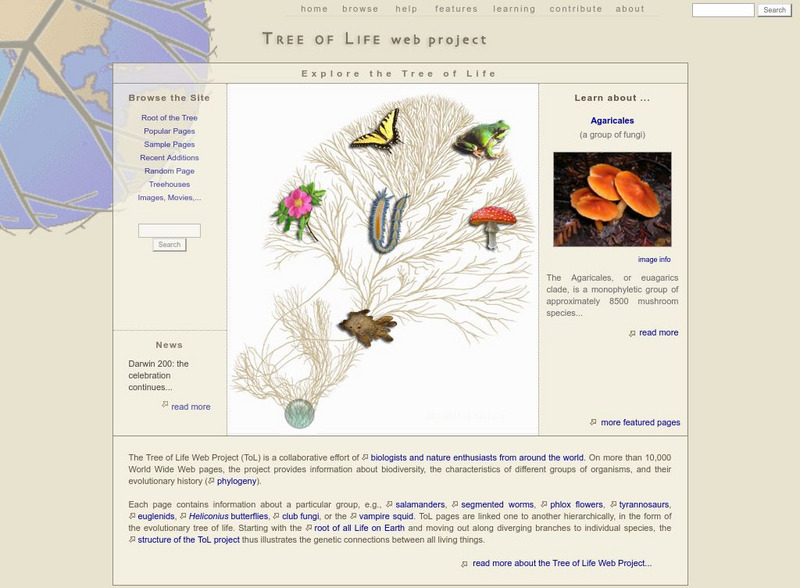
Tree of Life Project
The Tree of Life Web Project
The Tree of Life Web Project contains information on living organisms including their history and characteristics. Over 3,000 web pages are linked together uniting all living things.
Other
The Happy Scientist: What Is a Food Web?
A food web is a way of seeing how energy is transferred from organism to organism. All living things need energy. They use it to move, to grow, to reproduce. That energy has to come from someplace. Drawing a food web is a great way to...
Utah Education Network
Uen: Themepark: Cycles
This is a large collection of resources on cycles of nature and the Earth. There is a constant exchange of the elements between air, earth, water, plants, and animals. Most biological processes wind up back where they started. These...
PBS
Pbs Learning Media: Decomposers
Without the work of decomposers, living organisms would eventually use up all the raw materials in the environment, and dead organisms and wastes would pile up. This video segment from Interactive NOVA: "Earth" describes the role of...
Other popular searches
- Classify Living Things
- Grouping Living Things
- Basic Needs of Living Things
- Classifying Living Things
- Classification Living Things
- Needs of Living Things
- Non Living Things
- Classifying Living Organisms
- Five Kingdoms of Living Things
- Kingdoms of Living Things
- What Living Things Need
- Living Organisms Biology