Hi, what do you want to do?






Science Struck
Science Struck: Difference Between Paramagnetism and Diamagnetism
Compares paramagnetism to diamagnetism and lists the elements that are diamagnetic and paramagnetic.
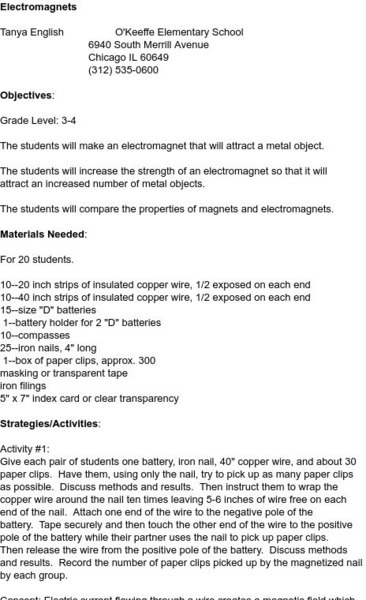
Science and Mathematics Initiative for Learning Enhancement (SMILE)
Smile: Electromagnets (Grades 3 and 4)
This lesson helps students to understand the difference between magenets and electromagnets. They will also create an electromagnet.
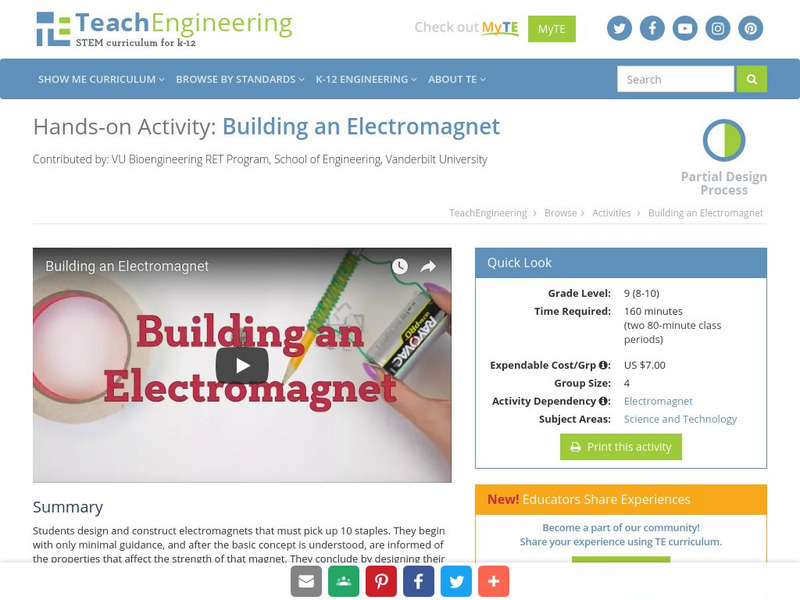
TeachEngineering
Teach Engineering: Building an Electromagnet
Students design and construct an electromagnet that must pick up 10 staples. They begin with only minimal guidance, and after the basic concept is understood, are informed of the properties that affect the strength of that magnet. They...
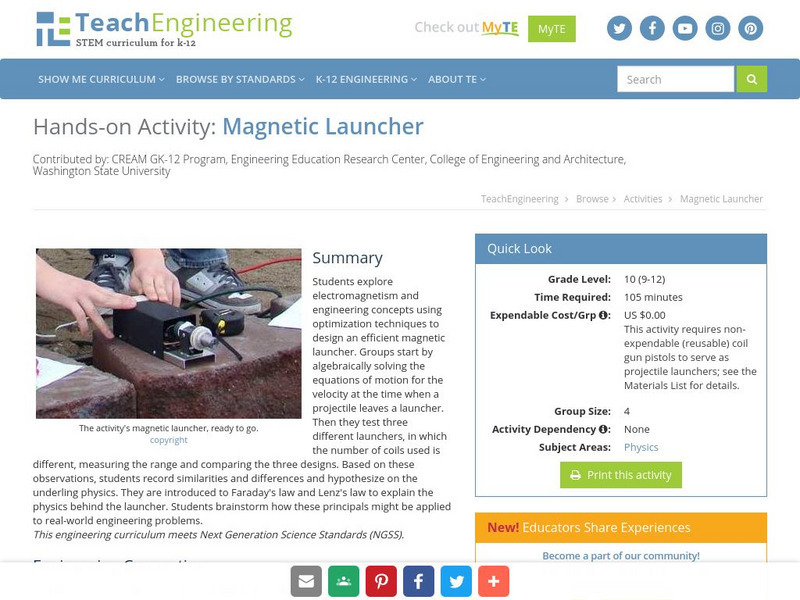
TeachEngineering
Teach Engineering: Magnetic Launcher
Students explore electromagnetism and engineering concepts using optimization techniques to design an efficient magnetic launcher. Groups start by algebraically solving the equations of motion for the velocity at the time when a...
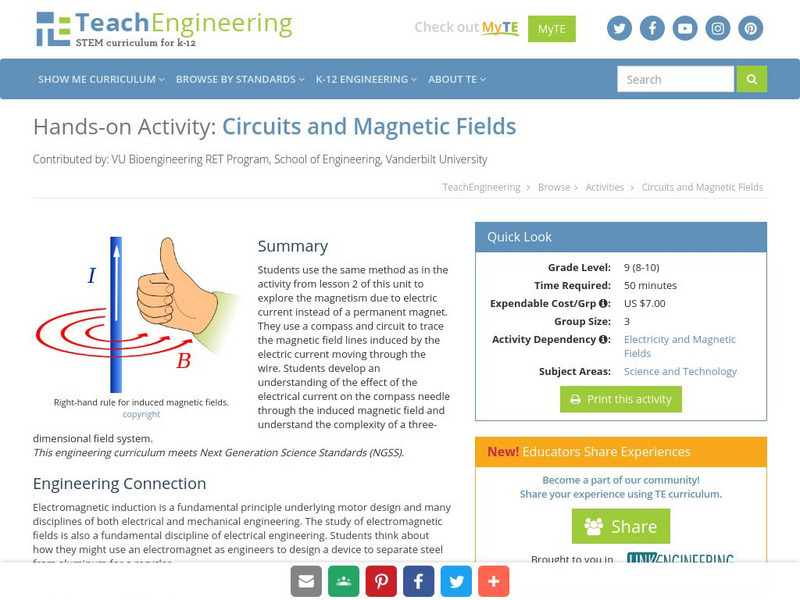
TeachEngineering
Teach Engineering: Circuits and Magnetic Fields
In this activity, students use the same method as in the activity from lesson 2 to explore the magnetism due to electric current instead of a permanent magnet. Students use a compass and circuit to trace the magnetic field lines induced...
Georgia Department of Education
Ga Virtual Learning: Ap Physics 2: Electromagnetic Induction
Through labs, readings, videos, and discussions, students learn about the concepts of Electromagnetic Induction.
National High Magnetic Field Laboratory
Magnet Academy: Timeline of Electricity and Magnetism: 1820 1829
Hans Christian Orsted's accidental discovery that an electrical current moves a compass needle rocks the scientific world; a spate of experiments follows, immediately leading to the first electromagnet and electric motor.

Alabama Learning Exchange
Alex: Are You Picking Up What I'm Putting Down?
How are magnetism and electricity related? Students will explore the relationship between magnetism and electricity, learn how to construct an electromagnet, and discover everyday uses of electromagnets. Students will create a multimedia...
TeachEngineering
Teach Engineering: Two Sides of One Force
Students learn more about magnetism, and how magnetism and electricity are related in electromagnets. They learn the fundamentals about how simple electric motors and electromagnets work. Students also learn about hybrid...
National High Magnetic Field Laboratory
Magnet Academy: James Clerk Maxwell
James Clerk Maxwell was one of the most influential scientists of the nineteenth century. His theoretical work on electromagnetism and light largely determined the direction that physics would take in the early twentieth century. Indeed,...
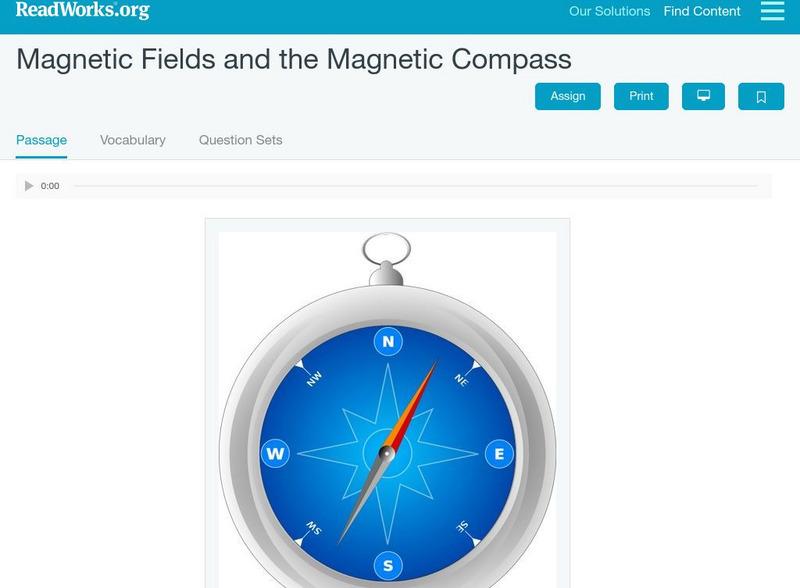
Read Works
Read Works: Electric and Magnetic Forces and the Modern Day Compass
[Free Registration/Login Required] An informational text about how a compass works using electromagnetic force. A question sheet is available to help students build skills in reading comprehension.

University of St. Andrews (UK)
University of St. Andrews: James Clerk Maxwell
Research resources for James Maxwell (1831-1879), who did revolutionary work on electricity and magnetism and on the kinetic theory of gases.
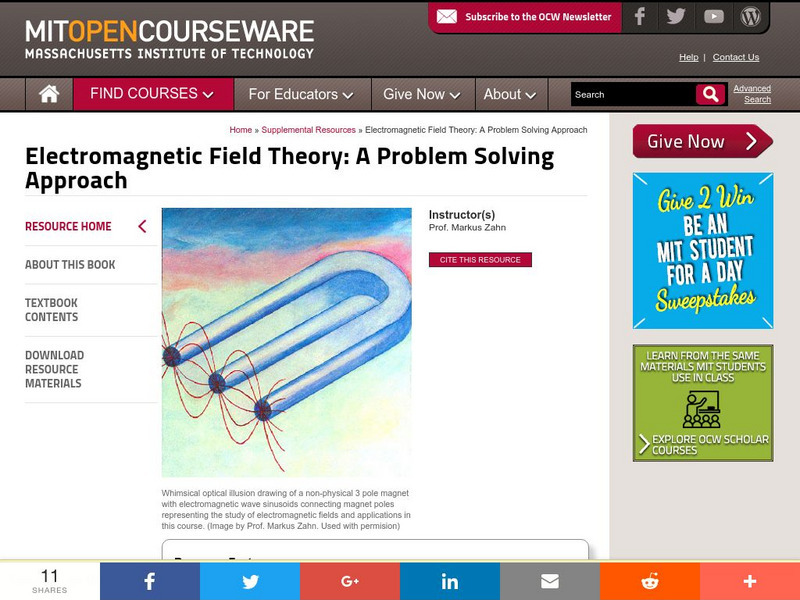
Massachusetts Institute of Technology
Mit: Open Course Ware: Resources: Electromagnetic Field Theory
College-level electrical engineering textbook starting from the Coulomb-Lorentz force law on a point charge. Sample problems that reinforce the content are found at the end of each chapter. Includes downloadable excerpts of the textbook...
National High Magnetic Field Laboratory
Magnet Academy: Hans Christian Orsted
A discovery by Hans Christian Orsted forever changed the way scientists think about electricity and magnetism. While preparing to perform an experiment during a lecture at the University of Copenhagen, he found that the magnetized needle...
National High Magnetic Field Laboratory
Magnet Academy: Charles Augustin De Coulomb
Charles-Augustin de Coulomb invented a device, dubbed the torsion balance, that allowed him to measure very small charges and experimentally estimate the force of attraction or repulsion between two charged bodies. The data he obtained...
National High Magnetic Field Laboratory
Magnet Academy: Andre Marie Ampere
Although he was not the first person to observe a connection between electricity and magnetism, Andre-Marie Ampere was the first scientist to attempt to theoretically explain and mathematically describe the phenomenon. His contributions...
National High Magnetic Field Laboratory
Magnet Academy: Lee De Forest
American inventor Lee De Forest was a pioneer of radio and motion pictures. He received more than 300 patents over the course of his lifetime, the most important of which was for a three-electrode vacuum tube, or triode, that he called...
National High Magnetic Field Laboratory
Magnet Academy: Heinrich Hertz
The discovery of radio waves, which was widely seen as confirmation of James Clerk Maxwell's electromagnetic theory and paved the way for numerous advances in communication technology, was made by German physicist Heinrich Hertz. In the...
Florida State University
Florida State University: Inductance
This article surveys inductance and its different forms. It discusses numerous topics associated with inductance such as Faraday's Law, self and mutual inductance, inductors, and magnetic field lines.
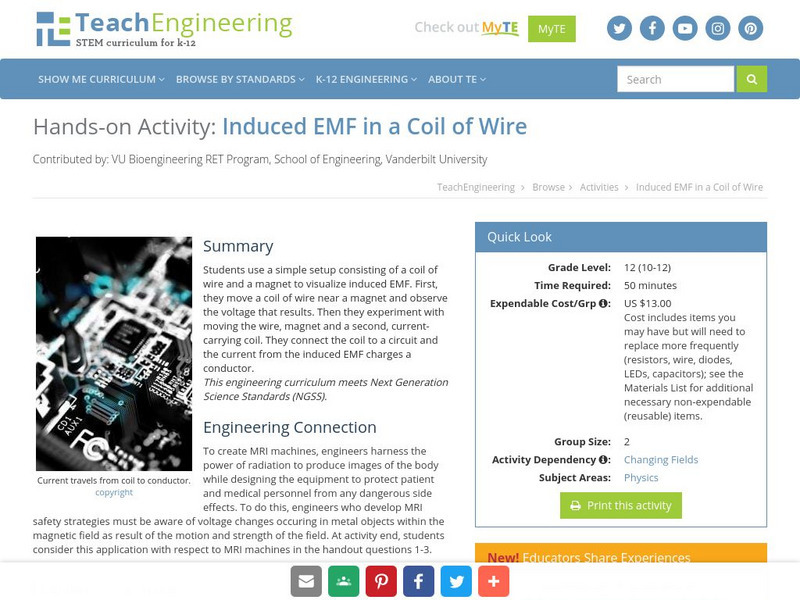
TeachEngineering
Teach Engineering: Induced Emf in a Coil of Wire
Students use a simple set up consisting of a coil of wire and a magnet to visualize induced EMF. First, students move a coil of wire near a magnet and observe the voltage that results. They then experiment with moving the wire, magnet,...
University of New South Wales (Australia)
University of New South Wales: Einstein Light
Einstein Light highlights the Theory of Special Relativity and related topics. Learn how Galileo, Maxwell, and Einstein contributed to our knowledge of relativity, electricity, magnetism, and time by watching fun, interactive modules.
Florida State University
Florida State University: Nature of Electromagnetic Radiation
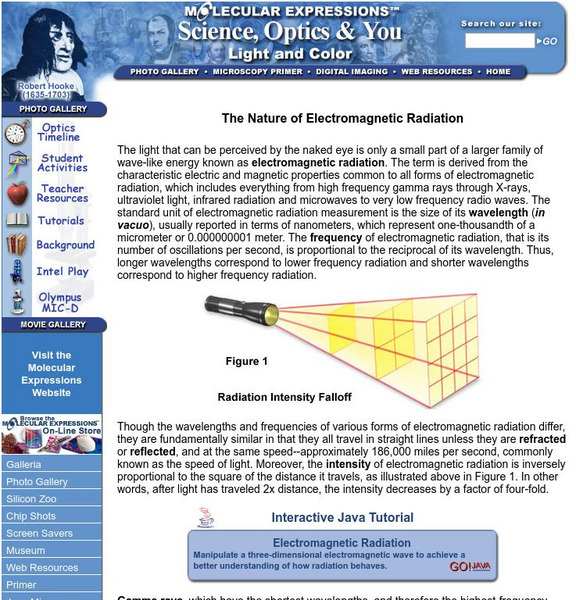
This site from The Florida State University provides an informational page on electromagnetic radiation discusses the characteristics and properties of its many forms including X-rays, gamma rays, ultraviolet radiation, infrared...
Science Bob Pflugfelder
Science Bob: Build an Electromagnet!
This site presents a procedure for creating your own electromagnet using an iron nail, some wire, and a battery. The site illustrates a connection between electricity and magnetism.
Cosmo Learning
Cosmo Learning: Physics Ii: Electricity and Magnetism
A collection of video lectures from a fundamentals of physics course taught at Massachusetts Institute of Technology. The course is the second in the sequence and focuses on electricity and magnetism The videos feature topics on...