Hi, what do you want to do?






Curated OER
Volume, Mass, and Weight
Study the difference between mass and weight. Your math group will compare the weight of an item to the amount of space that it uses. They'll then use conversion factors to find the difference between kilograms and pounds. Essential...

Curated OER
Many Ways to Represent Our Data
Demonstrate several ways to represent data with your class. They will use surveys to gather data and display the data using tally charts and graphs. Then answer questions according to the data.

Curated OER
"Jabberwocky": Inferring
Pupils, over an extended time, read and explain the nonsense words of Lewis Carroll's poem, "Jabberwocky". They infer the meaning of the poem using visualizing as well as decoding skills. While written for first graders, this is easily...

Curated OER
Some Houses Are Made of Straw, Wood, or Brick: But... This House is Made of Mud...
First graders read and discuss several stories. They share information about different types of shelter around the world. They explain that lifestyles and shelter depend very much on where people live and how they use the resources...

Curated OER
Introduction to Probability
In this probability worksheet, 11th graders review basic probability concepts such as chance, probability lines, and possible outcomes. There are 6 problems on here.

Curated OER
Graphing Data
Second graders graph data about their classmates. In this data analysis instructional activity, 2nd graders ask each other several questions about their hair color and eye color. Students graph the data that they collected.

Curated OER
Concept: What's The Chance?
In this concept worksheet, students perform probability experiments. Using collected information, they interpret the data. Students answer questions about probability. This five-page worksheet contains approximately 15...

Curated OER
Charts and Graphs
Fifth graders interpret data into graphs and percentages. In this organizing data lesson, 5th graders discuss bar, circle and line graphs. Students complete bar graph and apply probability using the results.

Curated OER
The Who's Who of Quantum Physics
This wonderful recap of powerful figures in scientific history includes pictures, important dates, and the information about their inventions or impact. Atomic structure and the photoelectric effect are introduced. The first slide gives...

Curated OER
Delicious Graphing
Fourth graders sort trail mix by type and use that information to create different types of graphs for comparing.

Curated OER
How Many Ice Creams?
Students discuss their favorite ice cream flavors and read the math problem. They brainstorm the problem and brainstorm for ways to solve the problem. Students work in pairs and share solutions.

Curated OER
Creating Circle Graphs with Microsoft Excel
Seventh graders will learn how to construct circle graphs using paper and pencil. Then they will learn how to construct circle graphs using Microsoft Excel. This lesson plan uses technology and shows learners how to cross skills into the...

Curated OER
What is the Risk?
Students investigate the 1950's pollution tragedy in Minamata, Japan. The elements of dose, response, individual susceptibility, potency, and threshold of toxicology are explored in this lesson.

Curated OER
Creating Circle Graphs with Microsoft Excel
Students create graphs of circles. In this geometry lesson, students use Microsoft Excel to create graphs. They construct the graphs using paper and pencil as well as the computer.

Better Lesson
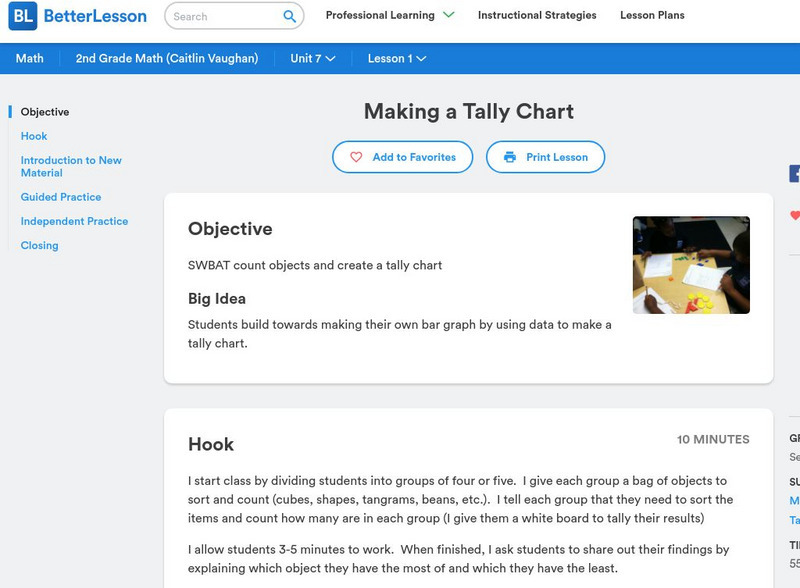
Better Lesson: Making a Tally Chart
Second graders build towards making their own bar graph by using data to make a tally chart.

Better Lesson
Better Lesson: Building Our Own Bar Graphs (Part I)
Second graders use data to create a tally chart and make a bar graph. This lesson includes a detailed plan, videos of students engaged in the lesson, and printable worksheets.
CK-12 Foundation
Ck 12: Statistics: Histograms Grades 9 10
[Free Registration/Login may be required to access all resource tools.] Make a histogram given a frequency table.