Hi, what do you want to do?






NOAA
Why Should I Care?: Show How Increased Carbon Dioxide Makes the Ocean More Acidic
How does a change in pH affect the ocean ecosystem? Scholars explore the idea by making an acid-base indicator in part seven of the 10-installment Discover Your Changing World series. First, they explore impacts of carbon dioxide in...

US Department of Energy
Wave Erosion
Fourth graders examine the effects of waves on coastal land. They discover how water's power can change the appearance of land formations.

American Museum of Natural History
Make Your Own Creatures of Light
Bioluminescent animals are the focus of a hands-on craft in which scholars create a scene of either a land or sea bioluminescent creature.

NOAA
Make Your Own Compass
Scholars build a compass using a needle, cork, magnet, and a water-filled cup in order to locate the magnetic north and south.

PBS
Reading Adventure Pack: Oceans
Flotsam by David Wiesner and The Magic School Bus on the Ocean Floor by Joanna Cole, illustrated by Bruce Degen, begin a reading adventure pack focusing on oceans. With story listening and thoughtful discussion, scholars complete several...

Exploratorium
A Splash of Color - Is Pure Water Colorless?
What makes the ocean blue but a glass of ocean water nearly colorless? Investigators prepare tubes of water to examine the color of water. Scholars discover the relationship between light absorption, color variations, and water depth as...

California Academy of Science
Be Prepared for an Earthquake
Earthquakes can be frightening and dangerous, but being prepared can make a world of difference. Perform an earthquake simulation during which the class practices how to drop, cover, and hold on as you read a script...
TeachEngineering
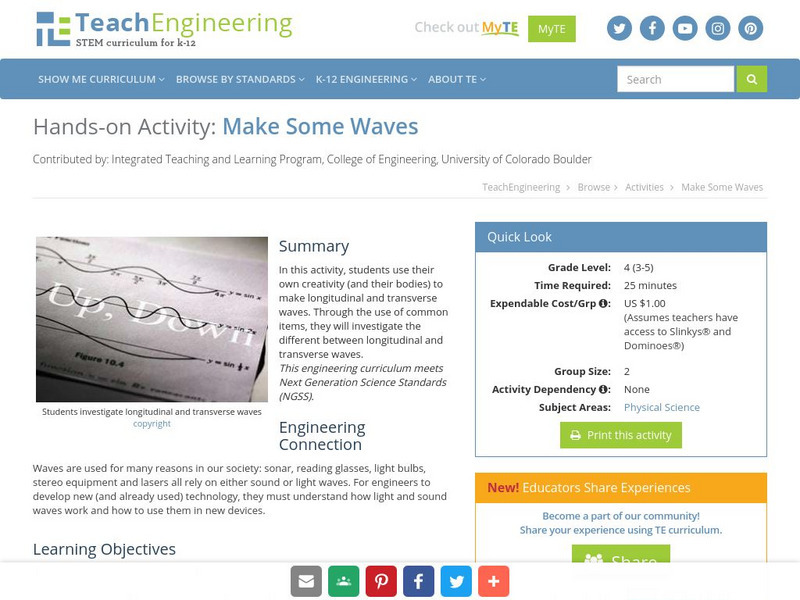
Teach Engineering: Make Some Waves
In this activity, students use their own creativity (and their bodies) to make longitudinal and transverse waves. Through the use of common items, they will investigate the different between longitudinal and transverse waves.
Science Buddies
Science Buddies: Tireless Tides: Extracting Energy From Ocean Tides
Renewable energy is the energy that is extracted from natural sources, such the Sun (solar), earth (geothermal), wind, and water (hydropower). These sources are renewable because they can be replenished by the same natural sources within...
Science Buddies
Science Buddies: Building Beaches
A day at the beach is a wonderful way to spend time with your family and friends. You can swim, play games, and build sand castles. But have you ever thought about how all of that sand got there and wondered why the shoreline weaves in...

TeachEngineering
Teach Engineering: Survive That Tsunami!
Students use a table-top-sized tsunami generator to observe the formation and devastation of a tsunami. They see how a tsunami moves across the ocean and what happens when it reaches the continental shelf. Students make villages of model...