Hi, what do you want to do?






Curated OER
Precision Tools
Young scholars discuss the appropriateness of using a specific tool to measure and define an object. After measuring the area of their classroom and the objects in it with the appropriate tools, they create a floor plan that makes the...

Curated OER
What's Your Expression
First graders explore facial expressions in a mirror and create drawings of people with a facial expression of their choice. They graph the facial expressions drawn.

Curated OER
Lagoon Lake
Pupils develop skill in using co-ordinates. Up to eight cardinal points of the compass are used making this a useful activity in simple map and grid work. They utilize educational software to gain practice.

Curated OER
Angles and Parallel Lines
Sixth graders draw parallel and intersecting lines to observe and examine the characteristics of alternate interior angles, vertical angles, corresponding angles, and supplementary angles. Through observation, they discover the...

Curated OER
ndirect Measurement Technique: Using Trigonometric Ratios
Ninth graders find the height of an object that would be difficult or impossible to measure directly. They construct and use a Clinometer to measure the angle of elevation (or depression). Students create a sketch of the measurement...

Curated OER
Comedia dell' Arte Paper Masks
Students create masks from the Italian Renaisance theatre and use them in one-act plays they write. they analyze the role and development of theatre in world cultures.

Curated OER
Take an Ant to Lunch
Second graders construct a model of an ant, exemplifying that ants are insects. Students gather data create a pictograph chart to show ant food preferences. Also, 2nd graders access the Internet to explore ant eating habits.

Curated OER
Kites of Japan
Students perform research into the designs of Japanese kites in order to appreciate them for their aerodynamic designs. The appreciation builds student interest in order to produce their own similar designs.

Curated OER
Eggs'ceptional Experiments
Students see evidence of chemical reaction and follow the scientific method to hypothesize, observe, and reach conclusions. They conduct a series of egg based experiments such as forming crystals and complete journal activities as a...


Curated OER
Plaster Sculpture – subtractive method
Practice the subtractive sculpture process with your class. They'll discuss the subtractive method, art form and space, then design a sculpture which they will create from a block of plaster. Technical instructions are included.

Curated OER
The Symmetry of Snowflakes
Celebrating the change of season with science and language arts activities.

Curated OER
Prefixes: ir and il
In this prefixes practice learning exercise, students respond to 52 questions that require them to fill in the blanks, write original sentences, can complete a word search.

Curated OER
Artists, Architects, and Architecture
Young scholars are introduced to the concept of architecture and how it has changed over time. In groups, they discuss how the places people have built reflects their values and needs. They use the internet to research the history of...
Better Lesson
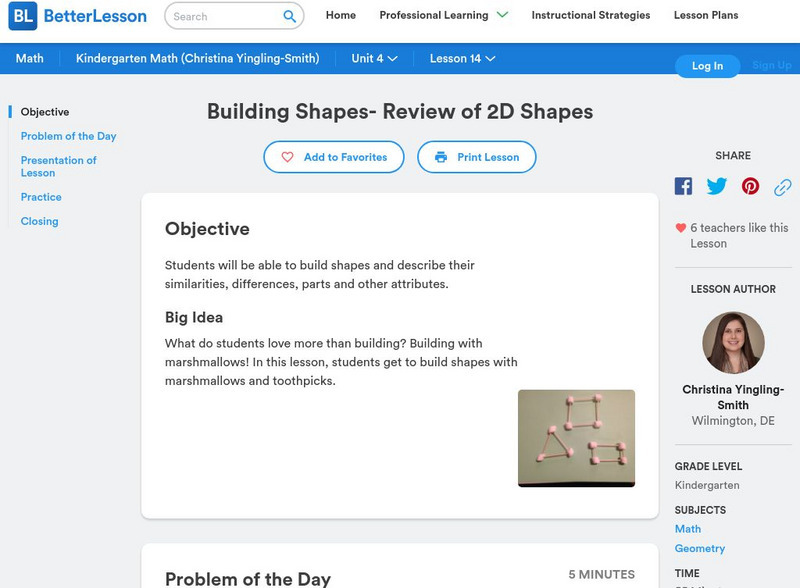
Better Lesson: Building Shapes Review of 2 D Shapes
What do students love more than building? Building with marshmallows! In this activity, students get to build shapes with marshmallows and toothpicks. Included are an extensive lesson plan, a video showing examples, a worksheet, and...
Government of Alberta
Learn Alberta: Math Interactives: Exploring Surface Area, Volume, and Nets
Investigate the concepts of area, volume, 3D shapes, and nets using this interactive Learn Alberta math. The solid shapes focused on this exploration include rectangular and triangular prisms, rectangular and triangular pyramids,...

NumberNut
Number Nut: Shapes, Symbols, and Colors: 2 D Shapes
Did you know that two-dimensional shapes are also called polygons? This lesson describes the various 2-D shapes and includes two interactive games to reinforce skills.
Scholastic
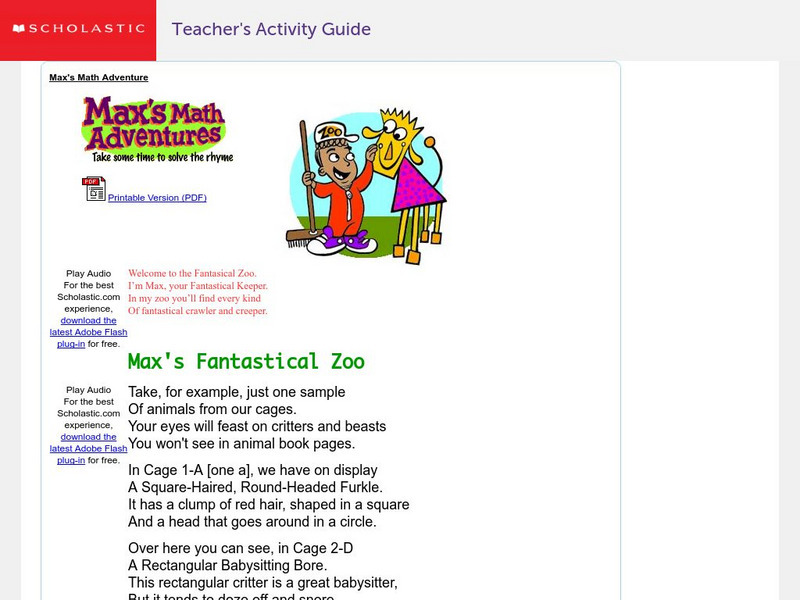
Scholastic: Max's Math Adventures: Max's Fantastical Zoo
Use this rhyming description of Max's Fantastical Zoo to make some amazing animals from geometric shapes. There is a teacher's guide for easy lesson planning.

Alabama Learning Exchange
Alex: Guess My Shape
The students will make the connection between 2-D and 3-D shapes using modeling clay and geometric solids and participate in an interactive web lesson. Students will make predictions about what 2-D shape they think will be made when they...

Other
Nearpod: 2 D Shapes
In this lesson on 2D shapes, 3rd graders will learn to discriminate quadrilaterals from other polygons. Additionally, they will be able to identify attributes of a square, rectangle, and rhombus.

National Council of Teachers of Mathematics
The Math Forum: Building a Pyramid
This Math Forum lesson gives instructions on how to build a paper pyramid. Bonuses included finding the surface area and volume of the pyramid.
National Council of Teachers of Mathematics
The Math Forum: The Cylinder Problem: Middle School Lesson
This lesson offers an interesting, hands-on experience for middle school students studying cylinders. Students will create cylinders, and measure and compare their volumes.
BBC
Bbc: Bitesize: Ks2: Maths: Shape, Space, and Measurement
Interactive lessons featuring 2-D and 3-D shapes, angles, time, and symmetry. For each section, play a learning game, read a lesson that includes comprehensive vocabulary, and take a quiz to find out what you've learned.

National Council of Teachers of Mathematics
The Math Forum: The Cylinder Problem: High School Lesson
Using an engaging approach, this lesson plan requires students to record the volume of cylinders as a function of the radius. Students will construct and measure the volume of several cylinders and then begin comparing these shapes.