Hi, what do you want to do?






Illustrative Mathematics
Field Day Scarcity
Introduce young mathematicians to concepts of financial literacy with this open-ended word problem. With seven dollars to spend during field day and given a list of available items and their prices, children must determine how they want...

Curated OER
Classroom Supplies
Challenge young mathematicians to buy classroom supplies by staying within the means of a $1,000 budget. The mathematical activity provides learners with the opportunity to decide what items from the supply list would benefit a class of...

Curated OER
Visiting the Arcade
Second graders take a trip to the arcade in an activity that engages them in problem solving with money. Composed of three word problems, youngsters are instructed to determine various combinations to represent a given value by using...

Curated OER
Gifts from Grandma, Variation 1
Composed of three word problems, this math activity exposes young mathematicians to relationships present in multiplication and division. The first problem is most useful with a tape diagram in which learners are working with equal-sized...

Illustrative Mathematics
Oakland Coliseum
Help algebra learners relate a real-life function that happens at the Oakland Coliseum every time the Raiders play. The resource states that the revenue of the Oakland Raiders home games is a function of the number of seats sold and the...

Noyce Foundation
Counters
For some, probability is a losing proposition. The assessment item requires an understanding of fraction operations, probability, and fair games. Pupils determine the fractional portions of an event. They continue to determine whether...

Illustrative Mathematics
Sounds Really Good! (Sort Of...)
Winning a lottery game with 60% odds sounds like a no brainer. This is when the math kicks in to show players that in the long run, they lose money the more often they play. Here is one simple question that opens the doors to a nice...

Illustrative Mathematics
Gifts from Grandma, Variation 3
There are three money word problems in this activity, each one is set in the same context. The first asks what was the total amount grandma spent, the second how many grandchildren grandma has, and the third asks how much grandma spent...

Mathematics Assessment Project
Lottery
A probability activity presents a lottery game as an idea for a fundraiser. Pupils analyze the game to determine the number of possible outcomes, then determine whether the game would be a good way to raise funds and to support...

EngageNY
The Difference Between Theoretical Probabilities and Estimated Probabilities
Flip a coin to determine whether the probability of heads is one-half. Pupils use simulated data to find the experimental probability of flipping a coin. Participants compare the long run relative frequency with the known theoretical...

Illustrative Mathematics
What is 23 ÷ 5?
Twenty-three divided by five can have a different value depending on the unit of measurement being asked. Learners problem solve 23 divided by 5 in a series of five word problems.

EngageNY
Mid-Module Assessment Task: Grade 7 Mathematics Module 4
Assess the ability of the class to solve percent problems with an assessment that covers a variety of percent problems from basic to multi-step. Pupils make connections between percent problems and proportional thinking to complete...

EngageNY
Mid-Module Assessment Task: Grade 8 Module 6
Make sure pupils have the skills to move on to the second half of the module with a mid-module assessment task. The formative assessment instrument checks student learning before moving on to the rest of the lessons in the unit.

Charleston School District
Review Unit 4: Linear Functions
It's time to show what they know! An assessment review concludes a five-part series about linear functions. It covers all concepts featured throughout the unit, including linear equations, graphs, tables, and problem solving.

EngageNY
End-of-Module Assessment Task - Precalculus (Module 5)
Give your young scholars a chance to show what they've learned from the module. The last installment of a 21-part series is an end-of-module assessment task. It covers basic and conditional probabilities, expected value, and...

Curated OER
Sounds Really Good! (sort of...)
Your friend Phil wants to know if he should play the lottery. Have your class use the given data to compute the expected value and explain to Phil what he should do and why. This handout is ideal for a quick assessment of skill and...
Lizard Point Quizzes
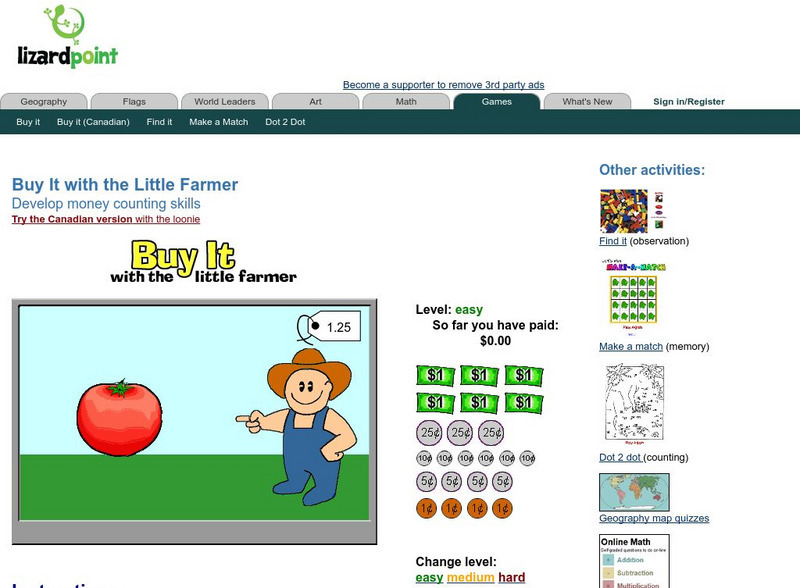
Lizardpoint: Buy It With the Little Farmer
This is an engaging math money game that helps students on three different levels master the concept of paying for various items.

Varsity Tutors
Varsity Tutors: Aplus Math: Non Java Flashcards (Mixed Topics)
Find a great selection of non-Java math flashcard activities. Choose from an index of flashcard topics of a variety of difficulty levels. Topics include: basic and advanced addition, subtraction, multiplication, and division, algebra,...