Hi, what do you want to do?






Curated OER
Power, Work and the Waterwheel
Middle schoolers use a two-liter bottle, dowel rod and index cards to design and construct a water wheel. They then calculate the power created and measure the work done by the water wheel in Watts and Joules.

Curated OER
Tides of Change
Students use the Internet to gather information on tides and then use this information to determine the period of revolution of the moon around the earth (part 1) and the relative pull of the sun and the moon on the tides (part 2).

Curated OER
What Trickles Down?
Middle schoolers explore different levels of permeability and compare the permeabilities of several different materials. They are introduced to the basic concepts of building design, landscape architecture, and environmental pollutant...

Curated OER
Let's Pretend
In this Language Arts worksheet, students read a poem called "Let's Pretend." The poem includes descriptions of different animals, such as a bird and a horse.

Curated OER
#3 "Our Community" Asthma Quiz
Students take an asthma quiz, they use their prior research and existing knowledge to answer the questions. They complete this true/false and fill in the blank test in reference to asthma information dealing with Miami-Dade County.

Alabama Learning Exchange
Seeds: How They Grow
Students observe the growing stages of plants. In this plant growth activity, students collect, germinate, and plant seeds to chart the growth process of plants.

Curated OER
No Flaw With Newton’s 1st Law
Students explain what inertia is in their own words. For this physics lesson, students investigate how Newton's first law applies to their robot. They discuss real world examples of the 1st law.

Curated OER
Triangles Are Not Bad
Students explore cultural diversity. In this multiculturalism lesson, students participate in a simulation that requires them to consider the implications of belonging to cliques and stereotyping others.

Curated OER
The Air We Breathe
Middle schoolers discover the cuases of pollution. They investigate different pollutants that exist. Stsudents research technologies developed by engineers to reduce the amounts of air pollution. Upon completion of assigned...

Curated OER
Triangle Triage
Students will use components to make a balanced decision. They will be able to rationalize their own decisions while understanding the perspectives of others. They will then develop criteria to quantify their decisions.

Curated OER
Let Your Ears Do the Walking
Students examine the effects of bycatching on water environments. They discover how echolocation works. They participate in a simulation of the process to use it while walking blindfolded.

Curated OER
The 35mm Camera Lesson
Ninth graders explore the 35mm camera. They discuss and identify the various parts and characteristics of the 35 mm camera. Students examine the two aspects of a 35 mm camera that control the light.

Curated OER
When Things Heat Up
Ninth graders investigate relationship between the temperature and concentration of dissolved oxygen in water. They examine how pollution and other natural influences can cause the parameters to change. In groups, 9th graders collect...

ABCya
Ab Cya: Molly's More or Less Quest
Molly is back in a More or Less Quest! This educational activity provides word problems with manipulatives for kids to practice comparing more or less. The word problems are read aloud and have objects that can be used for counting and...
CK-12 Foundation
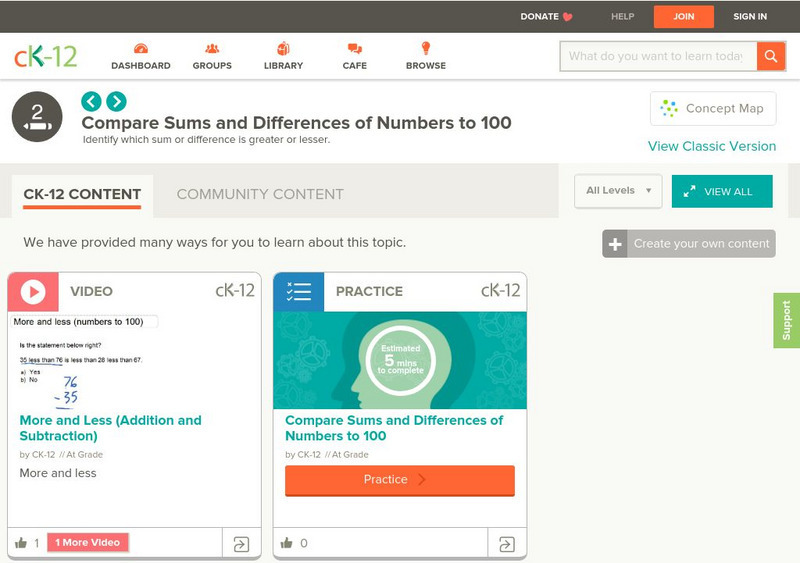
Ck 12: Elem Math: More and Less Addition and Subtraction
[Free Registration/Login may be required to access all resource tools.] The video describes how to break down a subtraction statement to determine if the statement should be more or less than. The video is followed by a series of...
Other
Nearpod: 1, 10, 100 More or Less
In this lesson plan, 1st graders will learn how to use base ten blocks and hundreds charts to find 1, 10, and 100 more and less than a given number.
PBS
Pbs Learning Media: Math + Arts: Chinese Music & Dance: More or Less
Students learn about Chinese culture and the concept of greater than and less than. After watching a student performance of a Chinese song and dance students are taught the difference between locomotor and non-locomotor motions. Students...

Alabama Learning Exchange
Alex: It's Automatic! More or Less With Ten
In this lesson, students will observe patterns with the use of a Hundreds Chart, web-based practice (IXL Hundreds Chart Practice), and by playing a game (10 More or 10 Less). The patterns noticed through the various activities will help...
Can Teach
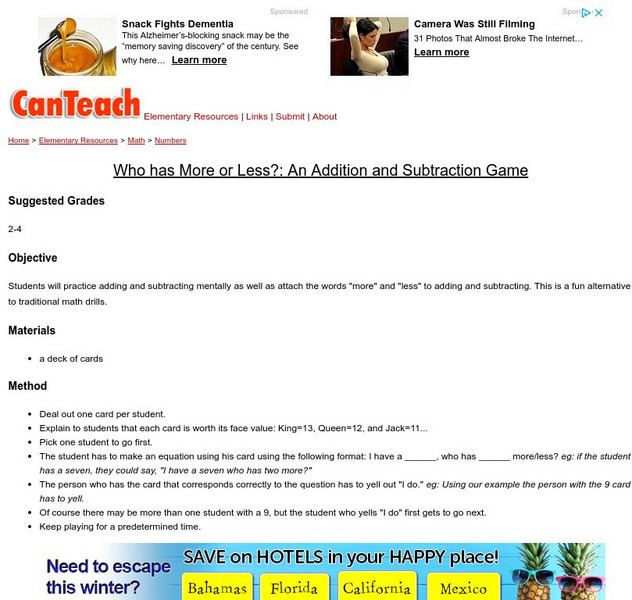
Can Teach: Who Has More or Less?
Want to practice addition and subtraction skills in a new and exciting way? Use this online math lesson card game activity.
Illustrative Mathematics
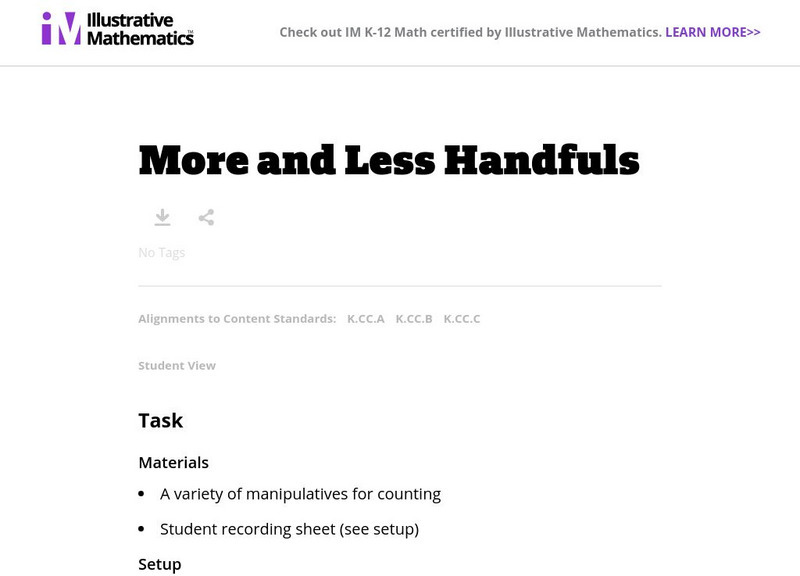
Illustrative Mathematics: More and Less Handfuls
This is a good small group/pairs activity to practice counting. Each student grabs two handfuls of counters and counts them. The student then draws and records the quantity on a student-recording sheet (example included). Student...
Khan Academy
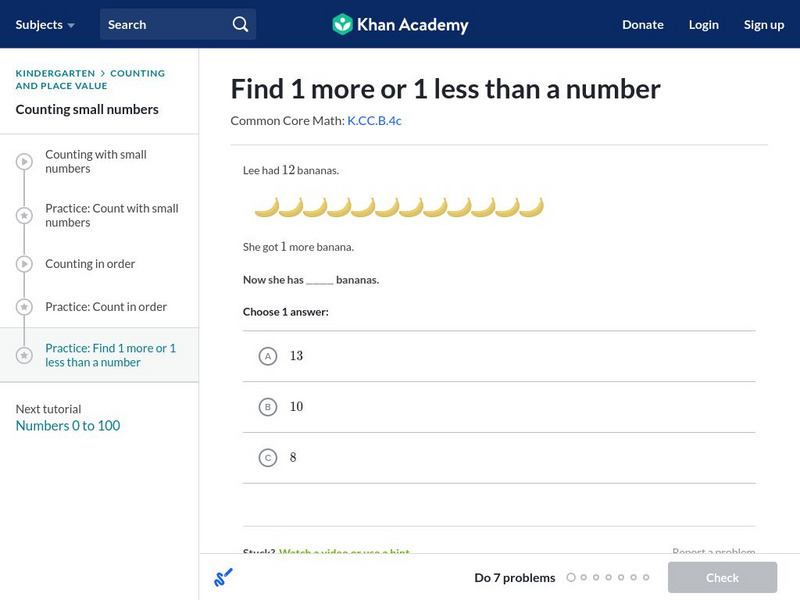
Khan Academy: Find 1 More or 1 Less Than a Number
Practice finding one more or one less than a number. Students receive immediate feedback and have the opportunity to try questions repeatedly, watch a video or receive hints.
Scholastic
Scholastic Lesson Plan: Simple Ways to Assess Math Sense
This site has two lesson plans are presented by Marilyn Burns and associates that use children's literature to help assess math sense. One lesson plan is for use with primary students while the other is for use with intermediate students.

NumberNut
Number Nut: More or Less: Comparing Values Less Than Thirty Cents
Compare two groups of coins and determine which group is worth more or less than the other. Money values are less than thirty cents. Words, not inequality signs, are used to compare the values. Score is kept as you go through activity.
CK-12 Foundation
Ck 12: Elem Math: Divide and Subtract With Remainders in Word Problems
[Free Registration/Login may be required to access all resource tools.] A practice quiz where students use division and subtraction to answer word problems by determining how much more or less is needed to satisfy the given amount.