Hi, what do you want to do?






Resources for Early Childhood
Making Math Meaningful and Enjoyable
Your young learners will enjoy mathematics that is meaningful correspondence as they play their way to a deep mathematical foundation. Organized around the math standards, this appropriate sequence of conceptual, preschool...

Illustrative Mathematics
Shape Sequence Search
Learning that size and orientation don't affect the classification of shapes is a big step for young mathematicians. Support children with developing this key understanding by looking at the array of shapes included in this resource. For...

101 Questions
Pixel Pattern
Any vintage video game users in the room? Young scholars use a video presentation to analyze patterns in pixel arrangements. By writing an arithmetic sequence, they make predictions about the size of the image.

Getting to Know
Shape and Form in Art
Introduce youngsters to the important role shape and form play in art with this extensive collection of activities and projects. From teaching first graders how to create mandalas to engaging third and fourth graders in the design...

101 Questions
Toothpicks
Analyze patterns and build functions. Young scholars work on their modeling skills with an inquiry-based lesson. After watching a video presentation of the problem, they write functions and make predictions.

101 Questions
Coins in a Circle
Round and round you'll go! Learners watch as different-sized circles fill with coins. They collect data and then make a prediction about the number of coins that will fit in a large circular rug.

Noyce Foundation
Tri-Triangles
Develop an understanding of algebraic sequences through an exploration of patterns. Five leveled problems target grade levels from elementary through high school. Each problem asks young mathematicians to recognize a geometric pattern....

101 Questions
Domino Skyscraper
Can a domino knock over a skyscraper? An inquiry-based lesson asks learners to calculate the size of domino needed to topple the Empire State Building. Using specific criteria and a geometric model, they find a solution.

101 Questions
Tether Ball
All work and no play makes for a boring classroom! Bring back memories by analyzing the patterns of a tether ball. Given the dimensions of the ball, pole, and rope, young scholars must determine how many times the ball will wrap around...

5280 Math
Polygon Polynomials
Patterns in polygons lead to patterns in polynomials. Presented with a series of polygons, individuals create polynomial expressions to represent their patterns. The algebra project consists of nine problems that incorporate polynomial...

101 Questions
Can-struction
Can you solve it?! A New York City art challenge involves making sculptures from cans. The task is to determine the number of cans used in the engineering award-winning sculpture. Scholars consider the patterns in the different layers to...

Curated OER
Seeing Dots
Your algebra learners interpret algebraic expressions, in order to compare their structures, using a geometric context. They also discern how the two expressions are equivalent and represent a pattern geometrically and algebraically.

Computer Science Unplugged
Twenty Guesses—Information Theory
How do we determine how much information to include and what can be left out? By playing a game of 20 questions, the class generates the best strategies for finding a number. They then move on to guessing the next letter in a short...

5280 Math
Interesting Times
Gain a little interest in functions with a real-life task. Young scholars analyze home loan data with a geometric sequence and series. They use the models to make predictions about the total loan payments at certain intervals in a...

Oregon Department of Education
Building Number Sense
It's never too early to begin a child's math education. This collection of fun hands-on activities engage youngsters in building their number sense as they learn how to count objects, identify numerals, compare amounts, and much more.

Dr. Seuss Enterprises
Read Across America
Celebrate the whimsical world of Dr. Seuss on Read Across America Day with a collection of science, technology, engineering, the arts, and mathematics activities, each linked to a popular Dr. Seuss story.

Illustrative Mathematics
Find The Numbers 0-5 or 5-10
In need of math station or center for your kindergartners? Model how to play this game with the whole class first and then make it into a center. Create a few sets of six number cards with 0-5 or 5-10 and then create a matching die with...

Illustrative Mathematics
Number of the Day
Daily routines not only help to manage classrooms, they can also provide students with rich opportunities for learning. This activity supports young learners in developing their number sense by counting up the school days on a class...

Illustrative Mathematics
How Many _______ Are In. . . ?
Help your learners gain meaningful understanding of dividing fractions using fraction models. The activity includes nine problems which are sequenced to show how the fraction division algorithm evolves. Have students use graph paper or...

NASA
Benford's Law
In this Benford's Law learning exercise, high schoolers read about the first digit frequency of numbers. Students solve 3 problems about sunspot numbers, solar wind magnetism and the depth of the latest earthquakes by using on line sites...
Annenberg Foundation
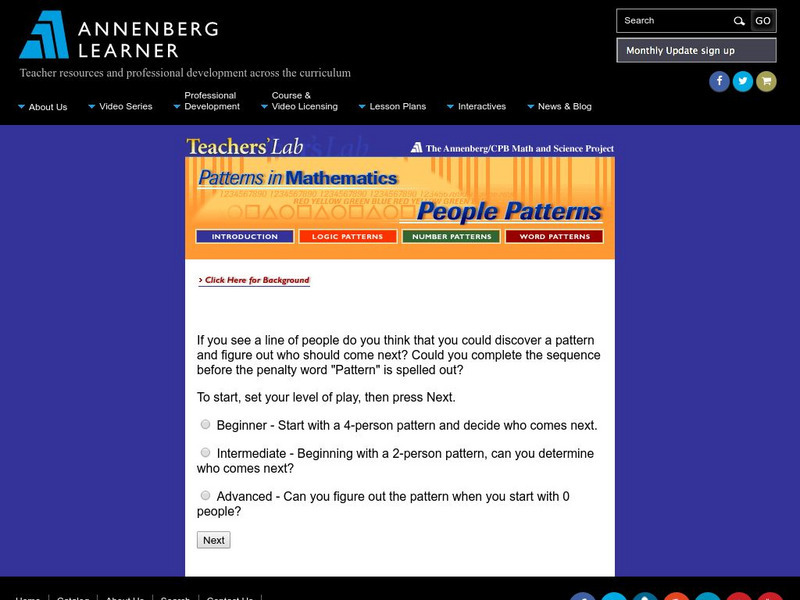
Annenberg Learner: Patterns in Mathematics: People Patterns
This interactive website offers young students an opportunity to discover the pattern and predict who will come next. Feedback and guidance are given for each response. It also offers three increasingly difficult levels that are available.
Scholastic
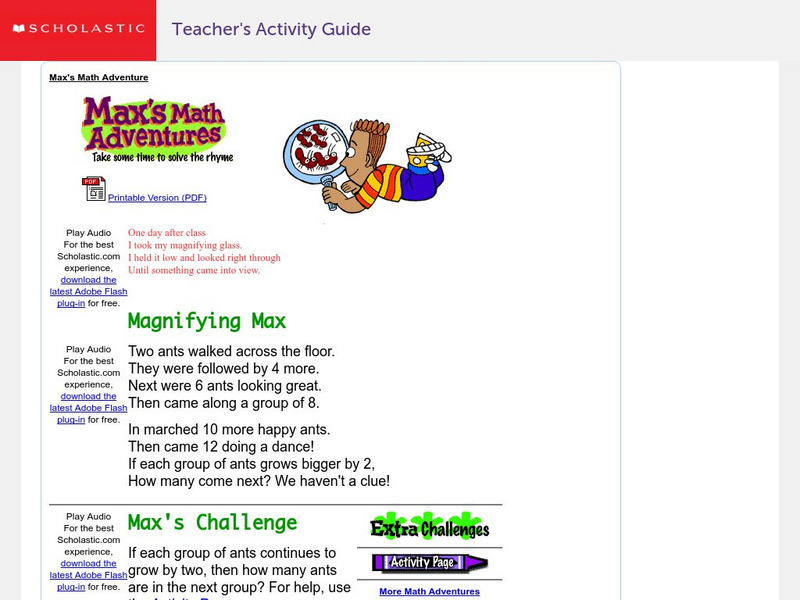
Scholastic: Max's Math Adventures: Magnifying Max
This site has the view through Max's magnifying glass. The ants seem to be walking past him in a pattern, can you help him predict how many ants are coming next? Teachers will like the teacher's guide, activity sheet, and extra challenges.

Other
Math Portal: Arithmetic Progressions
A mini-lesson on arithmetic progressions includes a definition, examples with solutions, and a set of interactive problems at the completion of each lesson.

Maths Challenge
Maths challenge.net: Perimeter Sequence
A "one star" geometry problem that requires finding the visual pattern and applying logic with basic math skills to find the perimeter from the sequence.