Hi, what do you want to do?






Curated OER
Solution Shapes
Eighth graders examine different solutions. In this solution material lesson plan students complete a lab activity and several worksheets.

Curated OER
Characteristics of Materials
Students describe and compare common properties of various classroom materials. In this science/matter lesson, students observe common classroom items and the materials they are made of to complete a list of common properties.

Curated OER
Water 2: Disappearing Water
Learners will observe the amount of water in an open container over time and also examine the amount of water in a closed container over time. They then will compare and contrast the sets.

Curated OER
Molecules
Students combine movement with science in this fun integrated lesson. When students are "liquid" they can "melt" or "ooze" at the end and when they are are "solids" they can "freeze" in a shape.

Curated OER
Activity #19 The Density of Alka Seltzer Gas
Students (teachers) complete the activity, they should not come in contact with Alka-Seltzer. They comprehend that the density of a gas can be calculated from its mass and volume. Pupils calculate the volume of gas generated by...

Curated OER
Where My Peeps At?
Students conduct a series of activity that demonstrates Charles' and Boyle's Law. For this chemistry lesson, students determine the relationship among pressure, volume and temperature. They solve problems using mathematical equation.

Curated OER
Super Glue Fuming of Latent Fingerprints
Students explore latent fingerprinting. They observe a supervised demonstration of the process that real-life crime scene investigators sometimes use to identify latent fingerprints. In addition, they brainstorm ways to improve the...

Curated OER
Can You Hear a Tree Fall in Space?
How does sound travel in space? Fifth graders investigate this question with a science activity, in which they research the properties of sound. Schedule a lab visit for individual Internet research, or include the activity after you...

Center for Literacy and Disability Studies, University of North Carolina at Chapel Hill
Tar Heel Reader: Three Kinds of Matter: Solids, Liquids, and Gases
Find out about the three states of matter: solids, liquids, and gases.
Texas Education Agency
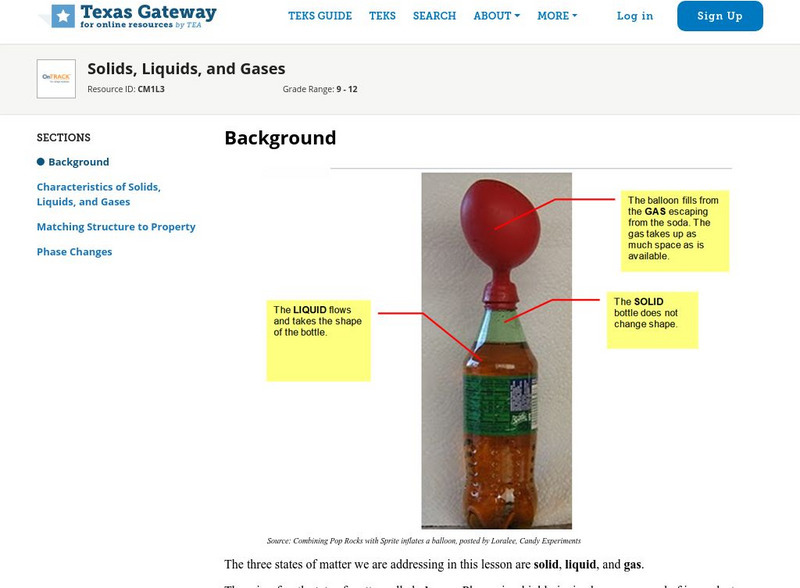
Texas Gateway: Solids, Liquids, and Gases
Given descriptions, scenarios, or illustrations, students will distinguish between the compressibility, structure, shape, and volume of solids, liquids, and gases.
The Association of the British Pharmaceutical Industry
Abpi: Solids, Liquids, and Gases
Students learn about solids, liquids, and gases in this interactive slide show. Animated cartoon characters explain concepts having to do with properties of matter. A self-checking quiz follows the lesson.
The Association of the British Pharmaceutical Industry
Association of the British Pharmaceutical Industry: Solids, Liquids, and Gasses
A collection of cartoon animations that teach students what they need to understand about solids, liquids, and gases.

American Chemical Society
American Chemical Society: Science for Kids: Solids, Liquids and Gases
Engaging hands on science lessons for grades 2-6 on the three states of matter.

Chiral Publishing
Chiral Publishing: An Introduction to Chemistry: Solids, Liquids, and Gases: Audio Book
An interactive guide to the basics of solids, liquids, and gases. Wonderful pictures show the makeup of each and how the particles move in these states of matter.

E-learning for Kids
E Learning for Kids: Norway Fjords: What Are Solids, Liquids and Gases?
The differences between solids, liquids, and gases and the properties of each are presented in this lesson.
American Chemical Society
Middle School Chemistry: Chapter 1: Solids, Liquids, and Gases
Five exemplary chemistry lessons about the three states of matter complete with handouts and animations.
CK-12 Foundation
Ck 12: Fifth Grade Science: Physical Science: Solids, Liquids, and Gases
[Free Registration/Login may be required to access all resource tools.] Explains how to describe matter in the solid state, about the properties of liquid matter and gases, and what the relationship between energy and states of matter is.
Science Education Resource Center at Carleton College
Serc: Learning Observation Skills Through Studying Solids, Liquids, and Gases
During this activity, learners will practice observing, question writing, and answer generating based on taking part in experiments. Students will work with different substances to observe changes in liquids, solids, and gases.
Quizlet
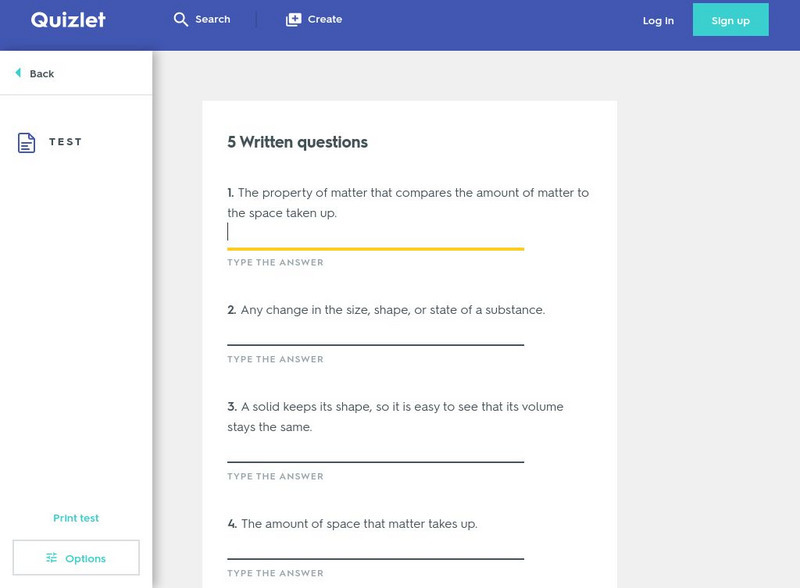
Quizlet: 6th Grade Science Vocabulary: Solids, Liquids, and Gases: Test
This interactive assessment features 7 matching, 7 multiple-choice, and 6 true/false questions over 20 terms related to Solids, Liquids, and Gases (the three states of matter).
Quizlet
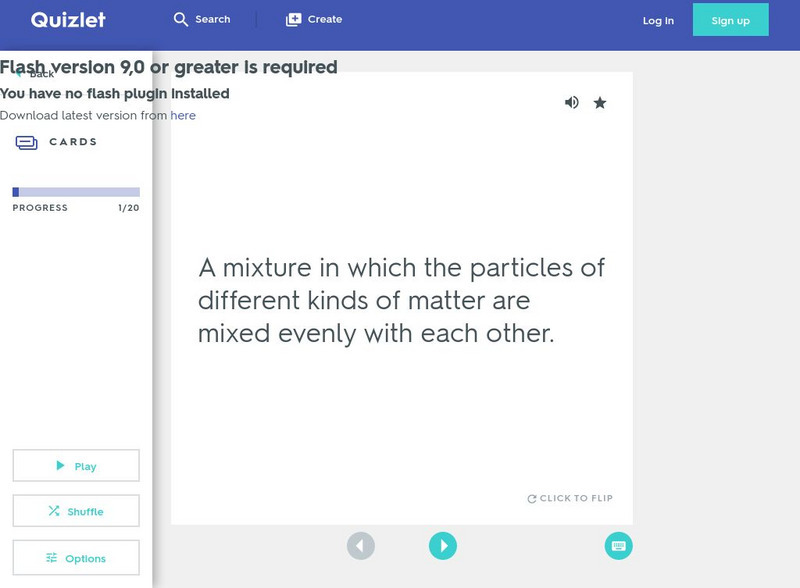
Quizlet: 6th Grade: Science Vocabulary: Solids, Liquids, and Gases: Flashcards
This set of interactive flashcards focuses on 20 terms related to Solids, Liquids, and Gases (the three states of matter).

Alabama Learning Exchange
Alex: Solids, Liquids, and Gases
This lesson focuses on solids, liquids, and gases. It has several review activities and an exciting lab experiment involving ice cream to complete the lesson.
Concord Consortium
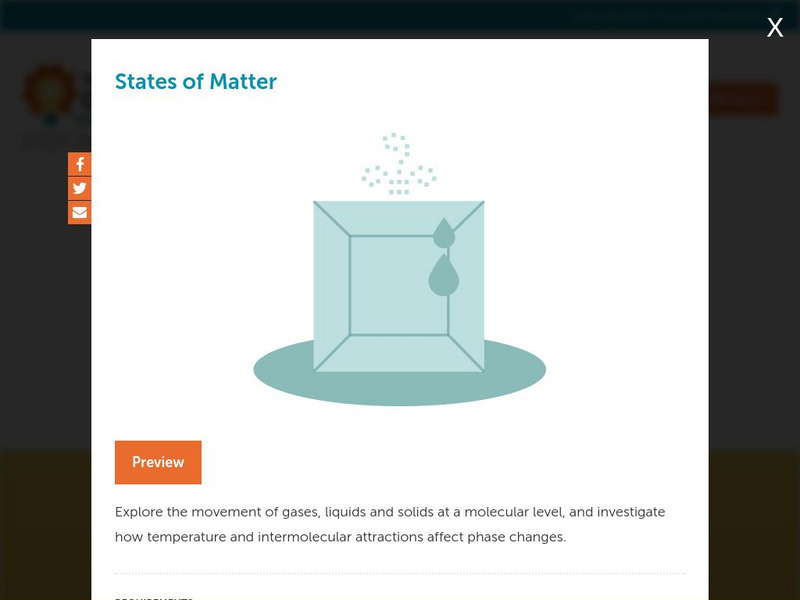
Concord Consortium: Stem Resources: States of Matter
Using simulations observe what solids, liquids, and gases look like at the atomic scale. After observing the different states of matter at their atomic level, students will be able to conclude about the forces and attractions that exist...
ABCya
Ab Cya: States of Matter
States of Matter is an educational activity for kids to learn about the different properties of matter. The lesson will introduce solids, liquids, and gases. Students will then be assessed through a sorting activity where they will...
Science Education Resource Center at Carleton College
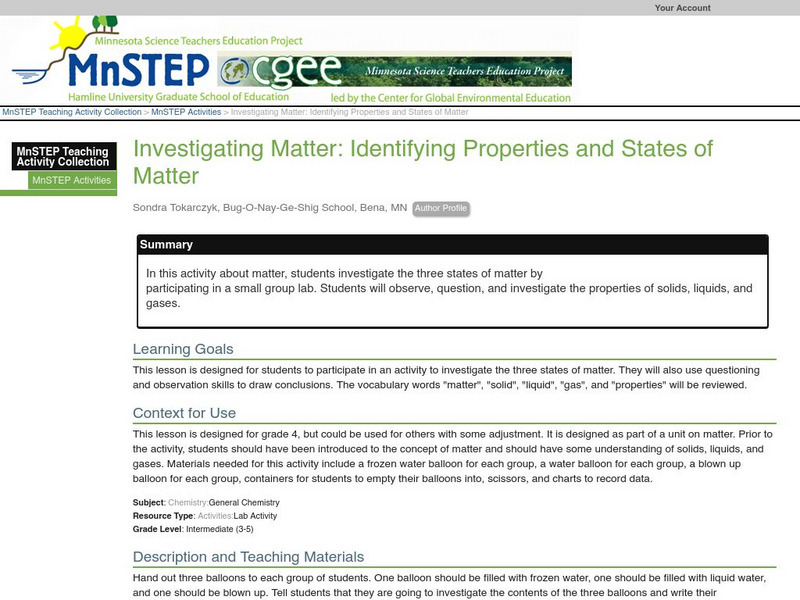
Serc: Investigating Matter: Identifying Properties and States of Matter
In this activity about matter, students investigate the three states of matter by participating in a small group lab. Students will observe, question, and investigate the properties of solids, liquids, and gases.