Hi, what do you want to do?






Curated OER
Conservation of Mass-Balancing Equations Study Guide
In this conservation of mass worksheet, learners balance 4 equations and identify the products, the reactants and the kind of reaction. Students then answer 5 questions about the conservation of mass.

Normal Community High School
Density
Change the density of water by adding minerals. The presentation discusses density—from the definition to calculations—and applies it to the real world. It briefly mentions specific gravity, and finishes by showing Archimedes'...

Curated OER
Do Different Colors Absorb Heat Better?
Students work together to test how the color of a material affects how much heat it absorbs. They make predictions and take notes on their observations. They discover how engineers use this type of information.

Curated OER
Weather "Whys"
Students explore the weather. In this weather data lesson plan, students collect weather data from Internet and media sources. Students graph the collected data discuss it as well as the seasons of the year.

Curated OER
Everything's Under Control
Fifth graders prepare for a "Mad Scientists Fair" by creating a controlled study and by conducting experiments. They make and record observations and classify specimens according to characteristics. They compare results to their original...

Curated OER
Hot and Cold Air
In this hot and cold water worksheet, students use hot and cold water to experiment and see what happens when the two mix together. Students also answer 7 questions.

Curated OER
Ocean Currents
Students determine how water and wind affect ocean currents. In this science investigation instructional activity, students follow the provided steps to enable them to consider how explorers may have used ocean currents to their advantage.

Curated OER
Water Currents
Students demonstrate how ocean currents are influenced by changes in density. They discover that temperature and salintiy affect density as well. They participate in a short experiment to end the lesson plan.

Curated OER
Physical Changes and States of Matter- Two
Third graders explore the concept of evaporation as they observe how the water level changes in a cup that is left out. Working in groups they observe physical changes in a group of everyday items. They record the changes in shape, size,...

Curated OER
Radioactive Half-Life
In this half-life worksheet, students determine how much of the radioactive isotopes will remain after a certain amount of time. This worksheet has 11 problems to solve.

Curated OER
Energy and Enthalpy
In this energy worksheet, students calculate how much energy is required to heat solutions. This worksheet has 4 problems to solve.

Curated OER
It's a Matter of Change
Pupils watch a video on matter and identify examples of solids, liquids and gases in the classroom. They discuss the attributes for each kind of matter and conduct an experiment to explore how matter can change form.

Curated OER
Heat 1
In this heat worksheet, students determine the heat gained or lost when matter changes phases. Students review the energy flow through ecosystems by comparing trophic levels and food webs. This worksheet has 10 fill in the blank, 5 short...

Curated OER
Language Arts Test B-Grade 6
In this grade 6 language arts test worksheet, 6th graders complete a 30 question multiple choice quiz covering a variety of grade 6 concepts.


Curated OER
Science: Water States
First graders investigate the various forms of water. They discuss the properties of water. They discover examples of water's various states and locate other solids, liquids, and gases in their homes.

Curated OER
The Water Cycle and Watershed
Middle schoolers summarize the steps in the water cycle. In this earth science lesson, students create a skit, song or poem showing the various components of the cycle. They identify the different watersheds in their area.

Curated OER
Sunlight and Heat
Students brainstorm about the sources of heat. They discuss that sunlight is one of those sources. Students complete a lab about cold water and warm water. They record the temperatures from each thermometer and discuss which container...

Curated OER
Condensation and the Water Cycle
Students explore the natural distallation process that occurs in the water cycle. They use plastic cups and cotton swabs to observe the condensation process that is evident in the water cycle.
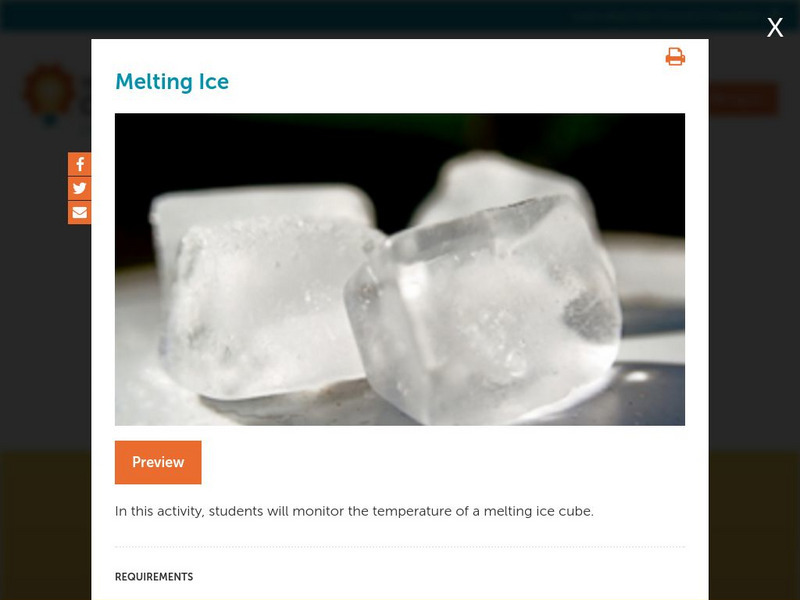
Concord Consortium
Concord Consortium: Stem Resources: Melting Ice
Using temperature probes, students will monitor the temperature of melting ice cubes in different situations. This lab activity, allows students to view the procedure and answer questions online that can be saved and evaluated by the...
Science Education Resource Center at Carleton College
Serc: Melting Ice Cubes
This activity helps students understand how the melting of ice cubes floating in water is influenced by the salinity of the water. It will introduce the concept of density and density driven currents and provide practice in using the...
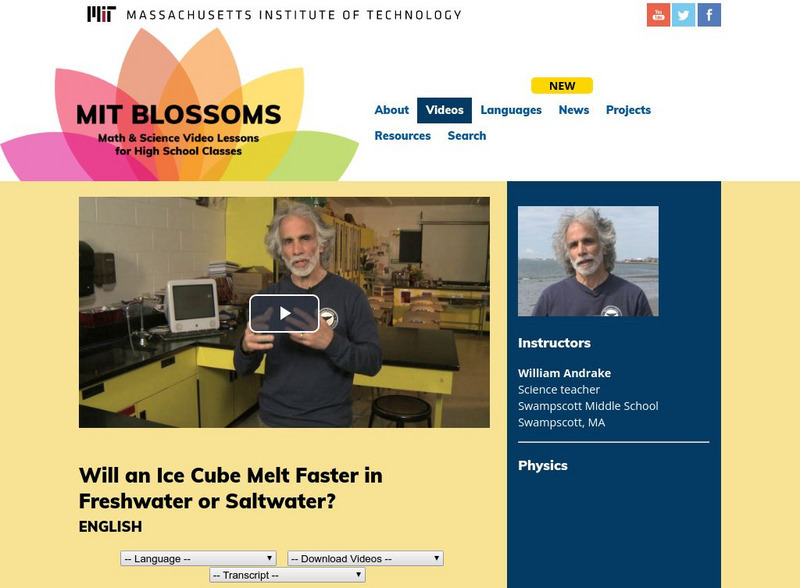
Massachusetts Institute of Technology
Mit: Blossoms: Will an Ice Cube Melt Faster in Freshwater or Saltwater?
Engage students in the study of the ocean and saltwater with these activities. Students will see that saltwater has different physical properties than freshwater - mainly density. This lesson can serve as a springboard into other...
Other
American Society for Engineering Education: E Gfi: Activity: Keep a Cube
In this activity, student teams in grades K-6 explore the design process by engineering a way to keep an ice cube from melting for 30 minutes. [6:00]

PBS
Pbs Learning Media: Melting and Boiling Simulation
Observe the motion and temperature of water molecules in this simulation as heat is applied to a beaker containing an ice cube.