Hi, what do you want to do?






Columbus City Schools
To Measure its Mass or Volume?
Atoms, elements, and molecules, oh my! Teaching the fundamentals of chemistry to curious sixth graders has never been easier to accomplish. Here is a resource that pulls together everything needed to get them off to a good start,...

Virginia Department of Education
The Particle Theory of Matter
Demonstrate the particle theory of matter to high school scientists with an engaging experiment that allows them to visually see the results as substances change from one state to another. The class concludes with a discussion about how...

Center for Learning in Action
Introduction to Matter
Begin your states of matter lessons with a demonstration designed to introduce the concept that all matter has properties. Reinforce this concept through vocabulary exploration, and the creation of atom models; salt, water, and carbon...

Curated OER
What do Atoms Look Like?
In this atom learning exercise, students answer 31 multiple choice questions about the structure of atoms, the periodic table, the reactivity of elements, orbital diagrams and the families of elements.

National Nanotechnology Infrastructure Network
Scale Models
With instructions to adapt the activities for any grade K-12, any teacher can incorporate the concept of scale into the classroom with a simple, yet effective lesson.

Columbus City Schools
What’s Up with Matter?
Take a "conservative" approach to planning your next unit on mass and matter! What better way to answer "But where did the gas go?" than with a lab designed to promote good report writing, research skills, and detailed observation....

Curated OER
The Causes of Differences in Density
Students explore how density changes. Students read an article on density. They observe a ball and ring demonstration and discuss the outcome. Students draw models of the demonstration and explain what happened.

Curated OER
The Causes of Differences in Density
Students explore the causes of differences in density. Students choose objects, measure the mass and volume, and calculate the density of each. They perform additional density experiments to model atoms and their correspondence to...

Curated OER
Matter
Fifth graders investigate the structure of matter. They examine pictures of atoms and molecules and discuss their relationships, and construct a model of a molecule using toothpicks and gumdrops.

Curated OER
The Bohr-Rutherford Model of the Atom
For this atom model worksheet, learners explore how scientists developed the Bohr-Rutherford atom model. Students complete 15 fill in the blank statements.

Cornell University
Thin Films
Combine mathematics and science to calculate measurements of unmeasurable materials. Individuals use knowledge of density and volume to determine the thickness of the film used in production. They also apply stoichiometry to...

Alabama Learning Exchange
Float or Sink?
Experiment with mass and density as scholars figure out what makes things float or sink. First, they watch a podcast introducing these concepts. Be sure to use the comprehension question to test their understanding. Young scientists...

Curated OER
The Structure of Materials
Students brainstorm what matter is and how they define it. They construct a water molecule with marshmallows and toothpicks. In addition, they watch videos to explore the use the idea of nanoscience to investigate the properties of...

Curated OER
Hydrogen Powered Cars
Students apply the principles of chemistry to investigate the concept of how a hydrogen powered car works. They study the electrochemical reactions that provide the energy source. Students also record observations in the functioning of a...

Curated OER
The Nanofiber Chocolate Factory: An Analogy
Learners investigate Nanotechnology. In this physic's instructional activity, students evaluate a hands-on model made from chocolate syrup and pretzels to determine the advantages of size. Learners weigh chocolate syrup to...

Curated OER
Why are Electrons Important?
Young scholars write electron configuration of elements using atomic numbers and they identify valence electrons. In this electrons lesson plan, students observe a demonstration showing the space-filling property of an electron. They...

Environmental Chemistry
Periodic Table of Elements: Gallium
A very detailed look at the element Gallium, a member of the Boron Group.
Science Education Resource Center at Carleton College
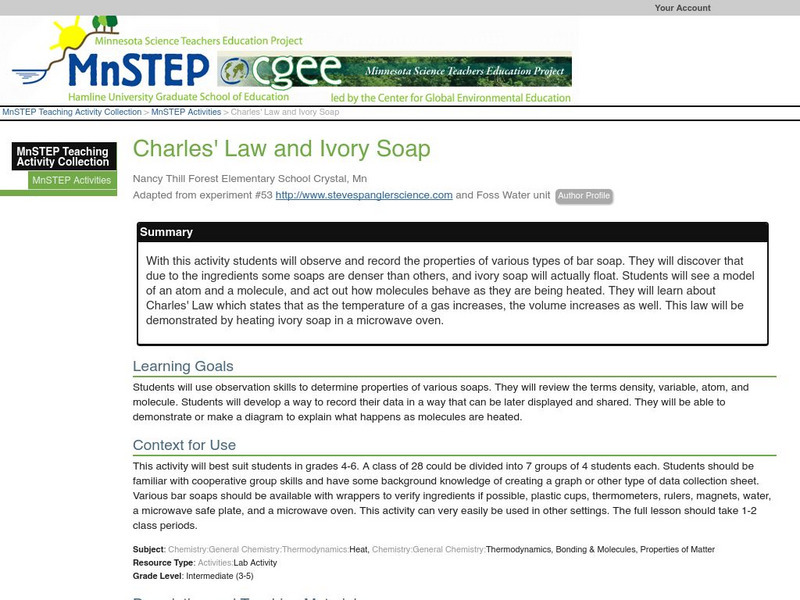
Serc: Charles' Law and Ivory Soap
With this activity students will observe and record the properties of various types of bar soap. They will discover that due to the ingredients some soaps are denser than others, and ivory soap will actually float. Students will see a...