Hi, what do you want to do?






Teach Engineering
Gumdrop Atoms
There's nothing sticky about the resource, unless you count the gumdrops! Scholars create a model of a lithium atom, complete with protons, neutrons, and electrons. It's just that these models are made with gumdrops and toothpicks.

Perkins School for the Blind
Mixtures and Solutions
Mixtures and solutions are different; one can be separated fairly easily and the other cannot. This hands-on experiment was written specifically for learners with visual impairments or blindness. They will use lemonade and trail mix to...

Teach Engineering
Active and Passive Transport: Red Rover Send Particles Over
I can move about freely, but you cannot. The class models the movement through cell membranes by way of passive and active transport. Members of the class play the roles of various proteins, atoms, compounds, and cell actions and mimic...

Serendip
Where Does a Plant's Mass Come From?
Where does the mass for a growing tree come from? Scholars consider a few different hypotheses and guess which is correct. They then analyze data from different experiments to understand which concepts science supports.

Teach Engineering
Engineering and the Periodic Table
Elements, to the rescue! Scholars first review the periodic table, and then learn about the first 20 elements and their properties and uses in the fourth of six lessons in the Mixtures and Solutions unit. Applying their newfound...

Colorado State University
How Do Long and Short EM Waves Interact with the Earth's Atmosphere?
Things are about to heat up in your classroom! A kinesthetic lesson asks learners to play the part of the gases in the earth's atmosphere and interact with the sun's radiation. The focus is to learn the impact of the increasing...

Teach Engineering
What is a Nanometer?
Teams learn about the size of a nanometer by measuring objects and converting those measurements. A worksheet then tests the groups' abilities to use nanometers by having them determine the size of objects that are too small to...

Serendip
How Do Biological Organisms Use Energy?
When an organism eats, how does food become energy? Young biologists follow glucose through the process of cellular respiration to the creation of ADP using a discussion-based activity. The resource also highlights conservation of mass...

Colorado State University
What Makes a Gas, a Greenhouse Gas?—The Carbon Dioxide Dance
Investigate a heated topic in environmental science. Scholars team up to play the parts of gas molecules in the atmosphere. As the teacher moves about, acting as the electromagnetic wave, learners react as their molecules would to the...

American Chemical Society
Heat - Energy on the Move
Turn up the heat. Individuals conduct two experiments to observe the difference between heated water and air versus cold water and air. Using food coloring, pupils observe the movement of the molecules in the two temperatures of water. A...

American Chemical Society
A Closer Look at Crystals
It's about to become crystal clear! Learners compare and contrast three different types of crystal substances. First they observe their structure and then investigate how they interact with various substances.

Cornell University
Study Soil
What's in soil? Young scientists study the pH levels of soil from their school yard. They observe the land and area the soil came from to decide if location has anything to do with acidity level.

American Chemical Society
Aware of the Air
It's there, even though no one can see it. Scholars create two different-sized parachutes out of shopping bags, then let them fall through the air. They should see that the larger parachute falls more slowly and interpret this to mean...

Colorado State University
Why Can Warm Air "Hold" More Moisture than Cold Air?—Vapor Pressure Exercise
Does it feel a little humid in here? Learners assume the role of water vapor in the atmosphere as they explore the differences between warm and cold air. They roll dice to determine their level of energy, which determines if they...

Curated OER
The Bio-fuel Project: Creating Bio-diesel
Students investigate bio-fuel. In this investigative lesson, students create bio-fuel from vegetable oil waste. Students will analyze, predict, collect and synthesize data from their experiments with bio-fuel.

Texas State Energy Conservation Office
Investigation: Chemical Models
Science teams make models of four different hydrocarbon compounds that we commonly use for fuel. Then they demonstrate chemical reactions that result when energy is produced. This can be used as an enrichment when your class is studying...
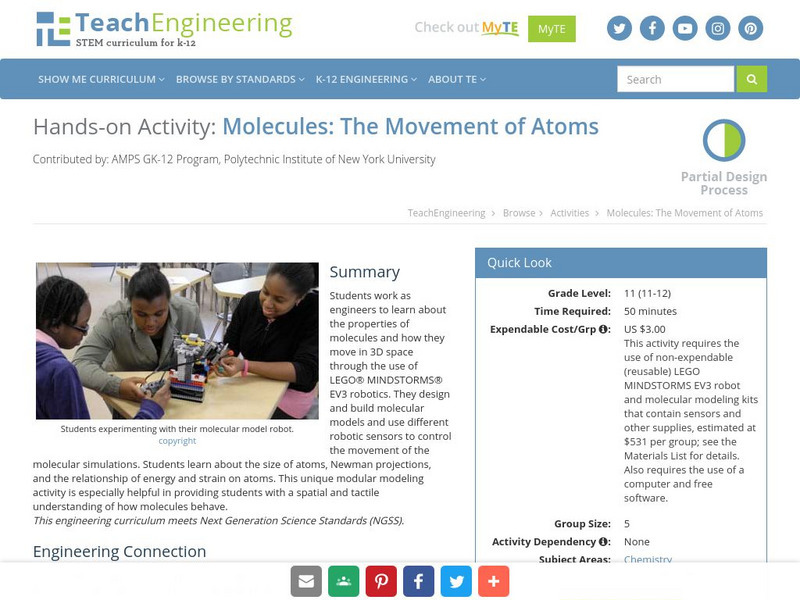
TeachEngineering
Teach Engineering: Molecules: The Movement of Atoms
Students work as engineers to learn about the properties of molecules and how they move in 3D space through the use of LEGO MINDSTORMS NXT robotics. They design and build molecular models and use different robotic sensors to control the...

University of Colorado
University of Colorado: Ph Et Interactive Simulations: Molecule Polarity
An interactive simulation that teaches about polarity, electronegativity, and bonds by changing the electronegativity of atoms and bond angles in a molecule to see how it affects polarity. This simulation can either be downloaded or...

Museum of Science
The Atom's Family: Mighty Molecules
In this activity, students construct models of molecules using marshmallows and gum drops.

CK-12 Foundation
Ck 12: Plix: Build Some Helium: Atoms to Molecules
[Free Registration/Login Required] Build your own helium atom and make sure it has the correct number of protons, electrons, and neutrons on this site. Site also includes a small quiz on the topic.
Museum of Science
The Atom's Family: Phases of Matter
Help the Phantom choose a material and observe the changes at different temperatures in the molecule chamber. What happens to the elements or molecules as the temperature changes?
Bill Nye
Bill Nye: Hole Y Water
This tutorial from Bill Nye uses an experiment with water and sugar to show how matter is mostly empty space.
NASA
Nasa: The Space Place: Ions in Action
The page from NASA's The Space Place describes a simple activity, charging a balloon and making it move small pieces of paper. It then goes on to give an excellent explanation of how the activity works, and how it involves ions. This...
Science Buddies
Science Buddies: Study Chirality With a Homemade Polarimeter
Some molecules can be either left- or right-"handed." The left- and right-handed molecules have the same number and type of atoms, and their chemical structures look identical, but they are actually mirror images of each other. Many...
Other popular searches
- Atoms and Molecules
- Gumdrop Atoms and Molecules
- Making Atoms and Molecules
- Science, Atoms and Molecules
- Science Atoms and Molecules
- Atoms and Molecules Lesson
- Atoms and Molecules Musical
- Combining Atoms and Molecules
- Atoms Molecules and Element
- Courting Atoms and Molecules
- Elements Molecules and Atoms