Hi, what do you want to do?






Curated OER
Lesson Plan 1: Up, Down, Right, Left - Function Families
Students work in small groups to draw the trajectory of several scenarios. They label parts of the resulting parabola (vertex, axis of symmetry). Students complete four stations to explore quadratic functions.

Curated OER
What's Your Speed?
Learners explore the concept of distance v. time. They use a CBR to collect data on their distance over time, then plot their data using a scatter plot and find an equation to model their data. Pupils discuss what if scenarios which...

It's About Time
The Electricity and Magnetism Connection
Magnets don't grow in fields, but magnetic fields are important to understand. The lesson covers the effect electricity has on magnetic fields. Scholars use a compass, magnets, and electrical wire to test magnetic fields and energy...

Curated OER
Hit Me If You Can!
Students graph linear equations using slopes and intercepts. In this algebra lesson, students identify the slope as being positive,negative or undefined. They differentiate between different quadrants on a coordinate plane.

Curated OER
Collecting And Fitting Quadratic Data
High schoolers investigate the concept of using quadratic data to plot coordinates on a plane. They also apply the quadratic formula for a variety of problems with the help of a graphing calculator to draw the parabola for given...

Curated OER
Charting a New Course
Learners calculate the distance they will travel. In this geometry lesson, students use the TI and CBL system to make calculation of a certain path. They explore geography by calculating distances between different areas as it relates to...

Curated OER
Relating Distance and Velocity Over Time
Students calculate the distance and velocity over time. In this algebra lesson, students graph a linear function to represent the distance vers time travel. They interpret their graphs and draw conclusion.

Curated OER
Let's Go Slopey
Pupils create a table of values to graph a line. In this algebra instructional activity, students identify the slope and intercept of a linear equation. They use a Ticalculator to graph their function.

Curated OER
You Drive Me crazy
Students calculate the distance and acceleration of an object. In this algebra lesson, students collect data and create table and graphs to analyze it. They complete a lab as they collect and analyze data on acceleration and distance.

Curated OER
Velocity
Students explore the concepts of velocity, acceleration, distance and football. They collect data on the velocity of a football and they determine the distance and height of a football when it is thrown. Students compare their findings...

Curated OER
Slopey Math
Learners identify the slope of a line and use it to solve real life problems. In this algebra lesson, students write linear equations in slope intercept form and make a correlation to its relation to the real world. They use the slope an...

Curated OER
Move It
Studens collect and graph data. For this algebra lesson, students use a CBL and CBR with a TI Calcualtor to observe linear graphs. They use the correct vocabualry as they discuss the collected data.

Curated OER
Linear Functions-Learn Your Lines
Students solve and graph linear equations. In this algebra lesson, students collect and plot data on a coordinate plane. They use the CBL and TI calculator to graph systems of equation.

Curated OER
"Ball Bounce" Quadratic Functions
Young scholars manipulate a ball and explore quadratic functions. In this algebra lesson, students analyze the graph of a quadratic function. They identify quadratic properties.

Curated OER
Investigation of Hooke's Law Lab
Students determine the spring constant by conducting an investigation. In this physics lesson plan, students collect data and create a graph of force vs. displacement. They compare the results of two different methods to find spring...

Curated OER
The Wave of the Future
Twelfth graders discuss sine curves and enter equations into their graphing calculator then compare different graphs created on their calculators. They identify the period, amplitude and phase shift given the graph or the equation of a...
TeachEngineering
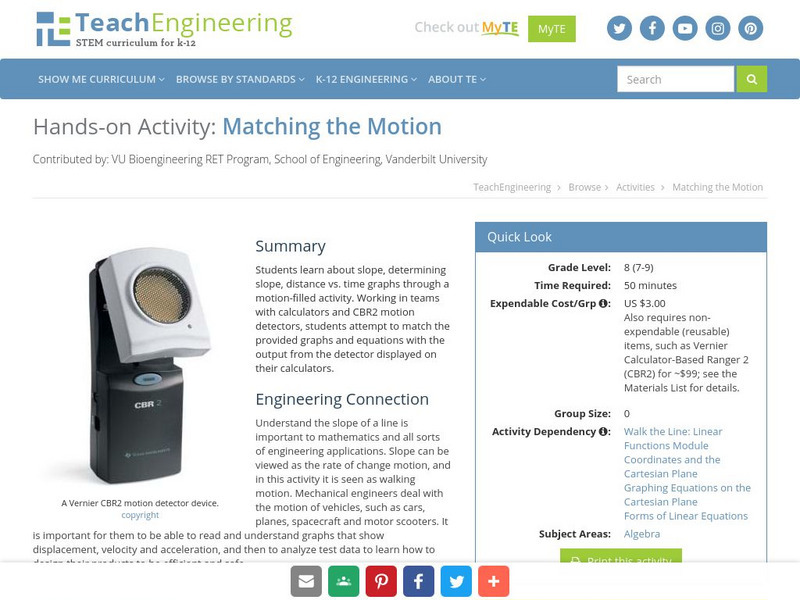
Teach Engineering: Matching the Motion
Students learn about slope, determining slope, distance vs. time graphs through a motion-filled activity. Working in teams with calculators and CBL motion detectors, students attempt to match the provided graphs and equations with the...
Concord Consortium
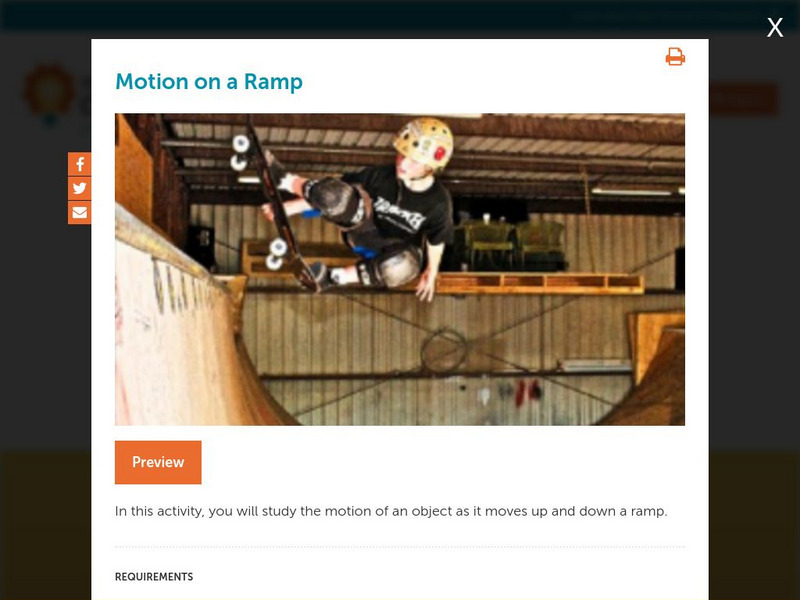
Concord Consortium: Stem Resources: Motion on a Ramp
Using a motion detector, students produce graphs that show the motion of a toy car as it moves on a ramp. Students collect distance versus time graphs and velocity versus time graphs as well as predict what the motion will look like on...
Texas Instruments
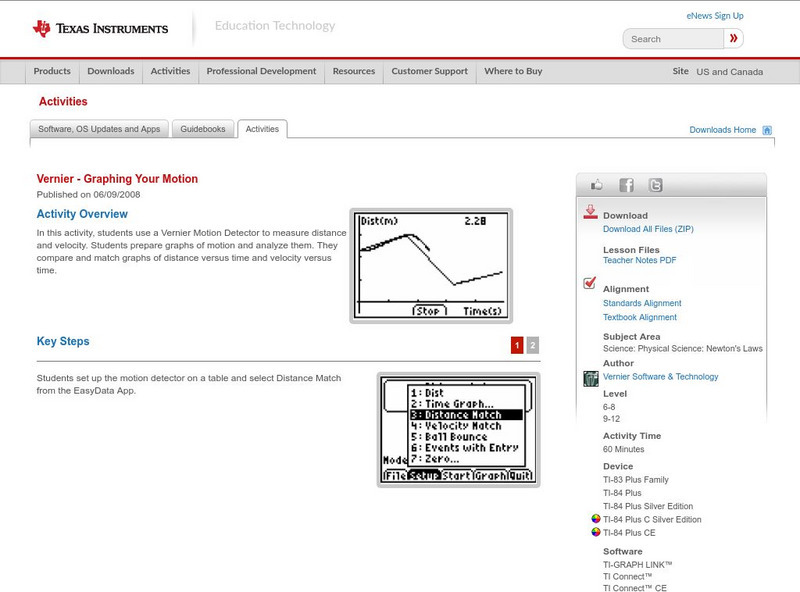
Texas Instruments: Graphing Your Motion
In this activity, students use a Motion Detector to measure distance and velocity. Students prepare graphs of motion and analyze them. They compare and match graphs of distance versus time and velocity versus time.
TeachEngineering
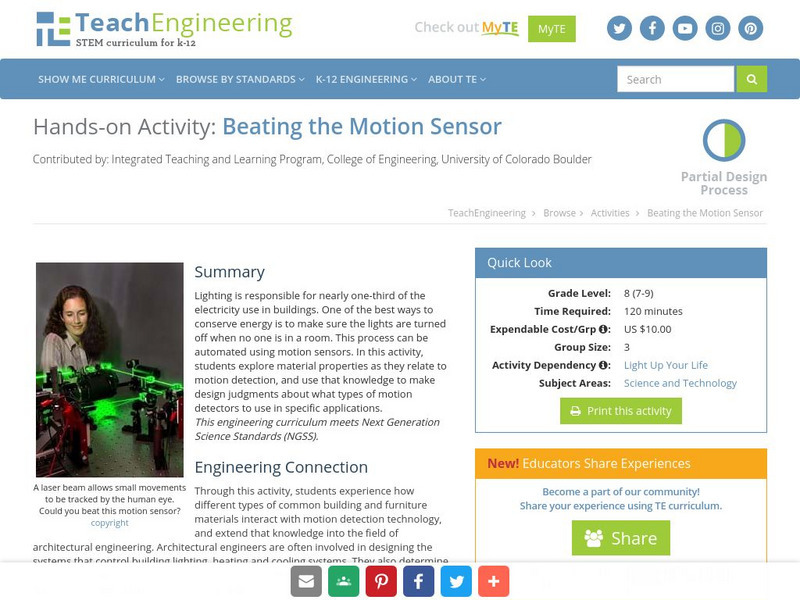
Teach Engineering: Beating the Motion Sensor
Lighting is responsible for nearly one-third of the electricity use in buildings. One of the best ways to conserve energy is to make sure the lights are turned off when no one is in a room. This process can be automated using motion...
Texas Instruments
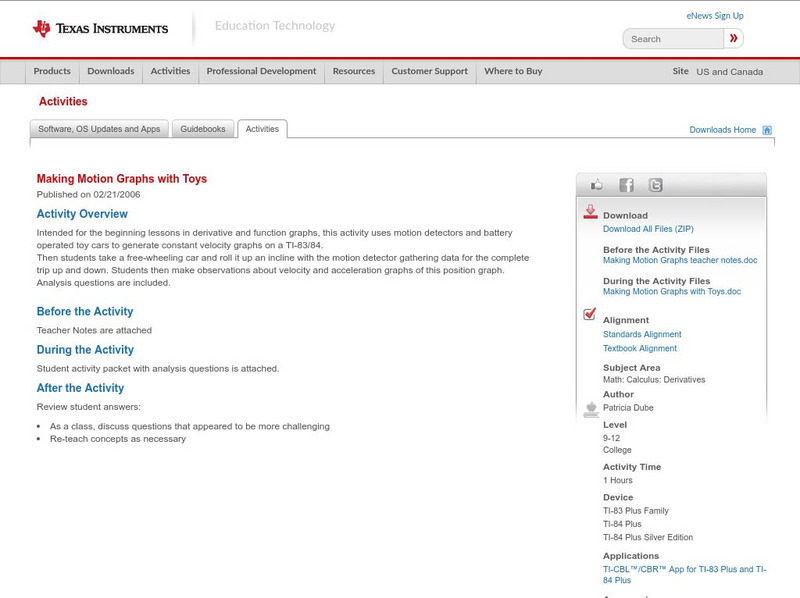
Texas Instruments: Making Motion Graphs With Toys
Intended for the beginning lessons in derivative and function graphs, this activity uses motion detectors and battery operated toy cars to generate constant velocity graphs on a TI-83/84. Then students take a free-wheeling car and roll...
Science Education Resource Center at Carleton College
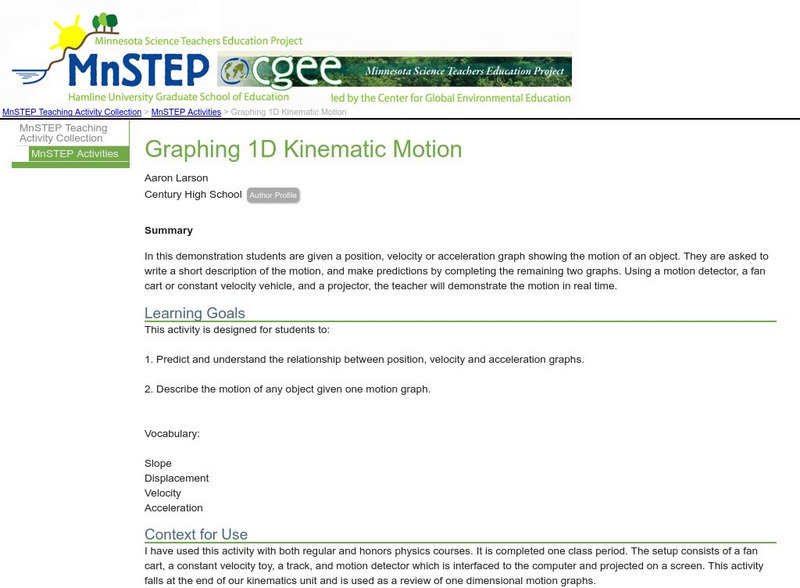
Serc: Graphing 1 D Kinematic Motion
In this demonstration students are given a position, velocity, or acceleration graph showing the motion of an object. They describe the motion, and then make predictions by completing the remaining two graphs. Using a motion detector and...
Texas Instruments
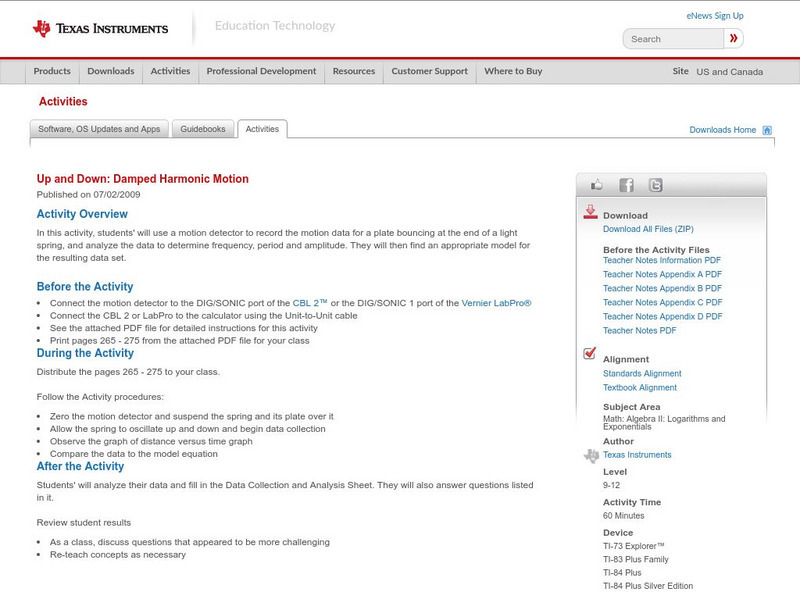
Texas Instruments: Up and Down: Damped Harmonic Motion
In this activity, students' will use a motion detector to record the motion data for a plate bouncing at the end of a light spring, and analyze the data to determine frequency, period and amplitude. They will then find an appropriate...
Texas Instruments
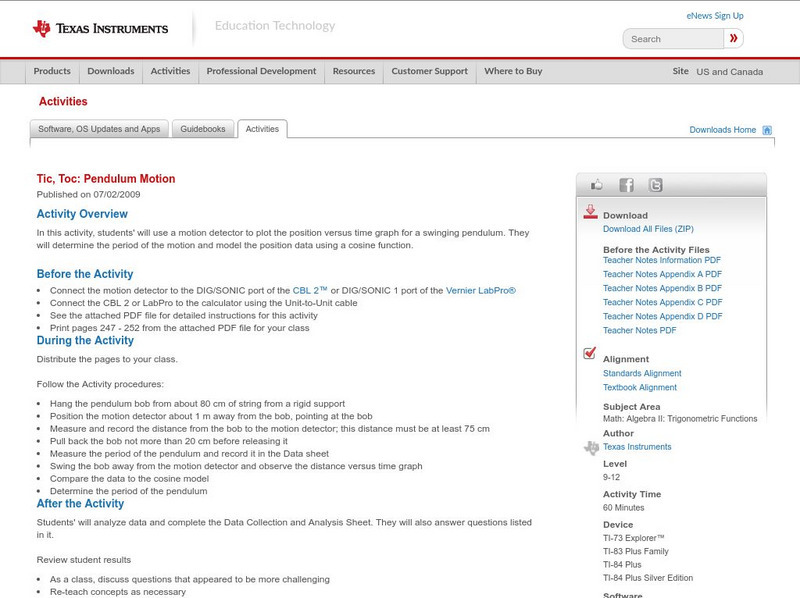
Texas Instruments: Tic, Toc: Pendulum Motion
In this activity, students' will use a motion detector to plot the position versus time graph for a swinging pendulum. They will determine the period of the motion and model the position data using a cosine function.