Hi, what do you want to do?






Broward County Public Schools
Force and Motion
Get the ball rolling with this upper-elementary science unit on forces and motion. Offering over three weeks of physical science lessons, this resource is a great way to engage the class in learning about simple machines, friction,...

Purdue University
The Represented World: Recreational STEM
How are forces and motion important to a swing set? Scholars explore the concepts of force and motion using swing sets. In preparation for their own STEM design project, individuals take surveys and data from peers, complete labs on...

Columbus City Schools
Force Field Physics
Attracted class members to an activity-packed journey through the science behind the invisible forces at work all around us. From jump rope generators to junkyard wars, there's never a dull moment when eighth grade physics scholars...

Columbus City Schools
May the Force Be with You
You won't have to force your classes to complete these engaging activities! Through exploration, young scientists learn that force has both magnitude and direction. They draw force diagrams, investigate force models, and complete a...

Curated OER
The Motions of the Oceans
Students examine the topics of ocean waves, currents, and tides. They locate and label ocean currents on a world map, conduct experiments, analyze key vocabulary, view demonstrations and record the data, and complete handouts.

Curated OER
Astronomy
Students complete a unit of lessons on our solar system, its stars, and astronomers. They record information in a space journal, design constellations, define key vocabulary, observe the phases of the moon, and create a group planet...

Curated OER
Our Universe: Always Moving, Always Changing
Students explore the main concepts of astronomy through the eleven lessons of this unit. The past, present, and future methods of studying the science are examined in this unit.

Georgia Department of Education
Ga Virtual Learning: Physical Science: Force and Motion
In this student-paced module, students apply Newton's Laws of Motion to everyday life, calculate mathematical relationships involving force and motion using algebraic formulas, and understand the difference between mass and weight.

E-learning for Kids
E Learning for Kids: Science: Egypt: What Can Forces Do?
A learning module reviewing how much force is needed to push or pull objects. Also learn about the force of gravity.
Texas Education Agency
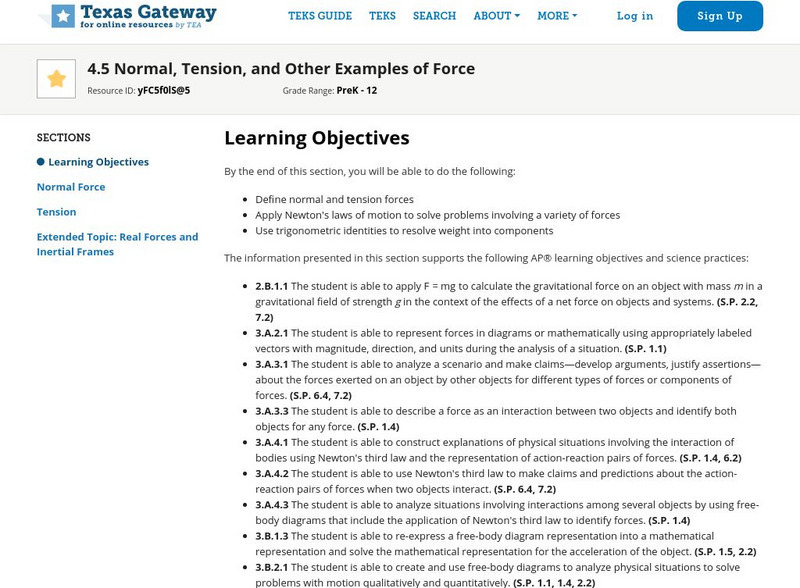
Texas Gateway: 4.5 Normal, Tension, and Other Examples of Force
By the end of this section, you will be able to define normal and tension forces, apply Newton's laws of motion to solve problems involving a variety of forces, and use trigonometric identities to resolve weight into components.
CK-12 Foundation
Ck 12: Universal Law of Gravity
[Free Registration/Login may be required to access all resource tools.] In this online tutorial students will learn to describe and calculate how the magnitude of the gravitational force between two objects depends on their masses and...

E-learning for Kids
E Learning for Kids: Science: Indian Ocean: What Kind of Natural Forces Do We Recognize?
Learn about forces (push or pull), gravity, and friction in this module by training dolphins.
CK-12 Foundation
Ck 12: Universal Law of Gravity
[Free Registration/Login may be required to access all resource tools.] Using Newton's Law of Gravity and the equations of uniform circular motion, students solve problems involving the force of gravity.

E-learning for Kids
E Learning for Kids: Science: Pirates: What Are Some Forces Around Us?
Covers the meanings of force, friction, and gravity, and the differences between magnetic and elastic spring force, and between weight and mass. The effect of air resistance on an object's motion is also touched upon.
Texas Education Agency
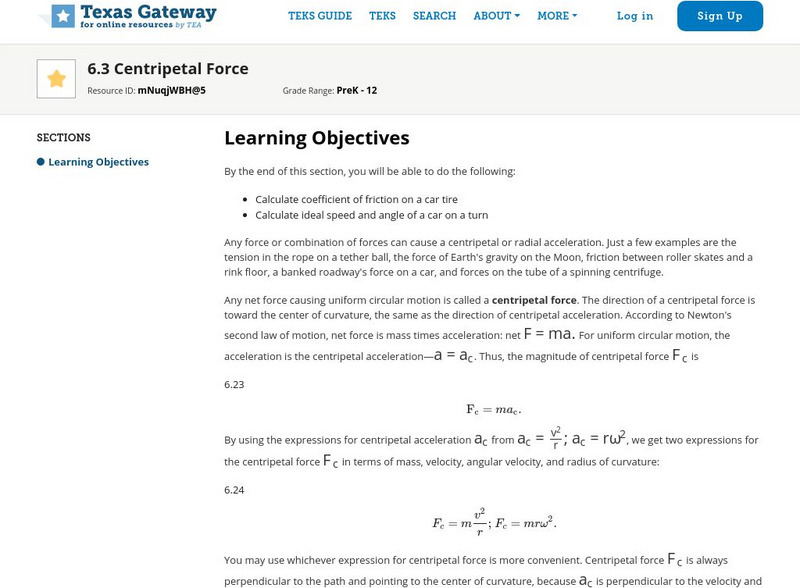
Texas Gateway: Uniform Circular Motion and Gravitation: Centripetal Forces
By the end of this section, you will be able to calculate coefficient of friction on a car tire and to calculate ideal speed and angle of a car on a turn.

Scholastic
Scholastic: Study Jams! Science: Our Solar System: Gravity & Inertia
A video and a short multiple-choice quiz on the topic of gravity and inertia, and how they work together to keep objects from floating off into space.
CK-12 Foundation
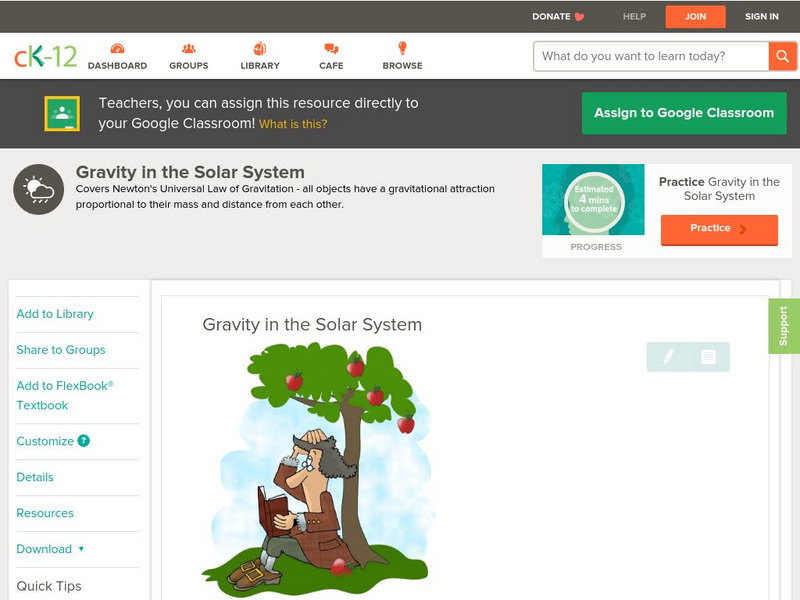
Ck 12: Earth Science: Gravity in the Solar System
[Free Registration/Login may be required to access all resource tools.] Understand the role of gravity in space.

TED Talks
Ted: Ted Ed: Would You Weigh Less in an Elevator?
Video that uses an elevator in motion to describe the relationship among weight, gravity, and relative motion. [3:36] Includes a short quiz and a list of additional resources to explore.
University of New South Wales (Australia)
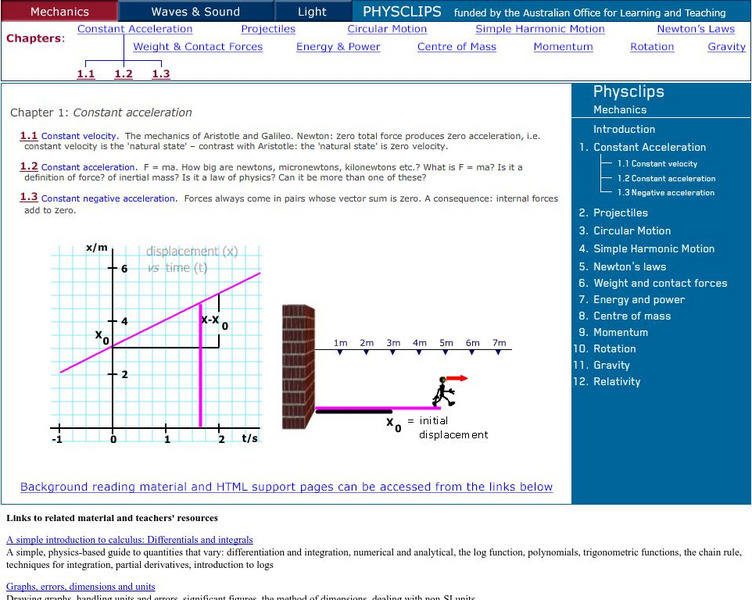
University of New South Wales: School of Physics: Physclips
Physiclips thoroughly presents mechanics concepts with animations and film clips.

CK-12 Foundation
Ck 12: Fifth Grade Science: Earth Science: Gravity
Do you know how gravity affects you? This module defines gravity and explains how gravity affects the motion of objects.
Other
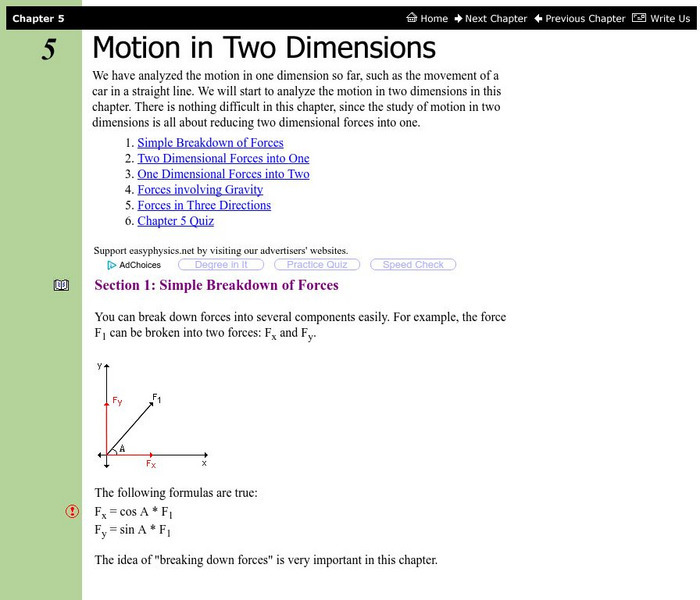
Easyphysics: Chapter 5 Motion in Two Dimensions
Learners investigate motion in two dimensions. Some topics examined are two dimensional forces, gravity, and forces in three directions. The resource includes example problems with solutions and a chapter quiz.
Physics Classroom
The Physics Classroom: Mathematics of Satellite Motion
The mathematics associated with the motion of satellites is described. Equations (for period, velocity, acceleration and force) are stated, symbols described, and sample problems solved. Includes five practice problems with solutions and...
Physics Classroom
The Physics Classroom: Circular Motion Principles for Satellites
From The Physics Classroom. Uses easy- to-understand language to discuss how circular motion principles apply to the motion of satellites. Describes the tangential velocity and centripetal acceleration of a satellite. Includes many...
TeachEngineering
Teach Engineering: Mechanics Mania
Through ten lessons and numerous activities, students explore the natural universal rules engineers and physicists use to understand how things move and stay still. Together, these rules are called "mechanics." The study of mechanics is...