Hi, what do you want to do?






Curated OER
AN INTERNATIONAL MENU
Studentsl expand vocabulary through word study, literature and class discussion (e.g. word origins, roots and affixes, meaning in context, levels of usage, etc.). They recognize food-related words that have entered the English language...

Curated OER
Russia's Colony: Examining the Effects of Russian Colonization
Students respond to the question: How did Russian colonization effect Alaska's history? students examine environmental, cultural, economic, social and political impacts.

Curated OER
Economic Crisis in Argentina
Students investigate the history, people, and the economy of Argentina. They complete a Webquest, explore various websites, answer discussion questions, and identify and read newspaper articles about local businesses that export goods to...

Curated OER
A Poem for Columbus - Junie B. Jones Series
For this poetry and rhyming words worksheet, students fill in the blanks in a poem about Christopher Columbus. They add a rhyming word at the end of each of the 14 stanzas. This worksheet is associated with the Junie B. Jones series of...

Curated OER
WHAT DID COLOMBUS SAY?
Students read and analyze two primary source documents written by Christopher Columbus.

Curated OER
Chinese Immigration in the Mid-19th Century
Young scholars interpret historical evidence presented in primary and secondary resources. In this Chinese immigration instructional activity, students research the Chinese immigration between 1850 and 1882.

Curated OER
Coronado: Misfortune's Explorer
Fourth graders discuss the importance of Coronado's expedition through Texas and the trials his men endured during the journey. They view and discuss a map of Coronado's route, the effects of weather on the Great Plains, and Buffalo....

Curated OER
The Third Question
Students reflect upon the rewards of providing services to others, and whether by giving they might perhaps be gaining at the same time. They explain how or why Knowing a foreign language can help people make new friends and build a new...

Curated OER
The Constitution: The Country's Rules
Students become aware of the Constitution and why it is important. In this early government lesson, students compare the Constitution to the class rules. They are both set in place so that we all stay safe and have fun. Students draw...

Curated OER
Friendly Letter Format
For this Westward Ho worksheet, students write a friendly letter and fill out a cause and effect chart for the story Westward Ho. Students complete 7 rows in the chart.

Curated OER
An International Menu
Students research etymologies using dictionaries. They explore the diverse origins of the common foods they eat after making a list of their favorite foods.

Curated OER
Listening to the Prairie
Students, in groups, visit an exhibit and for a prairie scavenger hunt to locate sunflowers and name products made from them. After sketching a prairie dog, they find nature cues farmers use when growing plants and raising animals. The...

Curated OER
Russia's Colony: A Story of the Colony Through Primary Sources
Learners read "Epidemic Timeline and Confessional Lists from Katmai 1831 and 1845." They construct a picture of life in Alaska during the Russian period.

Curated OER
Immigration in the Connecticut River Valley
Learners discuss and compare immigration during the 18th century to the Connecticut River Valley to that in America during the turn of the century.

Curated OER
Living History
High schoolers analyze how historians are trying to keep history alive and preserve it for generations to come. They view some schools trying to save an entire culture and language from extinction. Students participate in history...

Curated OER
Exploring Explorers
Ninth graders illustrate the routes taken by different explorers on a world map. They explain the need for the different exploration voyages. Students explore the web for information that may contain different points of view or...

Curated OER
Abraham Lincoln and the U.S. Constitution
Students investigate President Abraham Lincoln's use of the U.S. Constitution and its importance to the Civil War. In this US history lesson, students read text about President Lincoln and the US Constitution. Students examine the...
Other
Dept. Of Housing and Urban Dev. (Hud): Native Americans
A resource page for Native Americans in reference to land and/or homebuyers. Site is sponsored by the Department of Housing and Urban Development.
Nebraska Studies
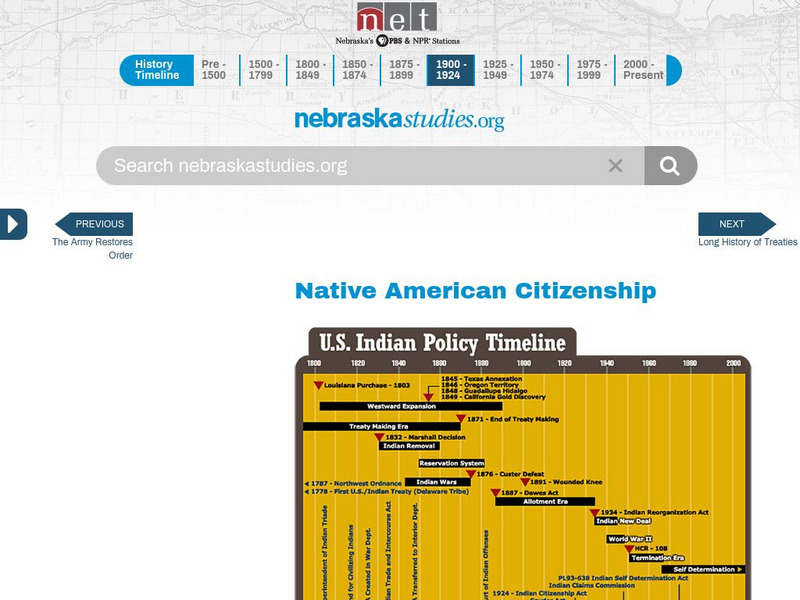
Nebraska Studies: Native American Citizenship
After invading the land long lived on by the Native Americans, the United States government only gave them the right to citizenship in 1924 as detailed here.

A&E Television
History.com: Native American History Timeline
Before Christopher Columbus came to America, the expansive territory was inhabited by Native Americans. Throughout the 16th and 17th centuries, as more explorers sought to colonize their land, Native Americans responded in various...
Other
History Today: Native Americans and the Federal Government
Andrew Boxer traces the origins of a historical issue still as controversial and relevant today as in past centuries. At the start of the twentieth century there were approximately 250,000 Native Americans in the USA - just 0.3 per cent...
State Library of North Carolina
N Cpedia: Stephen R. Claggett: Native American Settlement of North Carolina
The English began exploring and settling into the Carolina Colony in the late 1500-early 1600s. The land was already inhabited by Native American tribes. How did they all get along? Who were the Native Americans on the land?
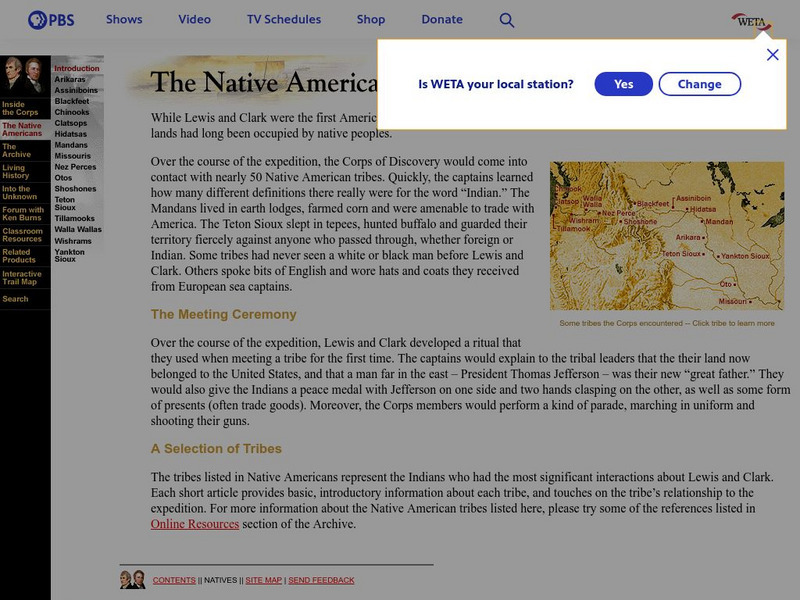
PBS
Pbs: The Native Americans
The Corps of Discovery came into contact with "Nearly 50 Native American tribes." This site from PBS discusses the tribes that had the most significant interactions with Lewis and Clark.

Nebraska Studies
Nebraska Studies: Tribes in Nebraska Give Up Lands in Treaties
Review this discourse of the many treaties enacted between the settlers and Native Americans during the development of the Great Plains, the problems that arose, and the creation of reservations.