Hi, what do you want to do?






Curated OER
WHAT DARWIN NEVER SAW: Evolution, Science, Biology, Natural Selection
Students view video showing recent field work on a twenty two-year study of finch beaks on a small island in the Galapagos, showing natural selection clearly operating in the wild.

Curated OER
Week 7: Animal Adaptations - Bird Beaks
Students use tools to represent bird beaks and pick up different types of food with them in order to discover which beak would help the bird survive depending on their food type.

Curated OER
A Simple Model for Natural Selection
Do you have what it takes to survive as a fit predator or will elusive prey lead to your extinction? Find out in a creative natural selection activity. Using different colors and shapes of grains to represent different species and...

Curated OER
The Beaks of the Finches
Students become birds and are given "beak-types". After completing the simulation, students relate results to adaptations and natural selection. Extensions of the simulation allow for comparative results and include population genetics.

Curated OER
How Evolution Works
Students work in groups to investigate and present genetic variation, adaptation, and sexual selection as it relates to evolution. In this evolution lesson, students watch a video discuss how the human eye could evolve due to natural...

Curated OER
Regents High School Exam: Living Environment 2008
Tne New York Regents High School Examinations are comprehensive and include various styles of questions, includingmultiple choice and the analysis of graphs. This particular version, the 2008 Living Environment exam surveys a variety of...

Curated OER
Regents High School Examination: Living Environment 2005
The 2005 version of the Regents High School Examination in the area of ecology is as comprehensive as previous years' exams. It consists of 40 multiple choice questions on everything from the structure of DNA to the interactions within...

Curated OER
Regents High School Examination: Living Environment 2003
The living environment, from the interior of a cell to the complex relationships among populations, are queried in this final examination. Learners look at air pollution maps, diagrams of cells, population graphs, and drawing of cells....

Curated OER
Natural Selection and the Peppered Moth
Students study natural selection and its process in the peppered moth. In this evolution lesson, students read about the concept of natural selection as suggested by Charles Darwin. Students then complete a natural selection simulation...

ARKive
Biodiversity and Evolution – Darwin’s Finches
Teens experience natural selection firsthand (or first beak) in an activity that has them act as finches foraging for food. Using different household items to act as different beak styles, your little finches will collect as much...

Curated OER
Exploring the Uses of Beaks
Students explore the uses of bird beaks in the wild by participating in experiment stations. In this bird adaptation lesson, students work in groups and complete experiment stations that represent different types of bird beaks. Students...

Curated OER
Clipbirds
Students attempt to pick up various objects with a wide variety of beaks, including scissors, spoons, etc.

Berkeley Engineering and Mentors
Darwin's Finches
Try a twist on the old finch beak and chopsticks activity by using M&Ms on a Twister mat. Spoons, knives, forks, and chopsticks represent beaks and are randomly assigned to your little birds, who must collect as much food as possible...

Curated OER
Beans, Beaks and Bears
Students explore evolution. After watching a video on evolution, students perform a variety of experiments using beans which illustrate the concept of evolution.

Curated OER
Dining Out With Fishes and Birds of the Hudson
The class will make observations to determine how environment has shaped the way particular birds and fish eat. They will view a series of photographs, read two short articles, and then consider how food availability has determined how...

Curated OER
How Evolution Works
High schoolers discuss the evolution of the eye and how a complex organ can evolve through natural selection. They research genetic variation, adaptation, and sexual selection. They analyze data to determine how beak length of Gal??pagos...

Curated OER
The Birds and the Beaks
Young scholars explore the adaptations that birds have. In this adaptations lesson students view a video and create a concept map of birds and their adaptive traits.

Curated OER
Mexican "Tona" Animal Masks
Young scholars study the Mexican legend related to masks. They select an animal with traits they can identify with and recognize in themselves. Afterward, they create a mask that will retain some human features, but take on the life of...

Curated OER
Evolution Crossword
In this evolution crossword worksheet, 7th graders complete a crossword puzzle about evolution. Students read the definitions to fill in the puzzle with evolution terms.

Curated OER
Dining Out With Fishes and Birds of the Hudson
While this lesson focuses on the birds and fish found on the Hudson River, it could be adapted for use in any classroom. Using a vocabulary list, learners explore the meaning of words like adaptation, habitat, barbel, and more. Then,...

Curated OER
Birds Learning Cycle Lesson Plan
Ninth graders explore the various adaptations of birds and compare differences and similarities of different birds.

Curated OER
Animals
Second graders define and describe the characteristics of a mammal and a mammal's importance to man. They also describe the life cycle of a frog and compare and contrast a larva and an adult frog. Finally, 2nd graders study and explain...
Howard Hughes Medical Institute
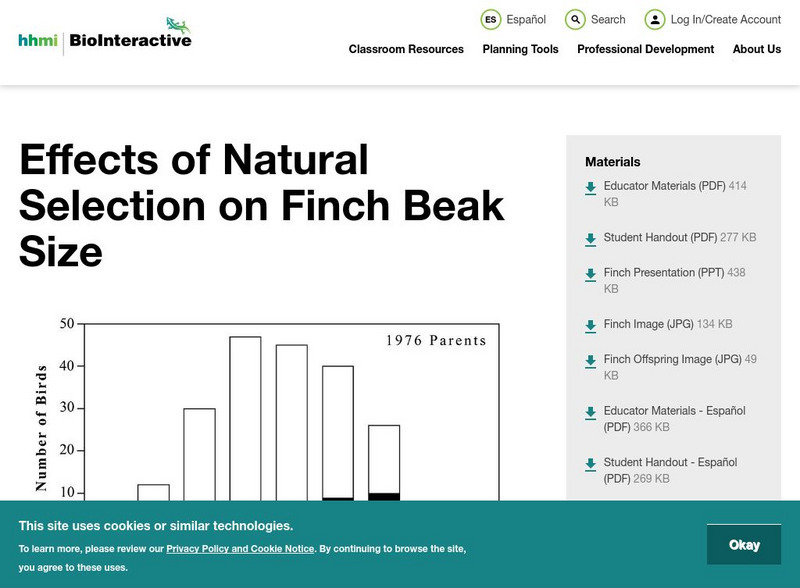
Hhmi: Bio Interactive: Effects of Natural Selection on Finch Beak Size
In this activity, students examine research on finches on the island of Daphne Major in the Galapagos Islands. The depth of the finches' beaks was measured before and after a drought. This data is displayed in graphs and students are...
PBS
Pbs the Life of Birds: Bills, Beaks and Food
This lesson plan explores how natural selection has influenced the development of features that contribute to successful feeding (bills, wings, talons, etc.), as well as identifying those characteristics that enable birds to obtain the...