Hi, what do you want to do?






Curated OER
Exploring Microscopes
Young scholars explore the parts of a microscope. In this microscope lesson, students examine simple and compound microscopes. Young scholars discover how the parts of a microscope work together to generate an image.

Curated OER
Reflection & Refraction
In this online interactive reflection and refraction activity, students respond to 7 multiple choice and fill in the blank questions regarding the information included in the provided paragraphs.

Curated OER
Mineral Properties
In this earth science worksheet, students look at the properties that are common to identifying minerals and the types of observations one can make.

Curated OER
Termite Trails
Students observe termite trail-following behavior. In this termite trails lesson, students draw a circle or other shape approximately eight inches across with a ball point pen. Teacher taps out termites into the circle and...

Curated OER
Light Is Amazing
Students investigate light and its energy. They discuss the properties of light, research how much light the moon absorbed on their birthday on a website, complete a graphic organizer, and create a kaleidoscope.

Curated OER
How does the Amount of Light Affect a Photogram?
Students observe pictures of themselves using film and discuss how they think the image is processed to produce a photograph. They are introduced to photogram paper comparing it to photograph paper but understanding that no film is...

Curated OER
Minerals Review
In this earth science worksheet, learners review the basic characteristics of minerals in the common categories of them all.

Curated OER
Advanced Sentence Completion 7
In this advanced sentence completion worksheet, students choose the best word(s) to complete each sentence. Students must fill more than one blank per sentence in some instances.

Curated OER
Advanced Sentence Completion: 8
In this sentence completion worksheet, students fill in the blank for the correct words for each sentence. Students complete 10 multiple choice questions. Click on "show all" to see the rest of the worksheet.

Curated OER
Exploring With Photograms
Learners observe the interaction between energy absorbed, reflected or transmitted through an object in a photochemical process with a classroom demonstration.

Curated OER
Which One Doesn't Belong?
Third graders identify words that are related with 80% accuracy. Given a list of four vocabulary words, 3rd graders identify specific relationships between three of the four words. They also identify which of the four words are not...
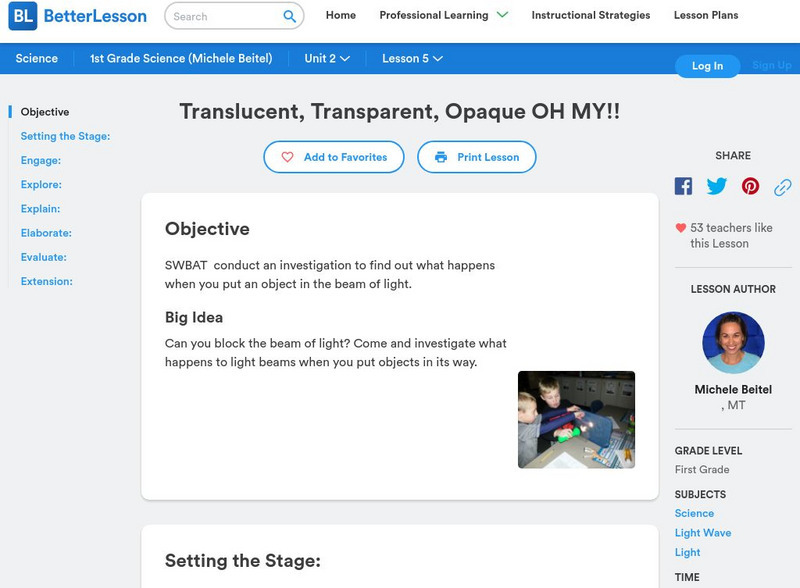
Better Lesson
Better Lesson: Translucent, Transparent, Opaque Oh My!!
Can you block the beam of light? Students will investigate what happens to light beams when you put objects in its way. These tests will allow them to learn new vocabulary (translucent, transparent, opaque) and discover how these terms...

Alabama Learning Exchange
Alex: Translucent, Transparent, and Opaque Objects
Students will become familiar with transparent, translucent, and opaque objects. Students predict whether items are transparent, translucent, or opaque. Finally, students will show what they have learned by producing a song, poem, cheer,...
![Discovery Education: Science of Everyday Life: Light and Shadow [Pdf] Lesson Plan](https://statictemp.lp.lexp.cloud/images/attachment_defaults/resource/large/FPO-knovation.png "Discovery Education: Science of Everyday Life: Light and Shadow [Pdf] Lesson Plan")
Discovery Education
Discovery Education: Science of Everyday Life: Light and Shadow [Pdf]
In this lesson plan, learners experience how light interacts with the environment by investigating relationships between shadows and light. Students will experiment with light by observing how light travels through materials and distances.
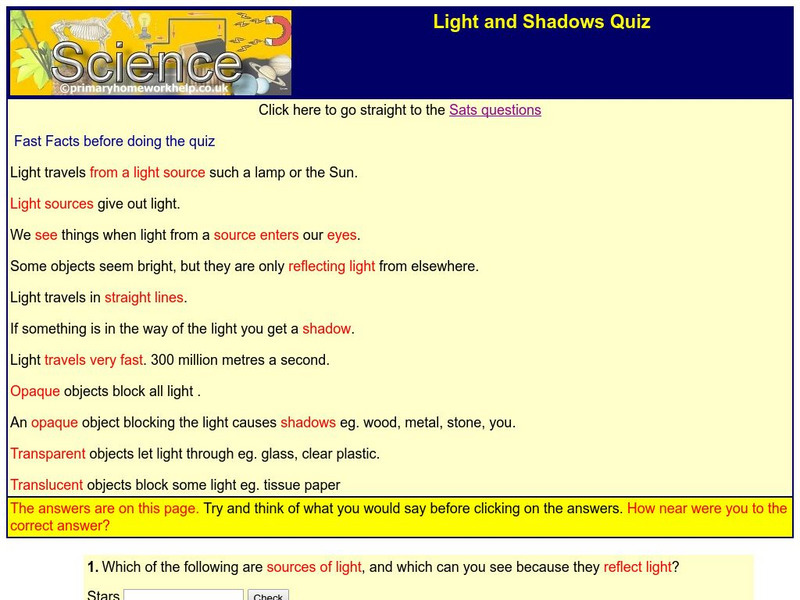
Project Britain
Primary Homework Help: Light and Shadows Quiz
This resource provides information about light and shadows. In addition, there is a short quiz that can be taken.
Other
Watercolor painting.com: Pigments and Paint
This resource provides an extremely detailed account of watercolor pigments and paints. It includes a long list of colors and how they are made.
Science Struck
Science Struck: Translucent, Transparent, and Opaque Materials
The definitions of transparent, translucent, and opaque can be found here. The article explains how the density of a material and its ability to absorb light determine which of these three properties it has. A list of examples is given...

Alabama Learning Exchange
Alex: Geometric Shadows
Students will identify objects as translucent, transparent, or opaque. Upon seeing the shadow of the opaque object, students will identify the geometric figure created by the shadow.This lesson plan was created as a result of the Girls...
E-learning for Kids
E Learning for Kids: Science: Winery: Why Can We See Through Some Objects but Not Others?
Learn about the properties of materials in their interactions with light, including whether they are opaque, transparent, or translucent, and which of these produce shadows.
ClassFlow
Class Flow: Light and Shadows
[Free Registration/Login Required] This unit introduces the relationship between light, an object and the formation of shadows.

ClassFlow
Class Flow: What Is Light?
[Free Registration/Login Required] This flipchart reviews the characteristics of light and its properties. Students are given examples of reflection, refraction, and lens types. An assessment component is included.
Ducksters
Ducksters: Physics for Kids: Light
Kids learn about the science of light. Energy made of waves and particles called photons traveling at the top speed in the universe. What is refraction? The difference between transparent, translucent, and opaque.
TeachEngineering
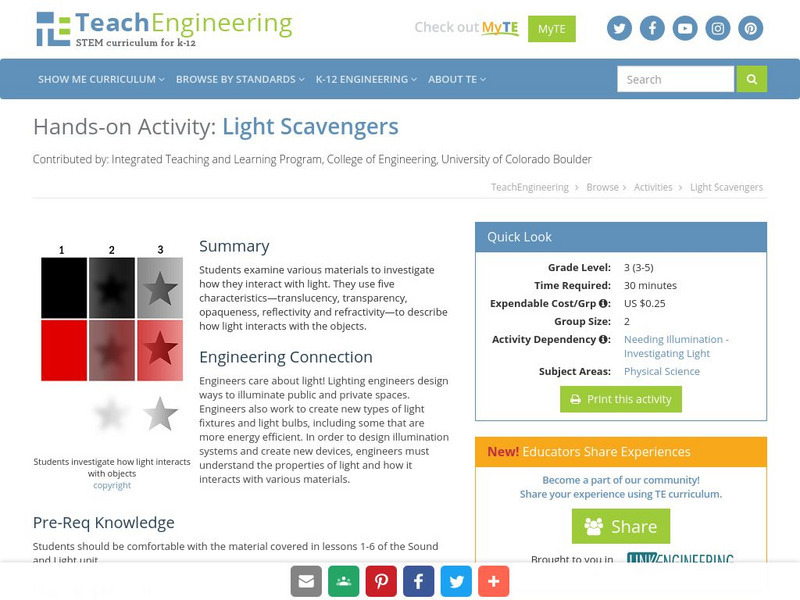
Teach Engineering: Light Scavengers
In this activity, students examine various materials and investigate how they interact with light. Students use five new vocabulary words (translucent, transparent, opaque, reflection and refraction) to describe how light interacts with...