Hi, what do you want to do?






Advocates for Human Rights
The Right to a Clean Environment: Water
First, young citizens learn about water consumption by doing some research themselves on their home water usage and sharing their findings with the class. Then, they do some brainstorming and devise a plan to reduce water consumption.

Environmental Protection Agency (EPA)
How Much Water Do You Use?
Incorporate reading strategies, math, research, and the scientific method into one lesson about water conservation. After reading a story about a landlady trying to determine how many people are living in an apartment, learners develop a...

Earth Day Network
Conserving Water Through Art!
Having fresh, clean drinking water is a privilege many people take for granted. Help raise awareness about the scarcity of water and the importance of conservation by discussing different ways water is used in everyday life. Brainstorm...

Curated OER
Water: From Neglect to Respect
The goal of this collection of lessons is to make middle schoolers more aware of the ways in which they are dependent upon water to maintain their standard of living. Learners compare water use in Lesotho to water use in the United...

Curated OER
Water Wise
Young scholars calculate their family's water consumption. In this water usage lesson, students discuss the water they use in their homes. Young scholars complete the 'water wise' worksheets to tally their family's use of water. Students...

Michigan Sea Grant
Water Quantity
It may be tricky for a young mind to conceptualize that less than 1% of all water on earth is useable for humans to drink. Simulating the amount of fresh water available on earth by removing measured amounts of water from a five-gallon...

Curated OER
No Impact Project: Water
Young scholars use the "No Impact Project" to analyze the consumption of water. In this water consumption lesson, students discuss the pros and cons of tap water or bottled water. Young scholars read about chemicals in water and watch a...

Curated OER
Read Aloud Lesson Plan: Water for One, Water for Everyone
Students listen to a read aloud about African animals as they access a watering hole. They discuss the characteristics of Africa such as the temperature, it distance from the students, and lifestyle of the animals. They talk about how...

Curated OER
How Much Water?
Learners investigate amount of water available in different countries around the world, compare it to their daily water use, and explore how unequal distribution of water can cause challenges to survival. Students then discuss need to...

Curated OER
Water, Water Everywhere and Not a Drop to Drink
Students identify the different stages in the water cycle. In this environmental science lesson, students research about different water pollutants in watershed. They describe ways to purify water.

Curated OER
Environment: How'd That Pollution Get There?
Students examine how global wind and water patterns aid in the spread of worldwide pollution. In groups, they read articles about the domino effect of pollution and create posters displaying its journey. On blank world maps, students...

Bridge
Mercury - Mercury is Rising
Hold a discussion in your class about the increase in mercury being found in fish that are caught commercially as food for humans. Given a worksheet, learners then calculate how much fish a person can safely eat each month to remain...

Beyond Benign
Ecological Footprint
How does your lifestyle measure up in terms of your ecological footprint? Young ecologists examine their impact on the planet using an insightful online calculator. A short quiz asks users to rank the size of their homes, their energy...

Curated OER
Power, Pollution, Pros and Cons
Students review what they know about non-renewable energy, compare and contrast advantages and drawbacks of each type, such as cost of energy sources, feasibility, air pollution, water pollution, and other risks, and create table listing...

Curated OER
Fishing For The Future
Students participate in a simulation using M&M's that highlights Garrett Hardin's concept of the "tragedy of the commons." They use the activities to study sustainability issues in the fishing industry.

Curated OER
Don't Use it All Up
Young scholars observe the way that a sponge absorbs liquids and discuss how we our use of natural resources affects the environment around us. They discuss the need to conserve resources so we don't run out of what we need.

Curated OER
Oil Slick Emergency
Students examine how to recover and remove oil from an oil spill. In this oil spill clean-up lesson students use role play and act like a committee to determine how to clean up an oil spill.

Curated OER
Make Sense of Nature
Learners participate in this program that heightens their awareness and curiosity of nature as well as their sense of adventure and exploring new surroundings. They identify and choose an object from nature after exploring it with other...
PBS
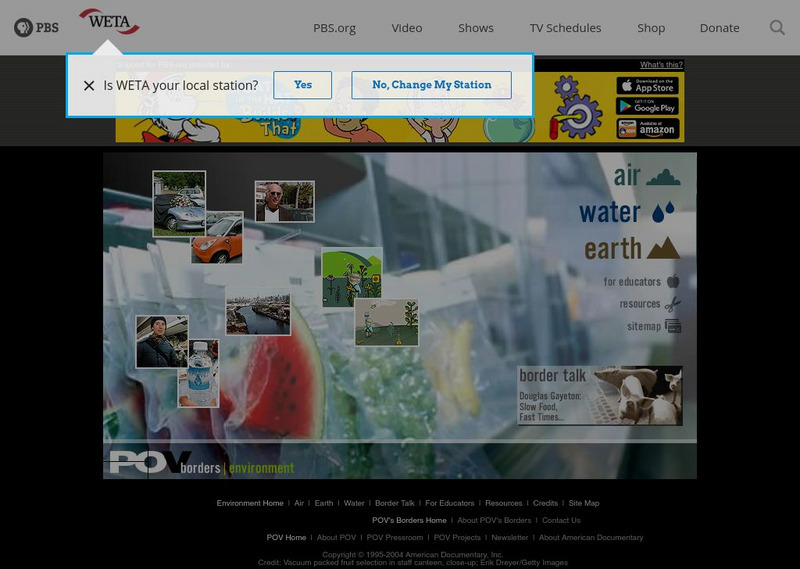
Pbs: Pov Borders: Environment
Point of View is television's longest running showcase for independent non-fiction films. This particular feature provides insight regarding alternative means of energy, transport, and the consumption of natural resources. Video, games,...