Hi, what do you want to do?






University of Waikato
Water Molecules in Drama
The state of molecules is changing. Young actors and actresses perform the process of phase change in front of the class. They assume the roles of water molecules and, as a group, show how the behavior of the molecules in the solid,...

University of Waikato
Looking at Water - Solid, Liquid, or Gas
Here's a tip: only one substance is commonly found as a solid, liquid, and gas. Learners use that knowledge as they investigate the properties of water in each state. They interact with water in each of its three phases and record what...

American Chemical Society
The Energy of Evaporation
Do all liquids evaporate at the same rate? Young scientists observe the evaporation rate of three different liquids. They measure the time, the temperature, and the change in energy. After comparing the chemical formulas, scholars...

Colorado State University
Why Can Warm Air "Hold" More Moisture than Cold Air?—Vapor Pressure Exercise
Does it feel a little humid in here? Learners assume the role of water vapor in the atmosphere as they explore the differences between warm and cold air. They roll dice to determine their level of energy, which determines if they...

Howard Hughes Medical Institute
Icefish Blood Adaptations: Antifreeze Proteins
Ever wonder how fish survive in freezing cold water—especially Antarctic waters? Some fish have an adaptation that lowers the freezing point of their life fluids. Learners model these adaptations in two lab explorations. The first...

US Department of Energy
Mountains of Erosion
Students study the changes in land formations caused by water erosion. They work in groups to build a model of a mountain composed of materials that will best withstand water erosion.

American Chemical Society
Soda Can Steam Engine
Steam engines have been around since the late 1600s, yet most pupils don't know how they work. Using an soda can, the instructor builds a simple steam engine for scholars to observe. Through a discussion, young scientists learn about the...

DiscoverE
Build a Bridge
Cost overruns are unacceptable—in the real world and in an engaging activity. Groups of pupils get together to build a bridge out of straws, paper cups, and tape. They keep track of costs ($1,000 for each material) and must stay within a...

Other
Water on the Web: Studying Heat Budgets of Lakes
Interesting activity that discusses many aspects of the energy in a lake, including the evaporation of the water into gas.
Museum of Science
The Atom's Family: Phases of Matter
Help the Phantom choose a material and observe the changes at different temperatures in the molecule chamber. What happens to the elements or molecules as the temperature changes?
University of Maryland
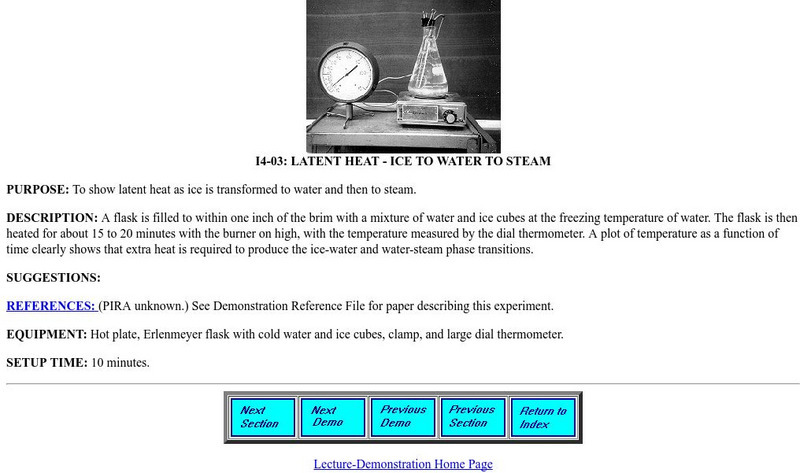
U. Of Maryland: Latent Heat: Ice to Water to Steam
A page from the University of Maryland Physics Lecture Demonstration Facility. Provides directions for a teacher demonstration of latent heat in the melting and vaporization process. Shows apparatus and set-up; provides suggestions....

Science Buddies
Science Buddies: What's the Point of Boiling?
You know that water can exist in three separate phases: solid (ice), liquid (water), and vapor (steam). To change from one phase to another, you simply add (or remove) heat. When water boils, what happens to molecules (for example sugar...
TeachEngineering
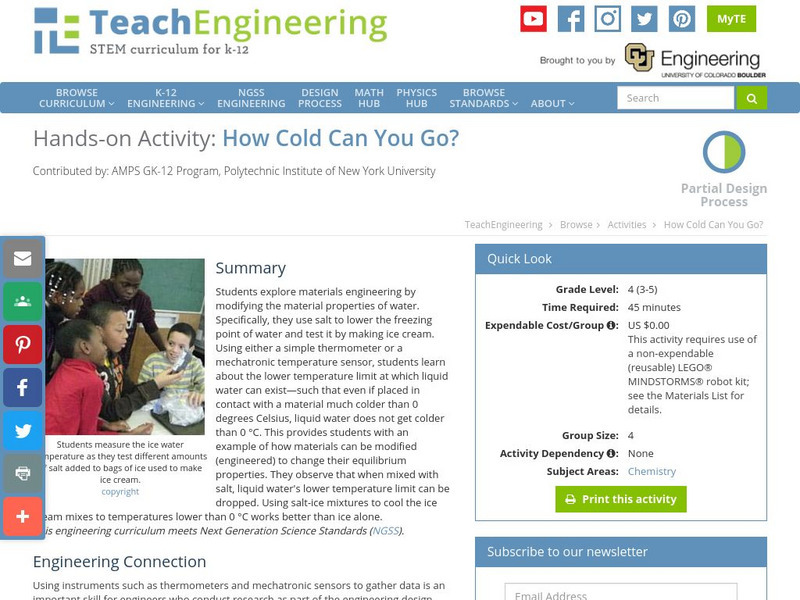
Teach Engineering: How Cold Can You Go?
Students explore materials engineering by modifying the material properties of water. Specifically, they use salt to lower the freezing point of water and test it by making ice cream. Using either a simple thermometer or a mechatronic...